
To understand Dusk, it helps to start several years into the future rather than at the beginning.
Imagine a world where blockchain technology is no longer experimental. Digital assets are issued by banks, shares settle on-chain, identity verification happens cryptographically, and compliance is automated rather than enforced manually. In that world, transparency still exists, but it is controlled, contextual, and legally meaningful. Sensitive data is not broadcast to everyone, yet every action is verifiable when required. This is the future Dusk has always been designed for. I’m not imagining a hypothetical use case. I’m describing the environment Dusk anticipated long before the market was ready to talk about it seriously.
Working backward from that future reveals why Dusk exists at all. Most blockchains were built on a philosophical assumption that openness equals trust. Every transaction visible. Every smart contract readable. Every state change permanent and public. That assumption works well for experimentation and grassroots finance, but it collapses when applied to real-world institutions. Banks cannot expose client data. Companies cannot reveal internal agreements. Regulators cannot approve systems that leak confidential information by design. Dusk did not emerge to challenge decentralization. It emerged to redefine what trust looks like when decentralization meets law.
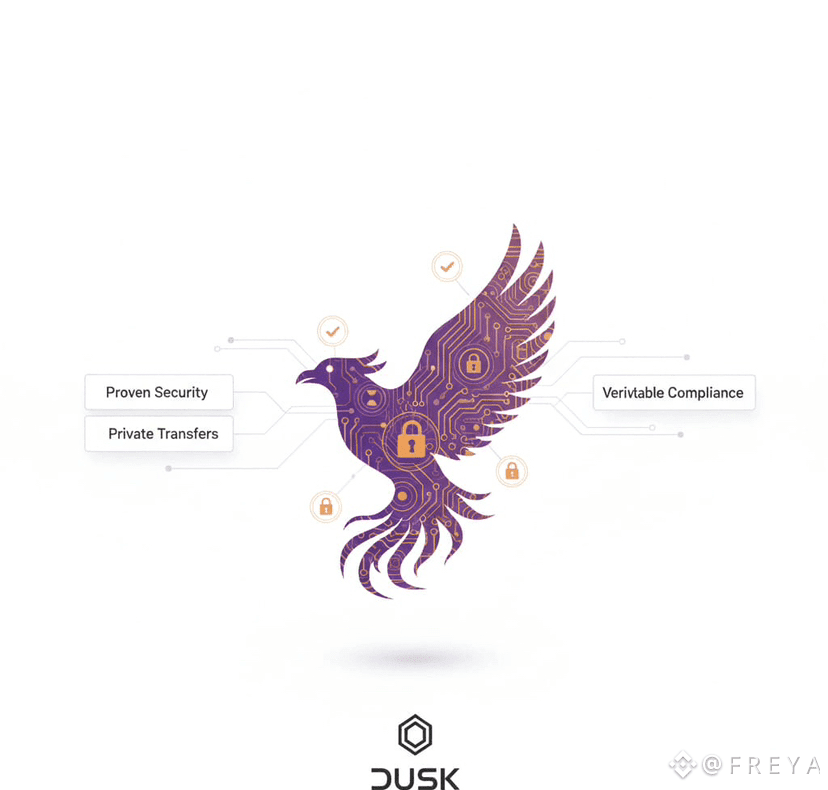
At its core, Dusk Network is not a privacy coin in the traditional sense. It is not about hiding activity from the system. It is about making privacy a structural property of compliance. That distinction shapes everything else that follows. From its cryptography to its consensus, from its token economics to its governance philosophy, Dusk is built around one idea: verifiable truth without unnecessary exposure.
The earliest conceptual phase of Dusk did not begin with code. It began with legal and cryptographic conversations running in parallel. The team recognized early that financial regulation is not an obstacle to decentralization but a constraint that must be designed around. Traditional blockchains treat regulation as something external, something applied afterward. Dusk treats regulation as an internal design parameter. This shift alone places it in a very different category from most networks launched in the same era.
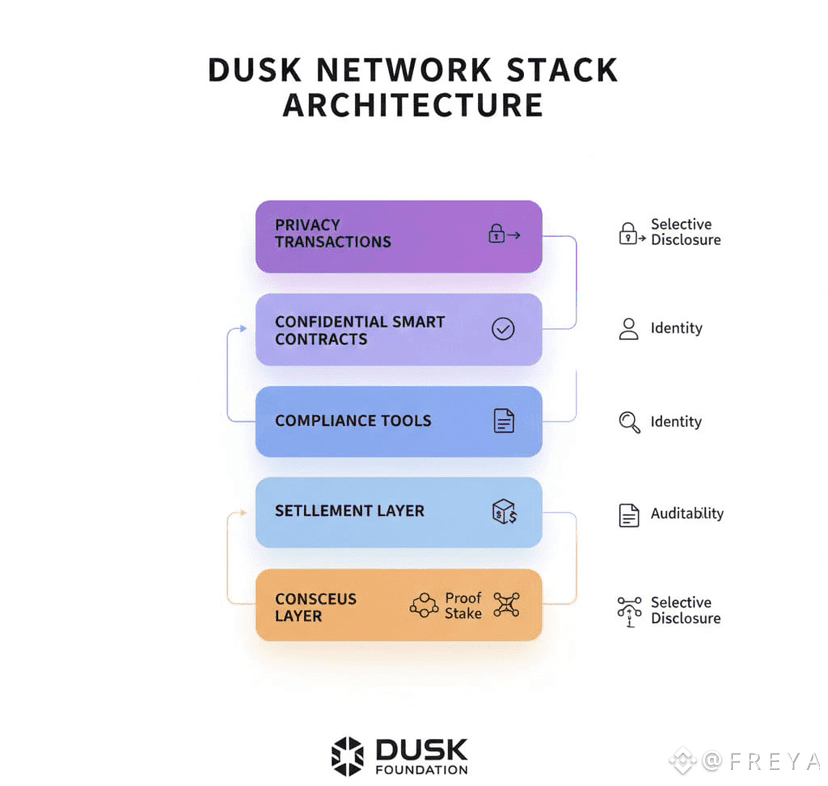
To appreciate why that matters, consider how financial systems actually operate. Compliance is not binary. It is contextual. A regulator needs to know that rules are being followed, not necessarily every detail of how. An auditor needs access, but only at the right time. A counterparty needs assurance, but not full disclosure. Dusk’s architecture is built to mirror this layered visibility. Information exists, but it is revealed selectively, cryptographically, and only when justified.
This is where zero-knowledge technology becomes more than a buzzword. In Dusk’s system, zero-knowledge proofs are not optional add-ons. They are foundational. They allow participants to prove properties of transactions, identities, or assets without revealing the underlying data. That means a user can prove they are eligible to participate without revealing who they are. A company can prove solvency without exposing its balance sheet. A financial instrument can comply with jurisdictional rules without publishing private agreements to the world.
Implementing this in a usable way is not trivial. Privacy technology increases complexity, both computationally and conceptually. Many early privacy-focused projects struggled because they optimized for secrecy rather than usability. Dusk made a different choice. It optimized for institutional usability. That meant accepting trade-offs in speed of development in exchange for correctness, clarity, and long-term viability. They’re building something meant to be trusted by entities that cannot afford experimental failure.
This design philosophy extended to consensus. Instead of relying on proof-of-work or simplistic staking models, Dusk implemented a proof-of-stake system tailored for predictable finality and governance participation. In regulated environments, uncertainty is risk. Transactions must settle reliably. Network behavior must be understandable. Dusk’s consensus mechanism reflects that requirement. It is not designed to impress with novelty, but to reassure with stability.
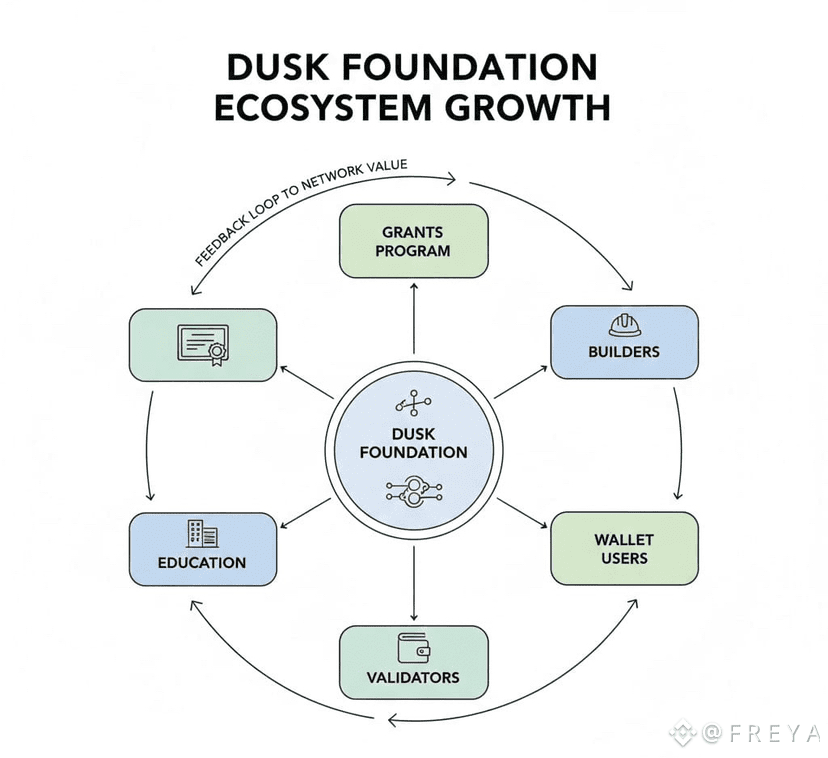
The DUSK token exists within this context. It is not framed as a speculative instrument, but as a coordination tool. It secures the network through staking, aligns incentives among validators, and enables participation in governance. Its value proposition is tied directly to network usage and trust rather than abstract narratives. We’re seeing here a token model that assumes maturity rather than hype, one that expects users to engage because the system is useful, not because price action is exciting.
As the network evolved, Dusk began attracting interest from a specific group of builders. These were not meme-driven communities or experimental DeFi teams. They were developers working on security tokens, compliant asset issuance, identity frameworks, and regulated marketplaces. Dusk offered something rare: a blockchain where privacy did not conflict with legality. For many institutional experiments, this was the missing piece.
One of the most significant technical contributions of Dusk is its approach to confidential smart contracts. On most blockchains, smart contracts are transparent by default. That transparency limits their usefulness for private agreements. Dusk introduced a model where contracts can process encrypted data while still producing verifiable outcomes. This enables use cases that simply cannot exist on transparent chains, such as private auctions, confidential lending terms, or regulated voting mechanisms.
This capability changes the role of blockchain itself. Instead of being a public bulletin board, it becomes a cryptographic execution environment. Outcomes are public when necessary, but inputs remain private. This mirrors how many real-world systems already operate, but with the added benefit of decentralization and immutability. It is not about replacing institutions. It is about upgrading the infrastructure they rely on.
Over time, governance emerged as a critical consideration. A network designed for long-term institutional relevance cannot be governed purely by informal consensus or rapid social pressure. Dusk approached governance as a gradual process, evolving alongside the ecosystem. Token holders participate, validators signal, and protocol changes follow structured pathways. This measured approach avoids sudden shifts that could undermine trust while still allowing adaptation.
Security has always been treated as non-negotiable. Privacy increases the cost of failure. A single vulnerability can undermine not only the network but the broader perception of privacy-preserving systems. Dusk invested heavily in audits, formal verification, and conservative rollout strategies. They’re not racing competitors. They’re reducing the probability of irreversible mistakes.
As the broader market matured, external conditions began to align with Dusk’s original thesis. Regulatory frameworks became clearer. Tokenization moved from concept to pilot programs. Institutions began exploring blockchain not as an experiment, but as infrastructure. In this environment, Dusk’s early focus on compliance and privacy started to look less like a niche decision and more like foresight. We’re seeing how problems that were once theoretical are becoming operational realities.
Interoperability is another area where Dusk’s design shows long-term thinking. Regulated assets do not exist in isolation. They need liquidity, settlement, and interaction with other networks. Dusk’s architecture allows for controlled interaction with external systems without sacrificing confidentiality. This flexibility is essential in a multi-chain future where specialization matters more than dominance.
Of course, challenges remain. Privacy systems require education. Many users still equate privacy with illegitimacy, a perception shaped by early narratives around anonymous blockchains. Dusk must continue explaining that privacy and compliance are not opposites. They are complementary when designed correctly. This communication challenge is ongoing, but it is also an opportunity to reshape how blockchain is understood.
Another challenge lies in adoption cycles. Institutional systems move slowly. Decision-making involves legal review, risk assessment, and long timelines. Dusk’s growth may never look explosive, but that does not mean it is weak. Infrastructure built for institutions often grows quietly, embedding itself deeply before becoming visible. If adoption comes, it will come with durability rather than volatility.
Looking further ahead, the role of privacy in digital systems is likely to expand rather than shrink. Data protection laws, user awareness, and corporate responsibility are all moving in the same direction. Blockchains that cannot adapt to these expectations may struggle. Dusk’s design aligns naturally with this trajectory. It does not require retrofitting. It was built with this reality in mind from the beginning.
In reflecting on Dusk’s journey, it becomes clear that this is not a project chasing the present moment. It is preparing for a future where decentralization is normalized, regulated, and embedded into everyday systems. That future may not arrive suddenly, but when it does, infrastructure that respects both privacy and law will be essential.
Dusk asks a quiet but profound question. What if trust does not come from seeing everything, but from knowing that the right things can be proven at the right time? As digital systems continue to evolve, the answer to that question may shape how value, identity, and responsibility are managed in the years ahead. If that happens, Dusk’s significance will not be measured by noise, but by how seamlessly it fits into a world that finally understands why privacy was never the enemy of transparency, but its necessary counterpart.