

Access to stable financial infrastructure is not evenly distributed across the world. In many regions, people and businesses face strict capital controls, unstable local currencies, and limited access to international banking systems. These barriers make it difficult to preserve value, plan long term, or participate in the global economy. When inflation erodes purchasing power and cross-border payments are slow or restricted, financial freedom becomes a daily challenge rather than a given.
Plasma is being built with this reality in mind. At its core, it focuses on expanding practical access to digital dollars through stablecoin infrastructure that works globally, permissionlessly, and efficiently. Instead of relying on traditional banking rails that can be costly, exclusive, or geographically limited, Plasma supports a model where anyone with an internet connection can interact with dollar-denominated value onchain. This shift has deep implications for individuals living in inflation-prone economies, remote workers earning across borders, and businesses that operate internationally but lack seamless banking access.
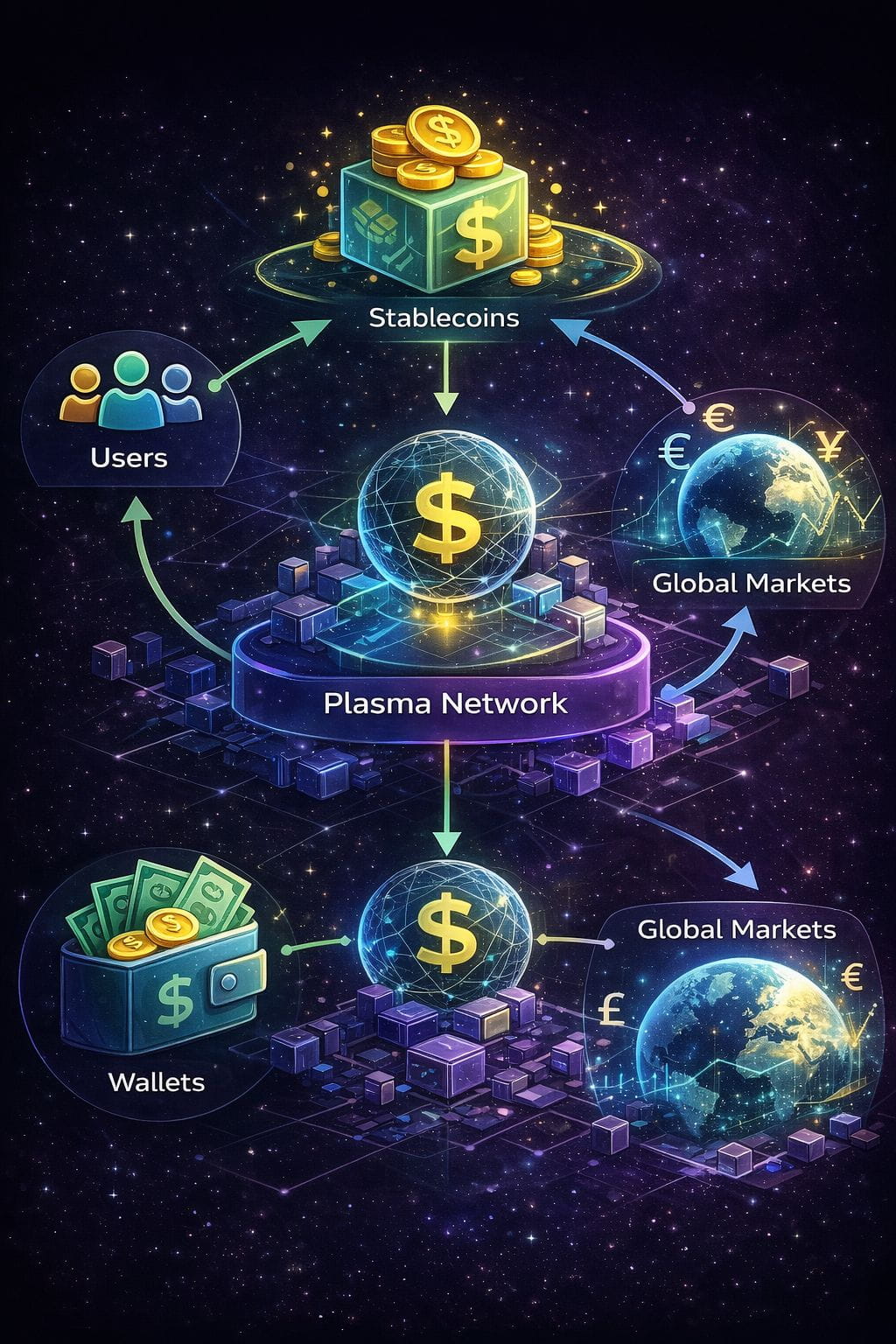
Stablecoins already serve as a bridge between local economies and global markets, but usability, privacy, and compliance remain critical challenges. Plasma approaches these issues by designing infrastructure that makes digital dollar usage feel closer to everyday finance rather than experimental crypto tooling. The network is engineered to support high-volume, real-world financial activity while remaining compatible with existing decentralized applications and wallets. That means users don’t need to relearn how to interact with blockchain systems just to gain more stable access to value.
A key part of this vision is enabling transactions that mirror the needs of real financial workflows. Payroll distribution, vendor payments, remittances, and treasury management all require reliability, predictability, and in many cases discretion. By focusing on stablecoin transfers as a primary use case, Plasma aligns its technical development with tangible economic activity rather than purely speculative trading. This positions the network as financial infrastructure rather than just another execution layer.
Privacy also plays an important role in expanding global dollar access. In traditional finance, transaction confidentiality is standard for businesses and individuals alike. On public blockchains, however, full transparency can discourage legitimate economic activity where discretion is necessary. Plasma’s direction includes mechanisms that allow users to protect sensitive transaction details while still operating within compliant and interoperable systems. This balance helps bring blockchain-based dollars closer to the expectations of mainstream financial users.
Equally important is accessibility. The barrier to entry for using digital dollars on Plasma is intentionally low: a smartphone, an internet connection, and a compatible wallet. There is no requirement for a local bank account in a major financial hub, no dependence on slow correspondent banking networks, and no need to navigate complex foreign exchange systems. For users in regions with volatile currencies, this offers a way to store value in a more stable unit and participate in international commerce without leaving their local environment.
From a developer and ecosystem perspective, Plasma’s approach emphasizes compatibility and integration rather than isolation. By building in a way that works smoothly with established smart contract standards and existing tools, the network lowers the friction for applications that want to support dollar-denominated activity. This encourages the growth of payment platforms, financial services, and cross-border commerce tools that can plug directly into the system.
Over time, the broader impact of this model could be significant. When individuals can easily hold and transfer digital dollars, they gain more control over savings, earnings, and financial planning. Businesses can operate across borders with fewer intermediaries and lower costs. Communities that were previously locked out of stable financial systems can connect to global markets more directly. In this sense, Plasma is not only a technical project but also part of a larger shift toward more open financial infrastructure.
By centering its development around stablecoin utility, usability, and real-world financial needs, Plasma is helping reshape how people think about dollar access in the digital age. It moves the conversation from speculation to function, from niche users to global participants. The result is a network designed to make digital dollars more practical, more accessible, and more aligned with the everyday realities of a connected world.

