
This week, every meaningful conversation circled back to the same quiet truth almost like an unspoken agreement among builders, operators, and thinkers alike:
Intelligence only matters when it lives where real work already happens.
And even more importantly, it must compound getting smarter, more useful, and more contextual over time.
Not louder.
Not more complex.
Not more demanding.
Just present. Embedded. Evolving.
This isn’t a trend. It’s a correction.
For years, we’ve mistaken intelligence for interruption. We’ve wrapped powerful systems in dashboards no one asked for, workflows no one wanted to learn, and tools that demanded adaptation instead of offering support. Builders were expected to stop what they were doing, move somewhere else, and then become intelligent.
That model is breaking down.
What’s emerging instead and what Vanar Vision quietly but clearly articulated is a different philosophy altogether: infrastructure that fits, not forces.
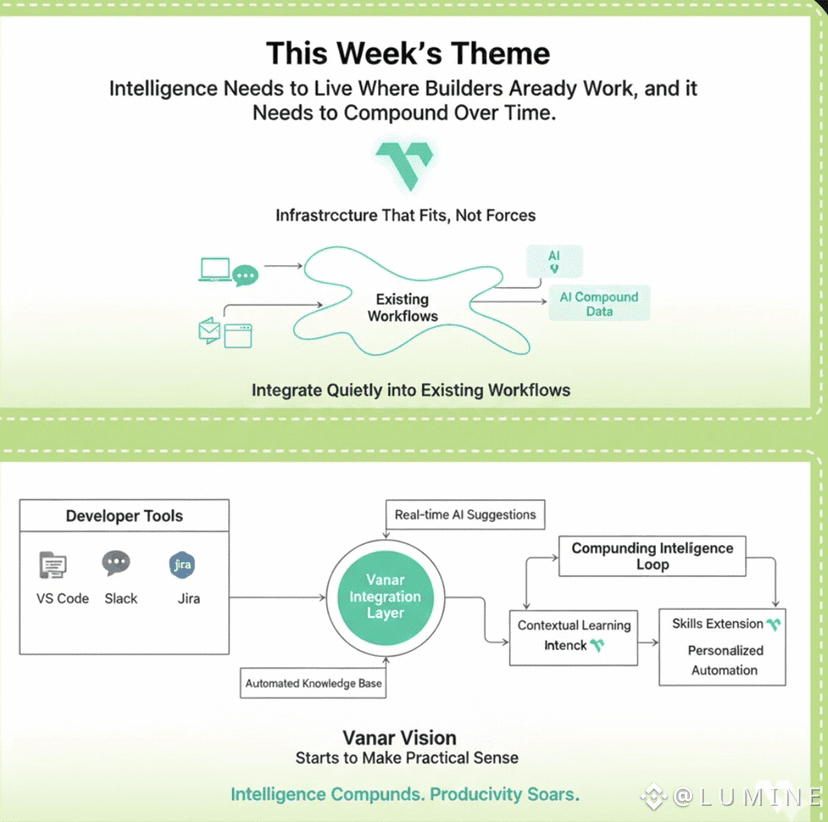
The End of Intelligence as a Destination
Traditional systems treat intelligence like a place you go.
You leave your editor.
You leave your terminal.
You leave your workflow.
You log in, configure, interpret, export, and then return to real work hoping the context survived the journey.
But builders don’t think in destinations.
They think in momentum.
Every unnecessary context switch is friction. Every forced adaptation is a tax. And every tool that asks for attention instead of earning trust eventually gets ignored no matter how powerful it claims to be.
The conversations this week made one thing clear:
intelligence that requires relocation is already obsolete.
The future belongs to intelligence that meets builders where they are inside the tools, environments, and rhythms they already trust.
Infrastructure That Fits, Not Forces
At @Vanar Vision, this idea wasn’t framed as a feature set. It was framed as a principle.
Infrastructure shouldn’t announce itself.
It shouldn’t demand onboarding rituals.
It shouldn’t feel like yet another layer to manage.
It should feel like it was always there.
The best infrastructure behaves the way good architecture does in a well designed city: invisible when it’s working, indispensable when it’s gone. It supports movement without dictating direction. It adapts to behavior instead of reshaping it.
This is what “fit” really means.
Not bending builders to systems but shaping systems around builders.
Quiet Integration Is the New Power Move
There’s a growing maturity in how serious teams think about intelligence. The obsession with flashy interfaces and aggressive automation is giving way to something more grounded: quiet integration.
Quiet doesn’t mean weak.
Quiet means confident.
It means intelligence shows up exactly when it’s needed—and nowhere else. It means suggestions feel like extensions of your own thinking, not interruptions from an external system. It means the tool understands context deeply enough to stay out of the way.
Vanar’s direction starts to make practical sense here.
Rather than asking builders to adopt a new mental model, the infrastructure adapts to existing ones. Rather than enforcing rigid flows, it learns from real behavior. Rather than resetting context every session, it compounds understanding over time.
That compounding effect is everything.

Why Compounding Intelligence Changes the Game
Most tools reset every time you open them.
They don’t remember why a decision was made.
They don’t understand how trade-offs were evaluated.
They don’t evolve alongside the builder.
Compounding intelligence does the opposite.
It accumulates context.
It learns patterns.
It internalizes preferences, constraints, and intent.
Over time, the system stops being a tool and starts behaving more like a collaborator one that understands not just whatyou’re doing, but how you think while doing it.
This is where intelligence stops being transactional and starts becoming relational.
And this is where infrastructure quietly transforms from support to leverage.
Builders Don’t Want More Tools They Want Less Drag
A recurring sentiment across conversations this week was exhaustion not from building, but from managing the overhead around building.
Too many platforms.
Too many integrations.
Too many cognitive interruptions.
The irony is that most of these tools were created to increase productivity. Instead, they fragmented it.
The insight here is simple but profound: builders don’t want more capability if it comes with more complexity.
They want fewer decisions.
Fewer switches.
Fewer explanations.
Infrastructure that fits reduces drag instead of introducing it. It respects attention as the most valuable resource in the system.
Vanar’s philosophy aligns directly with this reality. Intelligence isn’t positioned as an extra layer it’s woven into the fabric of what already exists.
From Control to Trust
Older infrastructure models were built around control.
Control the environment.
Control the workflow.
Control the user.
But modern builders don’t want to be controlled. They want to be trusted.
They want systems that assume competence. Systems that enhance judgment instead of replacing it. Systems that provide insight without removing agency.
When intelligence lives inside existing workflows, something subtle but powerful happens: trust compounds alongside capability.
Builders stop fighting the system.
They stop second-guessing recommendations.
They stop feeling managed by their tools.
Instead, they feel supported.
The Human Language of Good Systems
One of the most overlooked aspects of infrastructure design is language.
Not marketing language but operational language.
Does the system speak in abstractions, or in outcomes?
Does it respond with certainty, or with context-aware nuance?
Does it feel rigid, or responsive?
The most impressive systems emerging right now sound less like machines and more like experienced teammates. They don’t overwhelm with data. They surface what matters, when it matters, in a tone that respects the builder’s intelligence.
This is what makes the experience feel human even when the underlying technology is incredibly sophisticated.
Vanar’s approach hints at this shift: intelligence expressed not through dominance, but through understanding.
Invisible Infrastructure Creates Visible Results
When infrastructure fits properly, success stops being attributed to the tool.
Teams don’t say, “The platform helped us do this.”
They say, “We just moved faster.”
“We made better decisions.”
“Things felt easier.”
That’s the highest compliment infrastructure can receive.
Invisible infrastructure doesn’t steal credit—it amplifies outcomes. It allows builders to stay in flow longer. It reduces friction at the edges. It turns effort into progress with less waste.
And over time, those marginal gains stack up.
They compound.
Why This Moment Feels Different
We’ve heard promises like this before. Seamless. Intelligent. Integrated.
So why does this moment feel different?
Because builders are no longer impressed by potential—they’re anchored in reality.
They’ve seen what doesn’t work.
They’ve lived with bloated systems.
They’ve felt the cost of forced adaptation.
Now, expectations are sharper.
Intelligence must justify its presence. Infrastructure must earn its place. And anything that doesn’t respect existing workflows is quickly dismissed.
Vanar Vision didn’t introduce a grand reinvention. It articulated a realignment—a return to fundamentals that builders actually care about.
Fit over force.
Integration over interruption.
Compounding over resetting.
The Long-Term Advantage of Staying Out of the Way
There’s a strategic advantage to this approach that goes beyond user experience.
When intelligence compounds quietly inside workflows, switching costs increase naturally not through lock-in, but through value accumulation. The system becomes more useful precisely because it knows more, remembers more, and adapts better over time.
Builders don’t stay because they’re trapped.
They stay because leaving would mean losing a partner that understands them.
That’s not retention by design—it’s loyalty by relevance.
What Builders Will Remember
Years from now, builders won’t remember the dashboards.
They won’t remember the features.
They won’t remember the buzzwords.
They’ll remember how it felt to work.
They’ll remember whether tools respected their time.
Whether systems learned instead of lectured.
Whether intelligence felt like help—or like homework.
Infrastructure that fits leaves a different kind of legacy. One defined not by visibility, but by impact.
A Quiet Shift With Loud Implications
This week’s theme may have sounded subtle, but its implications are anything but small.
When intelligence lives where builders already work and compounds over time the entire relationship between humans and systems changes.
Tools stop being destinations.
Infrastructure stops being a burden.
And intelligence stops being a spectacle.
It becomes something better.
Something useful.
Something trusted.
Something that grows with you.
And in a world overloaded with noise, that quiet confidence might be the most impressive innovation of all.
