
For a long time, crypto enthusiasts believed that real-world assets would someday be tokenized through the same general-purpose blockchains that power the majority of decentralized finance (DeFi) applications today. It felt logical; the infrastructure that powered the blockchain protocols was layered with services that gave enhanced abilities for building new services. Why build new services when the blockchain was incredibly cheap? Why not use that space?
However, the assumption got weaker when faced with the actual functioning of the regulated finance industry. The public blockchain platforms are built for the most open of financial applications. They have a transparent state, public mempools, probabilistic stability, and have the most ability to build new structures. These components work well when the financial instrument being traded is meant for speculation. But when it's a regulated security, the use of the platform is limited. They cannot trade the identity of the holder. They cannot trade the audit of the instrument. They cannot trade the legal resolution of the instrument. The settlement for the bond cannot be left unsettled. The right to receive a dividend cannot be publicly listed. The people who maintain the ledger cannot be holding a target for an attack.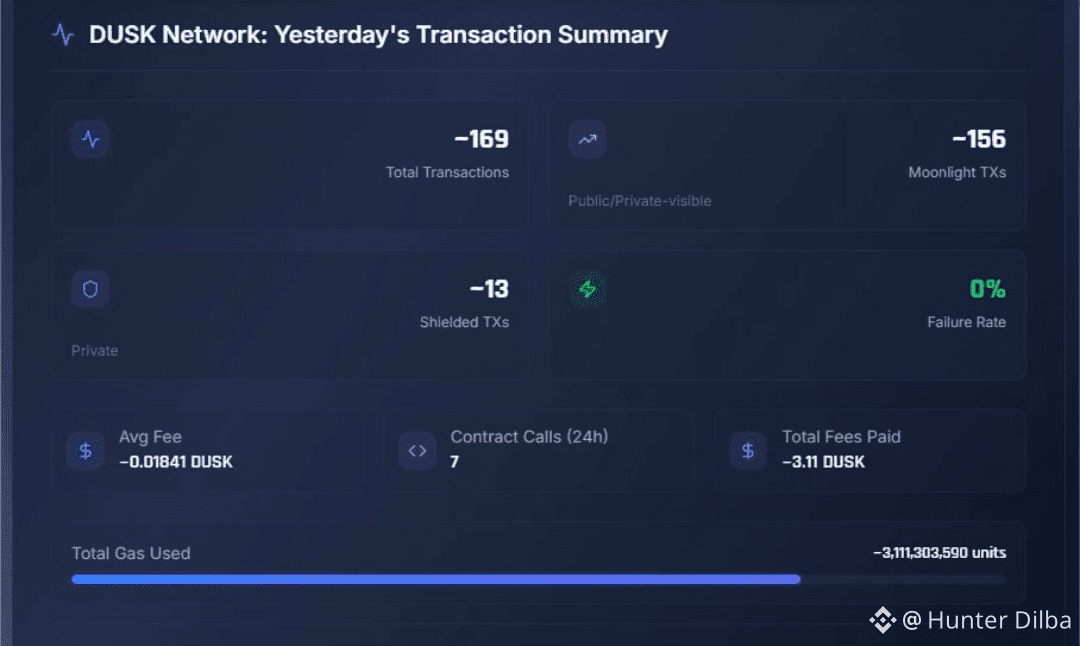
These constraints made with maintaining legality are what explain the slow progression of real-world assets on blockchain technology. They also explain the slow growth of applications on open blockchains. When institutions initiate a blockchain project, they usually stop when they cannot be certain of an outcome. Not a problem of yield, a problem of certainty.
Dusk Network didn't go around these constraints; it embraced them.
Real DeFi is Still To Come
Most of the privacy used in DeFi today is unsophisticated.
While mixing services and wallet rotation can hide blockchain activities for a moment, transaction graphs will still link activities. The same thing can be said for timing correlations, and analysis companies will nearly always re-identify users as activities increase. This makes it impossible for institutions handling even small nine-figure portfolios to use these systems.
With Dusk, things are different. Protocol-level, zero-knowledge proofed privacy can be used, but that can be scoped. Auditing can still be done on confidential transactions through selective disclosure. Regulator and auditor view keys can be given access to transaction activities without public revealing sensitive information. This design addresses the misconception that says “transparency is a must” for compliance, as that is not correct—compliance requires visibility and discretion.
The reason for this is that regulated finance does not want to be opaque, but it also wants to be accountable without the loss of data. This is the reason Dusk’s privacy model is suitable under this requirement.
The Legal Reality of Settlement and Deterministic Finality
In traditional securities markets, settlement finality is a legal construct, not a probabilistic one. There is no possibility for revising trades due to forks or reorganizations days after. That makes many of the popular consensus mechanisms incompatible with RWAs.Dusk uses a more decentralized Byzantine agreement (SBA) method to achieve this, boosted by cryptographic sortition. While validator selection is random, some positions can be described as "invisible validators." This approach reduces potential attack vectors and supports decentralization. More importantly, progress towards instant finality occurs: once a block is produced, it is final.
This is important, as it means that without this finality, tokenized securities cannot comply with legal standards for clearing and settlement. With this finality, on-chain infrastructure is beginning to resemble an automated clearinghouse, as opposed to a speculative ledger.
Here, $DUSK is critical, not as a standard utility token, but an anchor token, meaning it is collateral that secures the behavior of the validators, the privacy computation, and the settlement of the network.
Infrastructural Challenges and Compliance by Design
The 2018 wave of STOs failed, but there was still demand. Less infrastructure was not the issue. The problem lay with the forced approach to securities on the standard ERC-20 that failed to adequately and self-contained balance compliance with privacy. The outcome was a token that operated off-chain, dependent on centralized databases.
Dusk's XSC = Confidential Security Contract standard turns this approach on its head. The logic of compliance, with respect to whitelists, lock up, investor caps, voting rights, dividends, and so forth, is embedded and self-contained to the asset.Due to ‘Zero Knowledge Proofs’ technologies, issuers can fully comply while distributing dividends or facilitating governance without knowing the individual identities of the holders.
This means the assets are fully ‘self-compliant’ and retain compliance wherever the assets move, which is a unique and necessary feature for a fully operational global securities market that is open 24/7 and does not require fragmented intermediaries.
‘
Privacy-Centric Execution Environment
Dusk does not reach this bottleneck since Piecrust is the only WASM-based zero-knowledge virtual machine, especially designed for computational privacy.
Piecrust is unique in that it allows for the creative balancing of compliance and performance within complex architectures for the compliance and selective disclosure logic layers. Paired with Hedger, the tool for selective disclosure, this system is uniquely positioned for complex compliance requirements and does not allow privacy to compromise settlement speed.
DuskEVM is now live and allows for the use of all privacy and finality layers of Dusk to be used while remaining within the accepted operational frameworks of the Solidi y virtual machine. This is a significant contributor to optimizing frameworks for enterprise grade systems. It is now possible to deploy privacy-compliant systems with only seconds of settlement time.
Loss of Compliance. Remaining Cross-Chain Liquidity
Liquidity fragmentation is, in many ways, a cause for concern.Dusk does this with Chainlink CCIP, allowing tokenized assets like those in NPEX’s €300 million regulated portfolio, to transfer via public chains while still being compliant and private.
This is important because institutions operate in ecosystems that aren’t isolated. They need cross-chain interoperability, and the regulatory requirements are still in place. Because of this, Dusk is the self-proclaimed “first of its kind” to offer privacy, and cross-chain settlement to provide a bridge between regulated finance and crypto liquidity.
Why Dusk’s “Boring” Architecture Wins
Dusk wins by not marketing themselves by speed, or over exaggerating themselves by composability like the other chains. They keep a smart design, which is confident, and is predictable, with a focus on being “not boring” while securing the chain. Those in the institution are excited by this “not boring” design.
“Boring” design is the most responsible design, and responsible design is what wins when the market faces audits, a tough cycle, and regulations.
As DeFi becomes stagnant and investors pull back, responsible design will become more prevalent over the speculative design. Every “real world” tokenized asset does not need a loud chain that reflects constant activity. They need the silent chains that meet the legal requirements.
That is the layer Dusk chose to build—and why its relevance increases as the RWA narrative matures beyond experimentation into deployment.
