

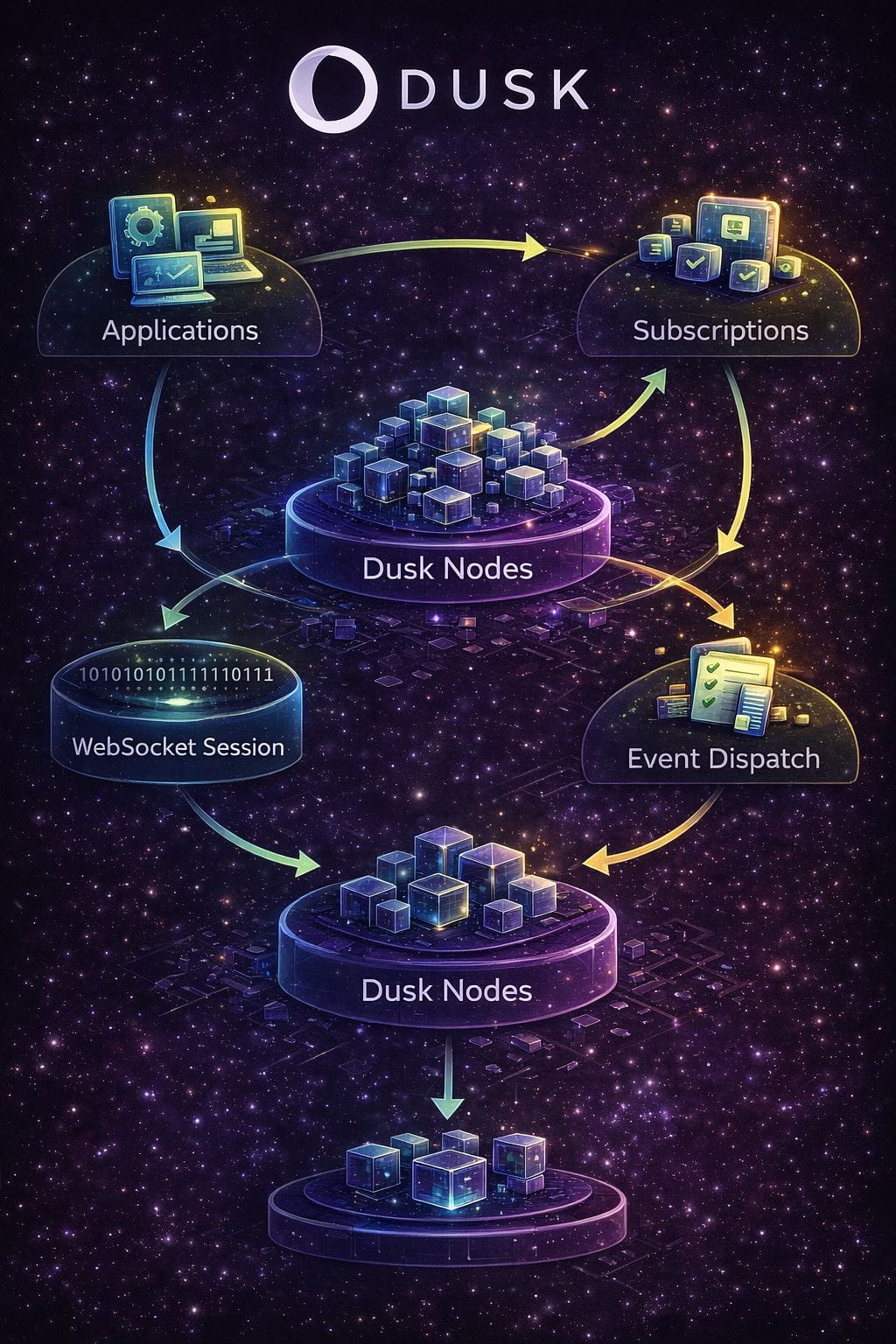
Modern financial blockchains need more than just consensus and smart contracts. They need reliable, real-time communication layers that allow applications to observe, react, and integrate with on-chain activity as it happens. This is where Dusk’s event-driven architecture becomes a defining advantage. The network doesn’t treat data access as an afterthought — it builds a structured, high-performance communication layer directly into its core infrastructure.
At the center of this design is an event system built for real-time interaction between nodes and external applications. Instead of forcing developers to constantly poll the chain or parse large volumes of formatted data, Dusk enables direct streaming of blockchain events. This approach dramatically improves efficiency for financial applications that depend on immediate awareness of state changes, such as trading systems, custodial services, compliance monitors, and tokenized asset platforms.
A key technical feature of this system is its support for binary data handling. Many blockchains rely heavily on JSON-based APIs, which are easy to read but inefficient for high-throughput or cryptographic data. Dusk’s architecture supports binary streams and binary proofs natively, allowing applications to process data in a more compact and performant format. This is especially important in environments where proofs, signatures, and encrypted payloads are common — precisely the kind of environment Dusk is targeting with its privacy-enabled and compliance-aware financial infrastructure.
Session-based communication plays a major role in maintaining real-time connectivity. Clients establish persistent connections to nodes, creating a continuous channel through which events can be streamed. Each session is uniquely identified, enabling secure and organized event subscriptions. This model ensures that applications such as wallets, exchanges, or institutional dashboards can maintain an uninterrupted flow of blockchain updates without repeatedly re-authenticating or re-synchronizing from scratch.
Event identification in the system is granular and structured. Rather than broadcasting generic notifications, Dusk organizes events around specific blockchain components and event types. Applications can subscribe to changes related to contracts, transactions, blocks, or other protocol elements. This fine-grained approach allows developers to focus only on the data that matters to their use case, reducing noise and improving performance.
Subscriptions themselves are handled through a clear lifecycle. Clients can subscribe to event streams, receive updates in real time, and later unsubscribe when the data is no longer needed. This dynamic model fits well with scalable backend services, where different modules may listen for different types of blockchain activity. It also aligns with institutional software practices, where systems are built around event-driven microservices that respond automatically to new information.
Beyond subscriptions, the architecture also supports event dispatching. This means applications can send structured data to the node and request processing or responses tied to specific blockchain components. For developers building advanced financial tools, this two-way interaction opens the door to sophisticated workflows, such as submitting proofs, triggering contract-related actions, or requesting targeted blockchain data in response to off-chain conditions.
The design includes clear response handling and structured status signaling. When an application interacts with a node, it receives meaningful feedback indicating whether a request was successful, requires further action, or encountered an incompatibility. This reliability is essential for financial integrations, where silent failures or ambiguous responses can create operational risk.
Another important piece of the infrastructure is the availability of general-purpose endpoints for querying blockchain state. These endpoints provide access to node information and overall network data, complementing the real-time event system. Together, they allow developers to build both reactive systems (driven by live events) and analytical tools (driven by historical or state-based queries).
Graph-based query capabilities further expand what developers can do. By supporting structured queries against blockchain data, Dusk enables complex data retrieval without forcing developers to manually traverse raw chain data. This is particularly valuable for compliance reporting, asset tracking, and institutional analytics, where structured insights must be derived from on-chain activity.
All of these communication features reinforce Dusk’s broader mission: enabling regulated, privacy-aware financial markets on blockchain rails. Financial institutions cannot rely on slow, unreliable, or opaque data access layers. They need deterministic event flows, efficient data formats, and well-defined interaction patterns. Dusk’s architecture answers that need by treating real-time data handling as a foundational layer rather than an optional add-on.
In practice, this means developers building on Dusk can create systems that mirror the responsiveness of traditional financial infrastructure while still benefiting from blockchain transparency and cryptographic guarantees. Trading venues can monitor settlement events instantly. Custodians can track asset movements with precise confirmation signals. Compliance systems can react to contract activity the moment it occurs.
By combining high-performance event streaming, structured subscriptions, binary data efficiency, and flexible query interfaces, Dusk provides a communication framework designed for serious financial applications. It transforms the blockchain from a passive ledger into an active, event-driven environment where institutions and developers can build responsive, compliant, and scalable on-chain systems.
