
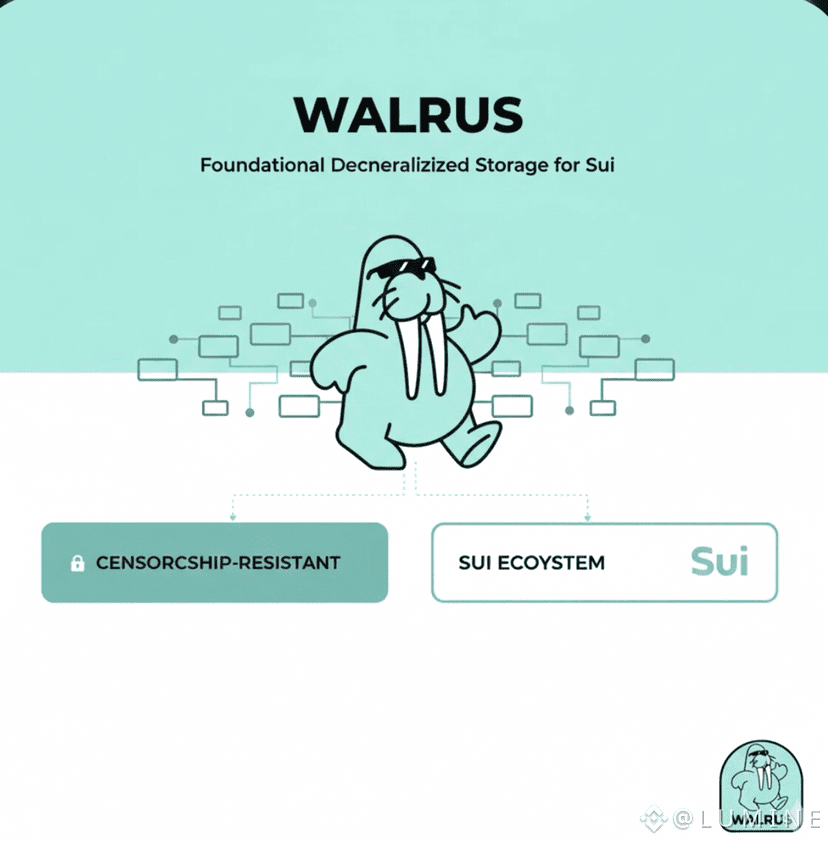
In every blockchain ecosystem, there is a quiet infrastructure layer that rarely trends on social media but ultimately determines whether the ecosystem scales or collapses under its own ambition. For Sui, Walrus occupies that role.
Walrus is not simply “another storage protocol.” It is designed as a decentralized, censorship-resistant data availability and storage layer, purpose-built to align with Sui’s object-centric architecture and high-throughput design philosophy. That alignment is not accidental it is structural.
At its core, Walrus solves one of the most persistent problems in Web3: how to store large, mutable, and long lived data in a decentralized environment without sacrificing performance, cost efficiency, or censorship resistance. While many blockchains offload this responsibility to external systems or centralized cloud services, Walrus treats storage as a first class citizen of the Sui ecosystem.
What makes Walrus especially compelling is its data lifecycle management model. Instead of treating data as static blobs, Walrus introduces a framework where data can be created, accessed, updated, expired, or archived in a cryptographically verifiable and economically optimized way. This matters because modern decentralized applications especially gaming, DePIN, AI-driven systems, and social protocols do not operate on static datasets. They generate living, evolving data streams.
From a developer’s perspective, Walrus reduces friction. Builders on Sui can rely on a native storage layer that understands the same design assumptions as the base chain: parallel execution, object ownership, and composability at scale. That cohesion translates into faster development cycles, fewer security trade offs, and applications that feel closer to Web2 in responsiveness while retaining Web3 trust guarantees.
From a network perspective, Walrus enhances censorship resistance and decentralization. By distributing data across independent storage nodes and enforcing cryptographic proofs of availability, the system resists both single point failures and coordinated suppression. This is especially relevant as blockchain applications move into politically sensitive or economically disruptive domains.
WAL, as the protocol’s token, is deeply embedded in this utility. It is not a superficial governance badge or speculative placeholder. WAL coordinates incentives across storage providers, users, and validators, ensuring that data availability remains economically sustainable over time. In other words, WAL is not just riding the Sui ecosystem it is helping to structurally reinforce it.
When you step back and look at Sui’s long-term ambitions mass adoption, real time applications, and institutional-grade performance it becomes clear that Walrus is less of an optional add on and more of a foundational pillar. Infrastructure rarely gets the spotlight, but it is where enduring value tends to accumulate.
Market Dynamics: WAL Price Stabilization, Technical Signals, and Ecosystem Context
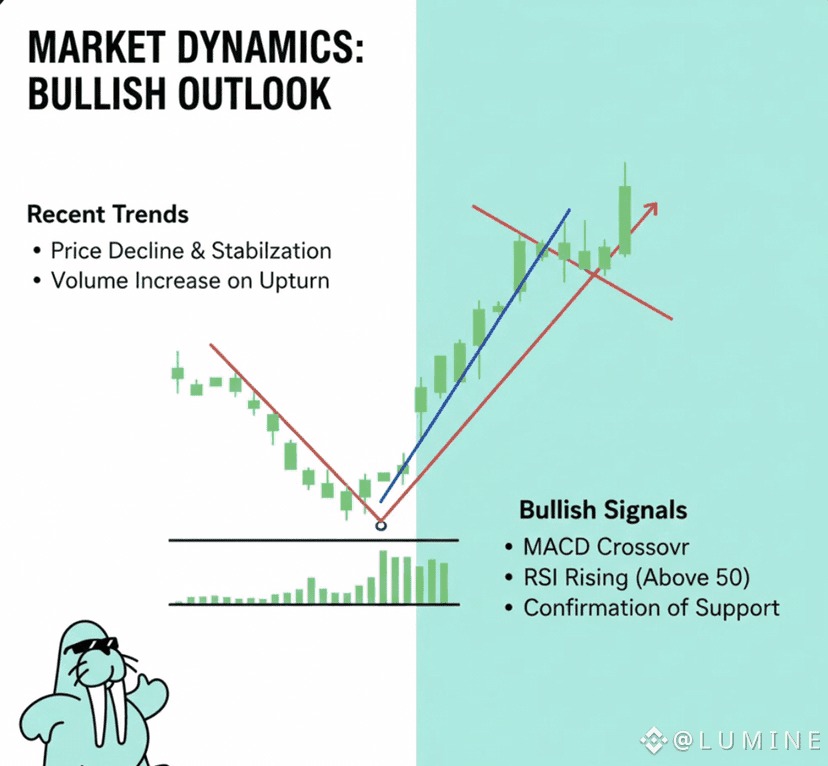
Market behavior often lags fundamentals, especially in infrastructure focused projects. WAL’s recent price action reflects this dynamic with striking clarity.
After experiencing a notable decline driven largely by broader market conditions rather than protocol-specific failures WAL has entered a phase of price stabilization. This stabilization is not merely a pause in volatility; it represents a recalibration of expectations as speculative excess drains from the system and long term participants begin to accumulate.
From a technical standpoint, several indicators suggest a shift in momentum. Volume profiles show reduced sell-side pressure, implying that weak hands have largely exited. Momentum oscillators point toward bullish divergence, a classic signal that downside exhaustion may be giving way to gradual accumulation. Price action has compressed into tighter ranges, often a precursor to directional expansion.
But technicals alone do not tell the full story. What makes WAL’s stabilization particularly interesting is where it is happening in the lifecycle of the Sui ecosystem.
Sui itself is still early in its adoption curve. Developer activity continues to expand, tooling is maturing, and new categories of applications especially those requiring heavy data throughput are beginning to emerge. Walrus sits directly at the intersection of these trends. As builders increasingly confront the limitations of traditional storage solutions, demand for Walrus’ capabilities becomes less theoretical and more immediate.
This creates an asymmetry in the market. While price action reflects short-term sentiment and liquidity conditions, underlying demand for decentralized storage infrastructure is quietly growing. WAL, therefore, exists in a zone where market perception has not yet caught up with functional relevance.
It is also important to contextualize WAL’s performance relative to the broader Sui ecosystem. Tokens tied to infrastructure layers often underperform during speculative cycles but outperform during periods of ecosystem consolidation and real usage growth. As hype rotates away from surface level narratives and toward sustainable revenue models, infrastructure tokens tend to re rate.
Another key dynamic is token behavior under stress. WAL’s ability to stabilize rather than cascade lower suggests a base of holders who understand the protocol’s long term value proposition. This kind of holder composition matters. It reduces reflexive volatility and creates conditions where positive fundamental developments can have an outsized impact on price.
In short, WAL’s recent market behavior is less a sign of weakness and more a reflection of transition from speculative pricing to value discovery. For investors and ecosystem participants who pay attention to structure rather than noise, this phase is often where the most meaningful positioning occurs.
Future Outlook: Adoption, Integration, and the Long-Term Role of WAL in Sui’s Growth
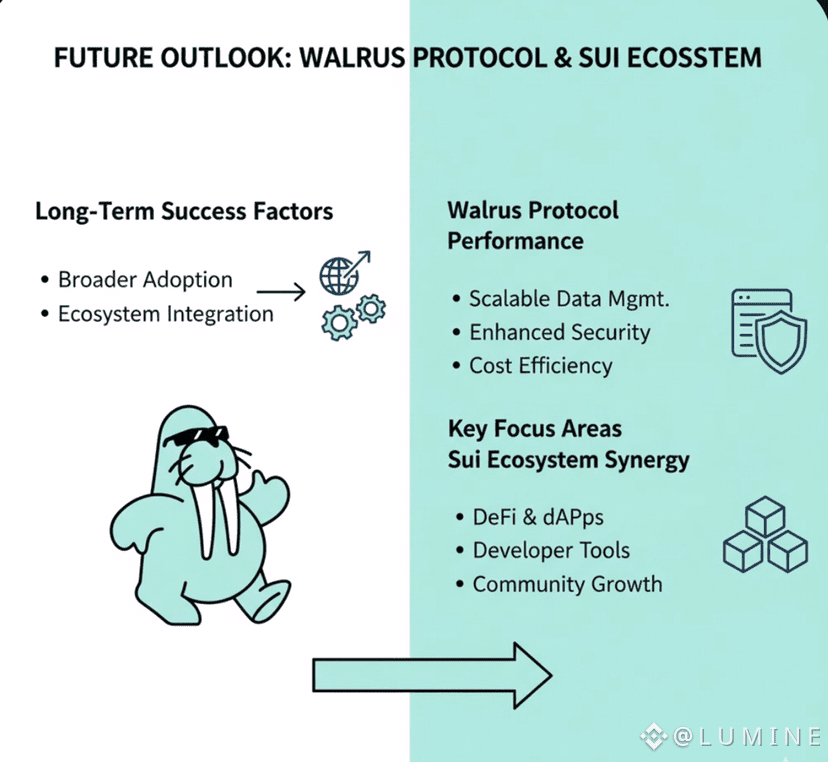
The long-term success of Walrus and by extension WAL hinges on a single, powerful variable: adoption through integration.
Infrastructure does not win by being loud. It wins by being indispensable.
Walrus’ future is tightly coupled to how deeply it embeds itself into the workflows of developers building on Sui. The more applications rely on Walrus for core functionality asset storage, content delivery, AI datasets, game state persistence the more WAL transitions from a speculative asset into a productive economic instrument.
One of Walrus’ strongest long-term advantages is its alignment with emerging application categories. Decentralized social platforms, on-chain gaming, AI-powered protocols, and DePIN networks all share a common requirement: persistent, scalable, and censorship-resistant data storage. These applications are data-heavy by nature, and their success depends on storage solutions that can evolve with them.
Walrus’ data lifecycle management is particularly well-positioned here. By allowing data to change states over time—hot, cold, archived, expired—the protocol introduces cost efficiency and flexibility that static storage systems cannot match. This creates a natural economic moat. Once applications architect themselves around this model, switching costs increase dramatically.
From an ecosystem perspective, Walrus strengthens Sui’s competitive positioning against other Layer 1 networks. Storage is often an external dependency in blockchain stacks, creating fragmentation and security trade-offs. A native, deeply integrated storage layer gives Sui a more cohesive and developer-friendly architecture. Over time, this cohesion can translate into higher retention, faster innovation, and stronger network effects.
For WAL holders, the long-term narrative is not about short-term price targets. It is about usage density. As storage demand increases, WAL’s role in securing, pricing, and governing that demand becomes more central. This creates a feedback loop where network growth reinforces token utility, and token utility reinforces network stability.
There are, of course, risks. Adoption is never guaranteed. Competing storage solutions will continue to evolve, and execution quality will matter. Walrus must maintain performance, reliability, and developer trust as usage scales. But these are execution risks, not conceptual flaws—and they are the kinds of risks that strong teams and active ecosystems are best equipped to manage.
Looking ahead, the most likely path for Walrus is not explosive overnight growth, but gradual entrenchment. It becomes the default choice, the invisible backbone, the system developers stop thinking about because it simply works. Historically, that is where the most durable value is created.
In that context, WAL’s future performance is less about speculation and more about participation in the maturation of the Sui ecosystem itself. As Sui grows into its ambition, Walrus grows with it not as a passenger, but as part of the engine.

