

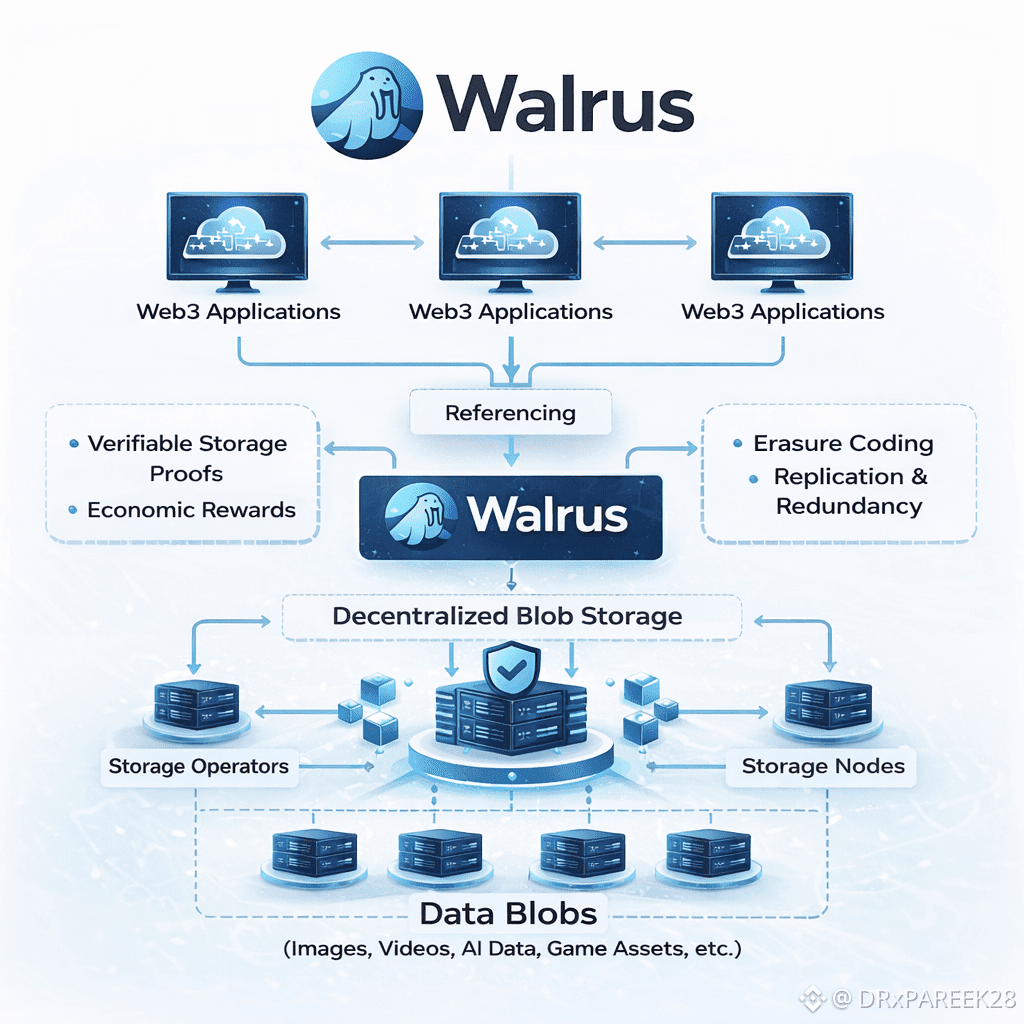
Walrus is emerging as one of the most interesting breakthroughs in decentralized data storage, designed specifically to handle the kind of massive, complex data that modern Web3 applications demand. While many blockchain systems focus primarily on transactions and smart contract execution, Walrus tackles a different but equally critical challenge: how to store and serve large blobs of data in a decentralized, verifiable, and cost-efficient way without relying on traditional centralized cloud providers.
At its core, Walrus is a decentralized storage protocol optimized for binary large objects, often called “blobs.” These blobs can include images, videos, AI datasets, game assets, NFTs with rich media, and any application data that is too heavy or inefficient to store directly on-chain. Instead of forcing blockchains to carry this data burden, Walrus creates a complementary layer where data is distributed across a network of storage nodes, while cryptographic proofs ensure that the data remains intact and available.
What makes Walrus stand out is its approach to data availability and redundancy. Rather than simply copying entire files across many nodes in a wasteful way, Walrus uses advanced erasure coding techniques. This means data is split into fragments, encoded with redundancy, and distributed across multiple operators. Even if some nodes go offline or behave maliciously, the original data can still be reconstructed. This dramatically improves reliability while keeping storage overhead more efficient than simple replication models.
Security in Walrus is not an afterthought. Each stored blob is tied to cryptographic commitments, allowing anyone to verify that the data retrieved is exactly the data that was originally stored. Storage providers must periodically prove that they still hold their assigned data fragments. These proofs are lightweight but powerful, forming the backbone of a trust-minimized storage market. Instead of trusting a company’s reputation, users rely on math and protocol rules.
Another key innovation is how Walrus aligns incentives. Storage nodes are economically rewarded for correctly storing and serving data, and penalized if they fail to meet protocol requirements. This creates a marketplace for storage that is open, competitive, and decentralized. Over time, this model can drive storage costs down while maintaining strong guarantees around availability and integrity.
Walrus is especially powerful when combined with high-performance smart contract platforms. Applications can keep their core logic on-chain while offloading heavy data to Walrus, linking to it through verifiable references. This unlocks new design space for Web3 builders: fully on-chain games with rich media, decentralized social platforms with large user-generated content, AI applications storing training data and model artifacts, and NFT ecosystems where the media is as permanent and verifiable as the token itself.
Scalability is another major advantage. Because Walrus is built specifically for data, it avoids the bottlenecks that occur when blockchains try to handle large files. The network can scale horizontally as more storage providers join, increasing capacity and resilience at the same time. This makes it suitable not just for niche crypto use cases, but for internet-scale applications that require serious storage throughput.
From a developer perspective, Walrus abstracts away much of the complexity of distributed storage. Builders interact with simple interfaces to upload, reference, and retrieve blobs, while the protocol handles encoding, distribution, and verification behind the scenes. This lowers the barrier to building truly decentralized applications that don’t secretly depend on centralized storage under the hood.
In the bigger picture, Walrus represents a shift in how we think about blockchain ecosystems. Instead of trying to force everything onto a single layer, it embraces modularity: execution on one layer, data storage on another, all connected through cryptographic guarantees. This modular approach is widely seen as the future of scalable Web3 infrastructure.
As demand for decentralized AI, gaming, media, and social platforms grows, the need for reliable, decentralized storage will only intensify. Walrus positions itself as a foundational data layer for this next generation of applications, offering a blend of efficiency, security, and economic sustainability. If blockchains are the trust layer for logic and value, Walrus is shaping up to be the trust layer for data itself.

