

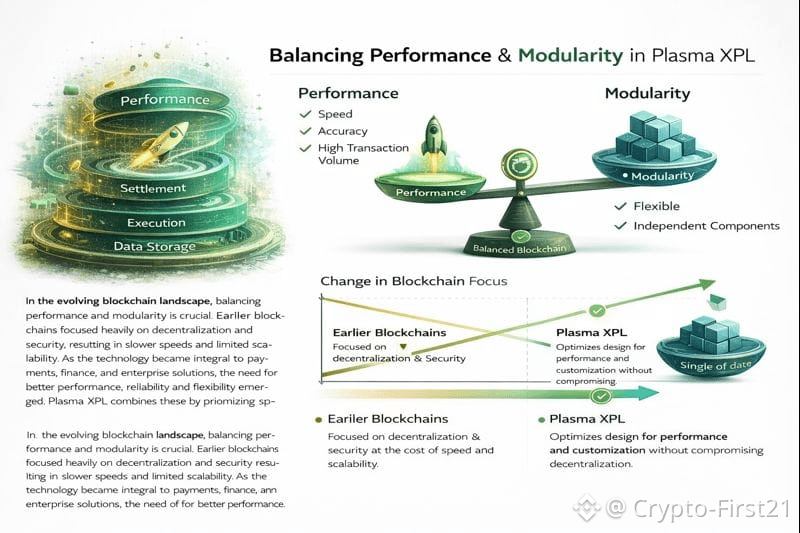
In an environment which is ever evolving and changing with regard to blockchains, it appears as though it is one or the other, but the whole idea of Plasma comes first with both. By performance, we are talking about speed, accuracy, and being able to process a lot of transactions without slowing down. The concept of modularity here is the ability to make changes and be flexible with regards to the different components without having to change anything with the overall network. Therefore, what we are talking about here is the balance of both, with the main focus being on being efficient for the blockchain, and everything else is taken care of with the different modular layers.
In order to grasp the reason for its importance, it is helpful to examine changes within the process of blockchain adoption. The early focus of blockchain systems was centered on decentralization and security. While this was at the expense of speed and user experience, businesses and institutions have different needs. With the expansion of the use of blockchain technology in the real world, particularly via applications within payments, finance, and business solutions, the limitations of earlier blockchain solutions became apparent. Enterprises and businesses need guarantees on performance, latency, and reliability. XPL fulfills these needs through the optimization of its design for reliability and confirmation speed. Additionally, it implies the customization of its components for various business domains. There is an added advantage for institutions that value compliance, scalability, and efficiency without compromising transparency.
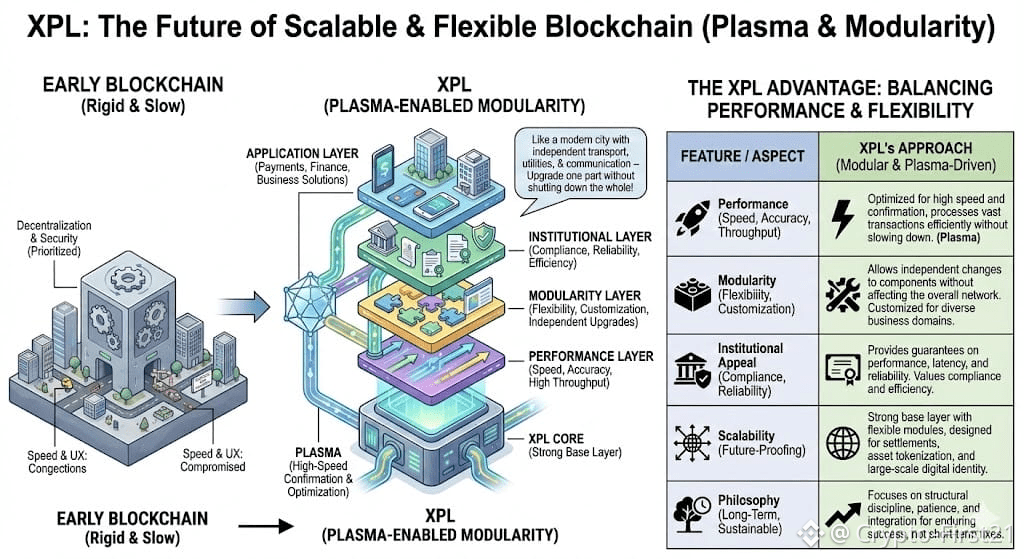
For example, technology terms such as modular architecture and execution layers may seem very complex, but the underlying technology is quite simple. The idea is that unlike other systems that seek to perform multiple functions at the same time, XPL allows the parts of the system to perform unique functions. This system can be likened to a contemporary city with transport, utilities, and communication systems running independently but being able to communicate effectively to the extent that should the need to upgrade one of the parts arise, it can be done without shutting down the entire city.
From the general viewpoint, there has been a rise in the interest level in blockchains that are scalable. Data collected from recent industry reports reveals that financial institutions, platforms, and infrastructure services are expressing interest in having modular connectivity options that are supported by guarantees. These firms are not trying to leverage short term trends. They are laying down the foundation for a system of settlements, asset tokenization, and a digital identity system, which will need to work at a large scale. XPL’s strategy is similar in the sense that it provides a strong base layer and flexible modules.
In personal terms, I find this course of action reassuring. Having seen many good technologies flounder as they grew too quickly without structural discipline, it seems sensible and thoughtful to create a system with sustainability at its heart. It suggests a philosophy of patience, flexibility, and integration rather than quick fix solutions.
Ultimately, it is expected that the success of systems such as XPL will be based, not on short-term measures of effectiveness, but rather upon the ability of those systems to meet the changing needs of humanity. As finance, governance, and digital communications increasingly integrate with blockchain platforms, it is anticipated that systems which can balance speed and flexibility will define the subsequent stage of the blockchain revolution. To a degree, XPL represents a movement beyond existing technological paradigms and towards a more advanced system of interconnectivity.

