

Most blockchains look impressive when traffic is light. Transactions confirm quickly, fees stay low, and everything feels smooth. But payment systems aren’t judged by their best moments. They’re judged by what happens when volume stays high for hours or days, when activity spikes unexpectedly, and when delays actually cost money.
That’s where payments at scale expose weaknesses.
When blockchains try to handle large, continuous payment flows, several problems show up at once. Congestion builds, fees become unpredictable, and transaction ordering turns into a bottleneck. Even networks with high theoretical throughput can struggle because global consensus forces every payment to compete for the same limited attention. What works well for occasional transfers often breaks down when payments become constant.
Plasma starts from a different assumption: payments are not an edge case. They are the core workload.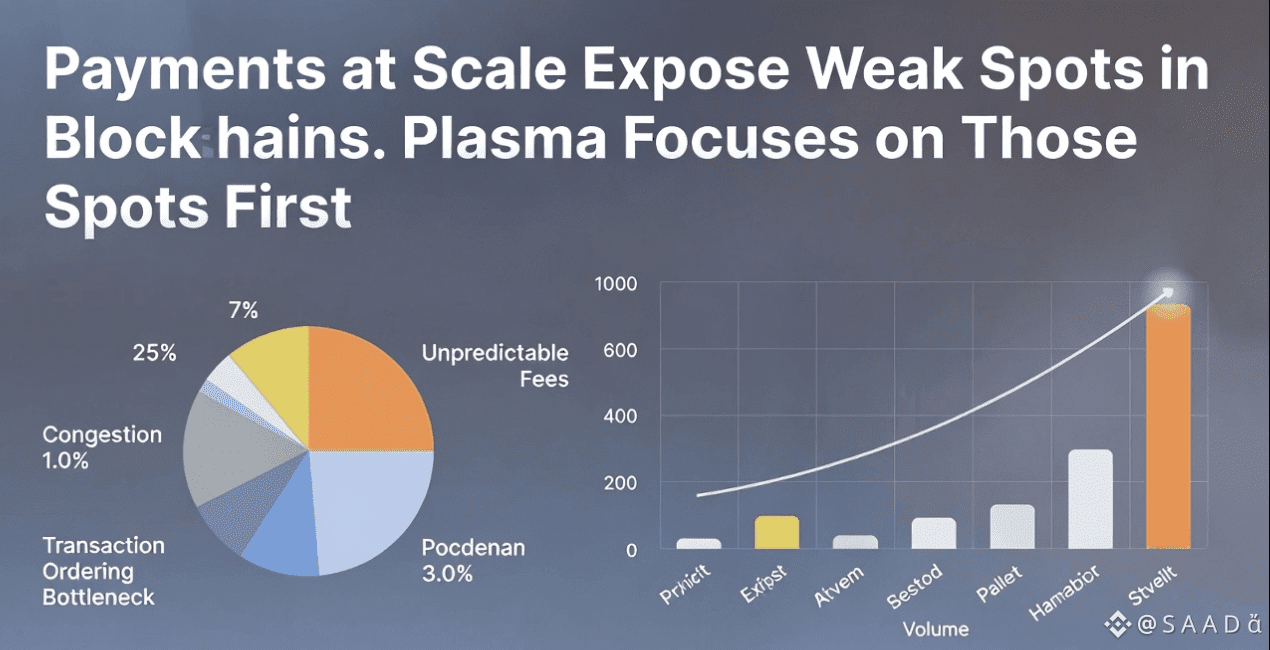
Instead of optimizing for peak TPS numbers, Plasma focuses on steady execution and dependable settlement. The goal isn’t to look fast in short demos, but to remain stable when payment volume doesn’t let up. That means designing the system so transactions can be processed efficiently without overwhelming the network’s ability to finalize and settle them correctly.
One of the weak spots Plasma addresses early is friction during congestion. In many systems, rising demand immediately leads to higher fees and slower confirmations. Plasma’s architecture is designed to reduce this pressure by handling execution in a way that prevents routine payment activity from clogging the path to final settlement. This keeps the network usable even when activity is sustained.
Another common failure point is predictability. For payments, “usually fast” isn’t good enough. Businesses and users need to know that transactions will settle reliably, not just eventually. Plasma prioritizes consistent behavior under load, so payment flows remain orderly instead of chaotic when volume increases.


The result is a system that treats payments like infrastructure, not experimentation. Quiet reliability matters more than flashy performance claims. When things work as expected in the background, users barely notice and that’s exactly the point.
Payments at scale don’t reward optimistic design. They reward systems that confront their weakest spots early. Plasma is built around that reality, focusing on the hard parts first so payments can keep moving when it actually matters.