
@Walrus 🦭/acc My initial encounter with Walrus was understated. It didn’t present itself as something urgent or demand immediate belief. There was no suggestion that everything hinged on paying attention right then. Instead, it surfaced almost casually, folded into a larger discussion about infrastructure rather than framed around tokens, incentives, or upside. That quiet introduction mattered. After spending enough time in this industry, you begin to recognize patterns in how projects announce themselves. Some raise their voices because they fear they won’t get another chance. Others are measured, speaking softly because they expect longevity.
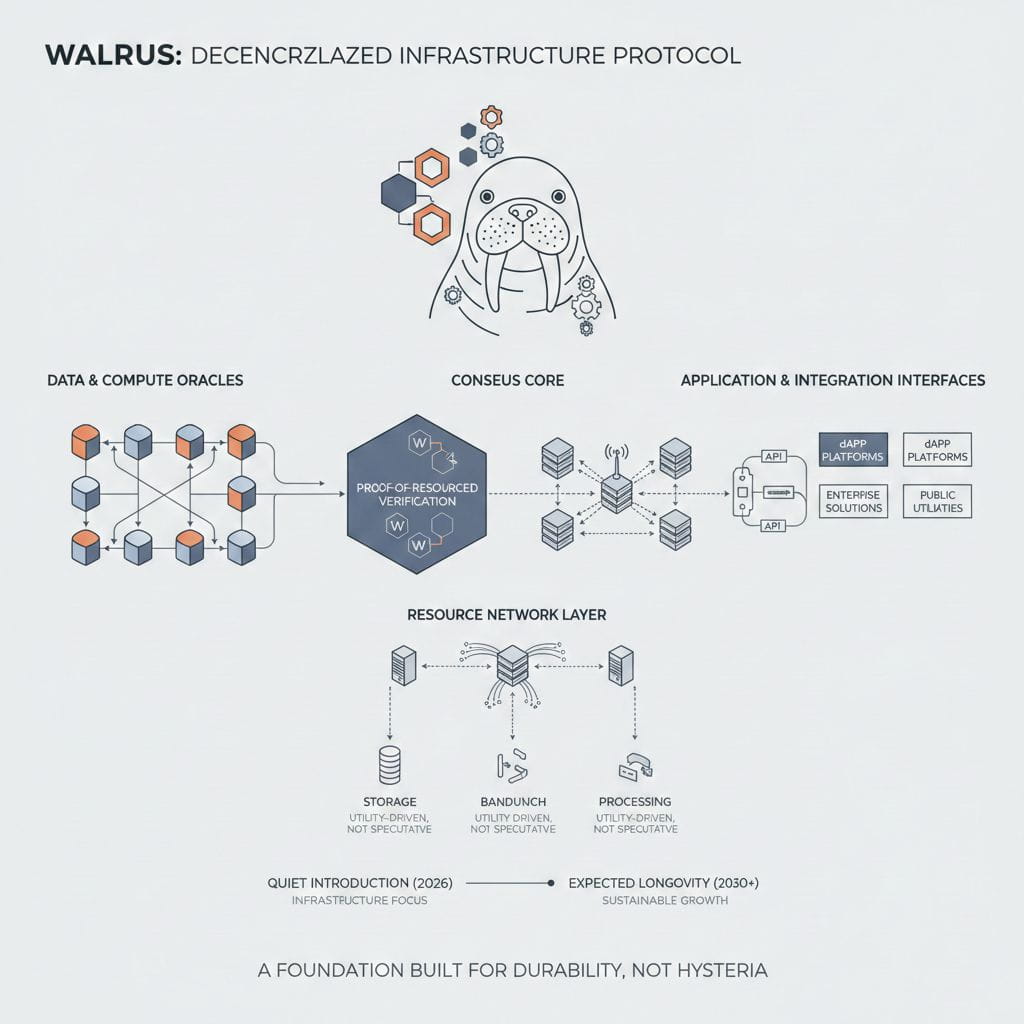
When Walrus appeared, the broader ecosystem was already weighed down by its own unresolved tensions. Decentralization was a familiar ideal, yet interacting with decentralized systems often remained awkward and inefficient. Storage was a clear example of this mismatch. Centralized solutions were fast, inexpensive, and easy to use, but they relied on trust assumptions that clashed with the values many builders claimed to hold. Decentralized storage alternatives existed, but too often they felt experimental functional, but fragile, and rarely seamless enough to disappear into the background.
Walrus seemed to acknowledge this reality without dramatizing it. Rather than casting centralized storage as a villain, it treated it as a reference point. The goal was not disruption for its own sake, but parity: creating a decentralized option that didn’t feel like an ethical compromise in everyday use. This distinction is subtle, yet meaningful. It reframes the project from one driven by ideology to one grounded in pragmatism. Walrus does not assume users will choose it purely out of principle. It assumes they care about uptime, pricing, and predictability, alongside concerns like privacy and ownership.
Part of what makes this philosophy notable is what Walrus deliberately avoids prioritizing. It does not attempt to expose every layer of flexibility or customization to the user. Instead, it accepts that complexity belongs beneath the surface, while the interface remains intentionally minimal. In a space that often celebrates extensibility as an end in itself, this restraint can feel almost old-fashioned. Yet it feels purposeful. It reflects the belief that good infrastructure should recede, not constantly advertise its sophistication.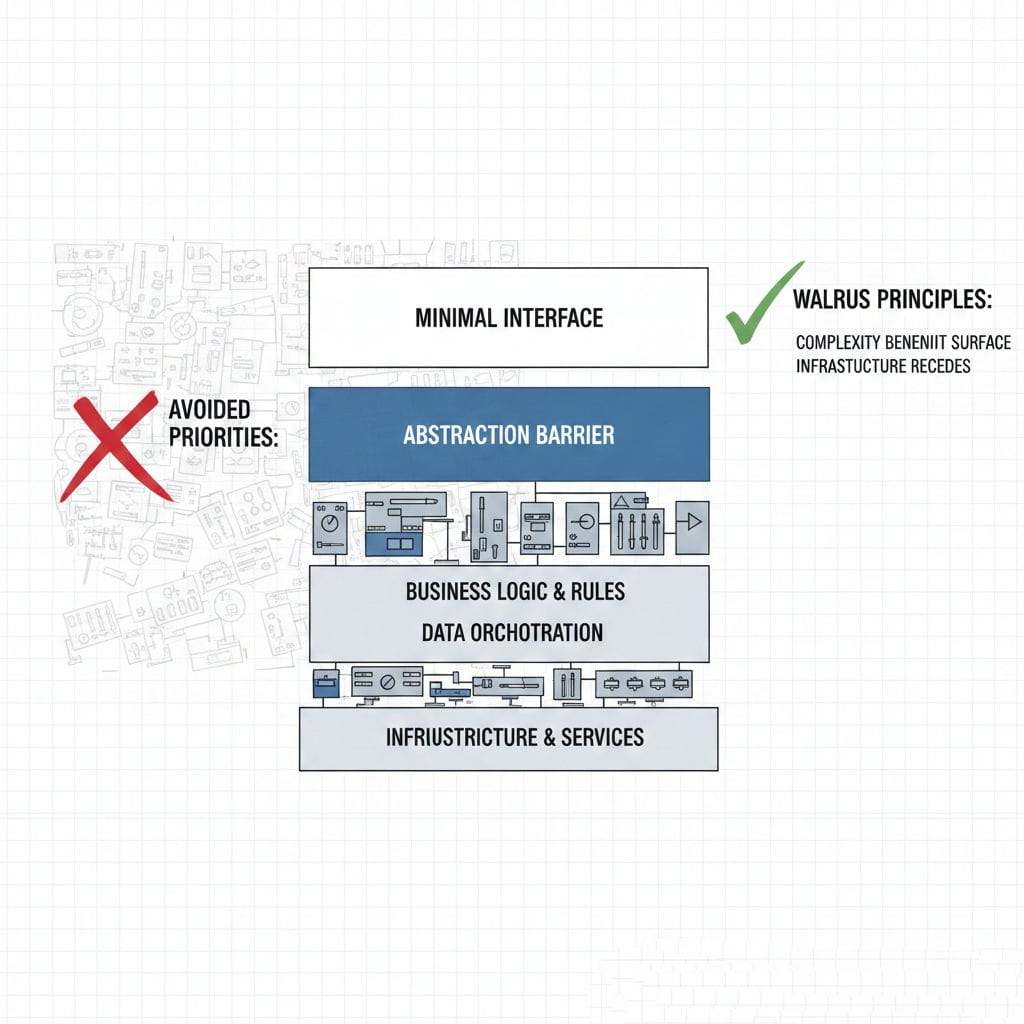
These design decisions also reveal a willingness to confront trade-offs head-on. Walrus acknowledges that securely distributing data at scale involves sacrifices whether in speed, simplicity, or protocol-level elegance. Rather than obscuring these realities behind marketing language, the system is built around them. It doesn’t pretend decentralization comes without cost. Instead, it treats factors like redundancy, resilience, and expense as constraints to be balanced, not inconveniences to be ignored.
Over time, what becomes apparent is how narrowly scoped the project’s ambitions are. Walrus is not trying to be a social platform, a financial primitive, and an identity solution simultaneously. It confines itself to infrastructure and seems at ease with the idea that most end users may never recognize its name. In an environment that rewards attention and visibility, this is an unusual stance but a coherent one. Infrastructure that seeks the spotlight often ends up competing with the very applications it’s meant to support.
As a result, adoption unfolds slowly, in the way foundational technologies often do. There are no dramatic spikes in usage, no moments that force the market to take notice. Instead, relevance accumulates incrementally. Developers test it, some commit, others move on. Enterprises observe from a distance, waiting to see how it performs under mundane, uncelebrated conditions. This gradual pace can be mistaken for a lack of momentum, but it may simply reflect the nature of what Walrus aims to be: something dependable enough to fade into the background.
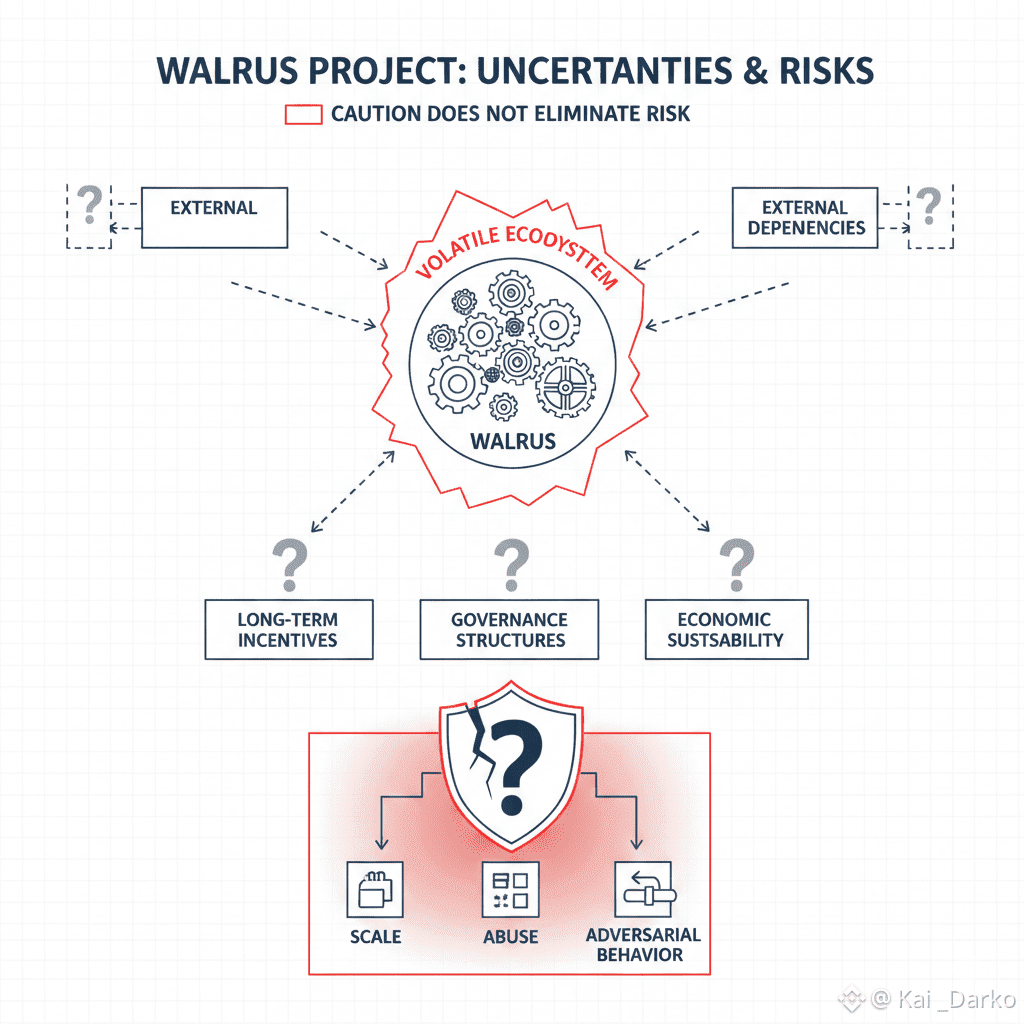
That said, caution does not eliminate risk. Walrus still exists within a volatile ecosystem and depends on external systems it cannot fully control. Open questions remain around long-term incentives, governance structures, and economic sustainability. It’s unclear how the system will respond to real-world stress pressure that comes not from theoretical models, but from scale, abuse, and adversarial behavior. These uncertainties are not unique to Walrus, but they are genuine, and acknowledging them is part of evaluating the project honestly.
There is also the matter of demand. While decentralized, privacy-focused storage sounds broadly appealing, actual adoption often arrives unevenly. Many users tolerate familiar compromises until those compromises fail them personally. Walrus appears to be positioning itself for that inflection point, rather than trying to manufacture urgency prematurely. This patience may resemble indecision to some, but it can also signal clarity of intent.
What ultimately makes Walrus compelling is not that it promises transformation, but that it quietly examines the present. It asks whether decentralization can become more functional and less performative. It raises the possibility that infrastructure doesn’t need to constantly declare its values if those values are embedded deeply enough to feel ordinary. In doing so, it subtly challenges a culture that often mistakes volume for progress.
After watching several market cycles come and go, projects like Walrus tend to linger longer in memory than louder alternatives. Not because success feels inevitable, but because they appear built to tolerate uncertainty. They allow space for iteration, correction, and gradual improvement. They don’t demand conviction; they reward observation.
It’s difficult to say what role Walrus will ultimately occupy. But trajectory matters more than outcome. The trajectory here points toward systems that respect users enough not to oversell themselves, and infrastructure that values quiet dependability over spectacle. Whether or not Walrus ever becomes widely recognized, its posture offers a useful reminder: some of the most meaningful progress in this space happens out of view, shaped by people more focused on being useful than being seen.

