

For years, blockchains have been trying to accomplish all of this simultaneously. They hold the transactions, reach consensus on the order of the transactions, hold the data, and lock all of this down in one place. While this has been helpful in providing trust in financial systems, it has come with many costs. For instance, the more the network has grown, the slower the transactions have been, the higher the fee has been, and the higher the cost of data storage. One of the problems that has remained unsolved and has flown under the radar in blockchain technology is the conflict that has existed between the finality of transactions and their availability. In examining this problem, Walrus aims to fill this gap with a simple yet effective solution.
To illustrate why this is significant, let’s consider how blockchains typically function. In a transaction, we have the need to make the information available to anyone on the network who wants to check it, and also make it final and immutable. This is like trying to have a library and a courtroom function at the same time, in the same place. It’s a congestion problem. Data availability, when it comes to large amounts of data like images, videos, or proofs, is also a storage problem. Finality is the other consensus problem. These happen at different speeds depending on the ruleset. Walrus is built with this in mind. Walrus is built in such a way that data availability is a separate layer on the Sui blockchain, not slowed down by replication or consensus.
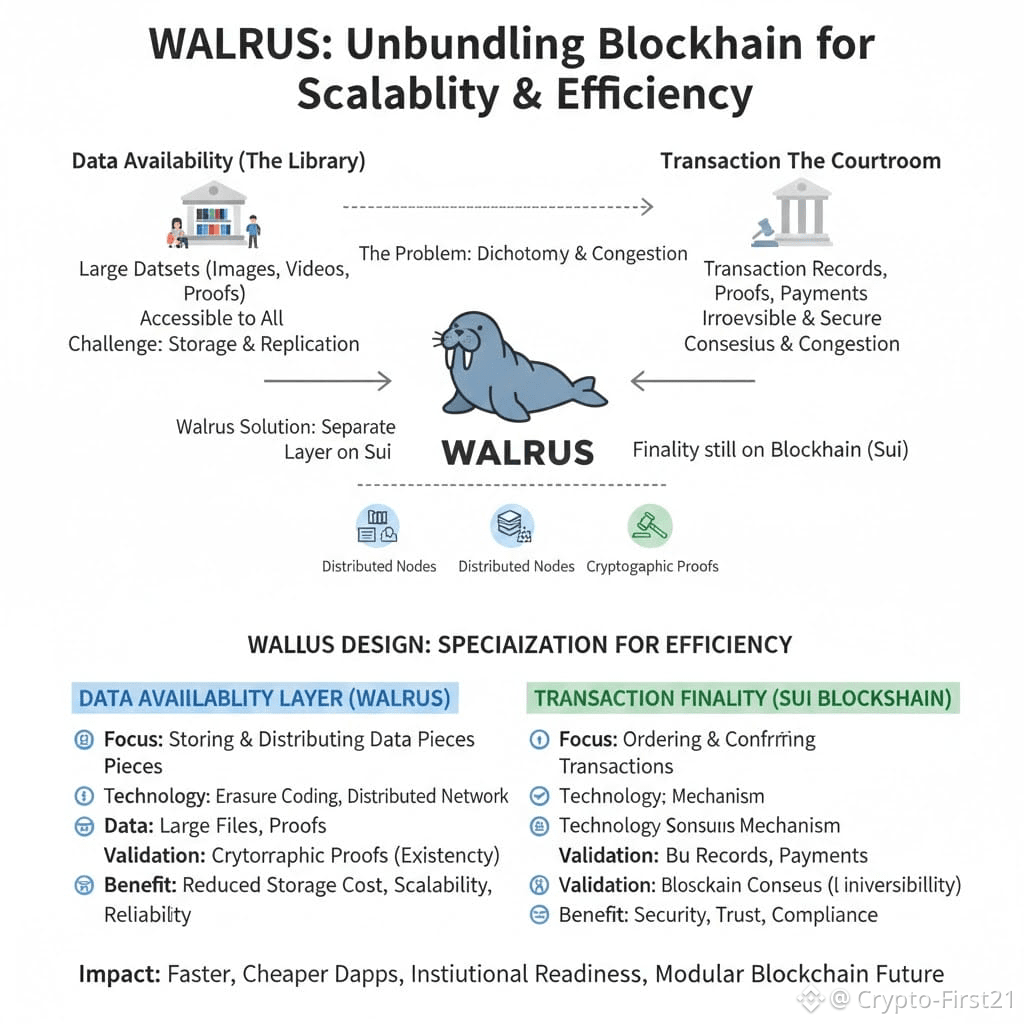
Walrus is utilizing advanced erasure coding as a technique to divide large pieces of data into smaller pieces and distribute these pieces across a multitude of nodes. What Walrus is doing is that only a certain amount of those pieces is required to actually retrieve the original file, thus providing the ability to fail while keeping costs down. Rather than storing the original file, Walrus is storing pieces of the file in an efficient manner, but cryptographic proofs regularly validate the existence of data, thus providing assurance about the availability of the stated data without actually storing the entire file on each node. On the contrary, finality is still left to the blockchain, which actually stores proofs and payments, as mentioned in the above section.
From an market standpoint, this design lands at an important time. Rollups, gaming platforms, AI applications, and media platforms all need quick access to large datasets. However, storing those datasets directly on chain is still not feasible. Modular systems are the norm, and data availability layers are no longer thought of as optional features. Walrus can be seen as a part of this movement. It can reduce storage costs and make it more reliable, enabling applications that were too expensive or complex to be deployed in a decentralized manner. Institutions, for example, will always be particularly interested in predictability, reliability, and auditability. A system that can guarantee data availability without unnecessarily bloating a base layer is a particularly compelling fit for their thought process.
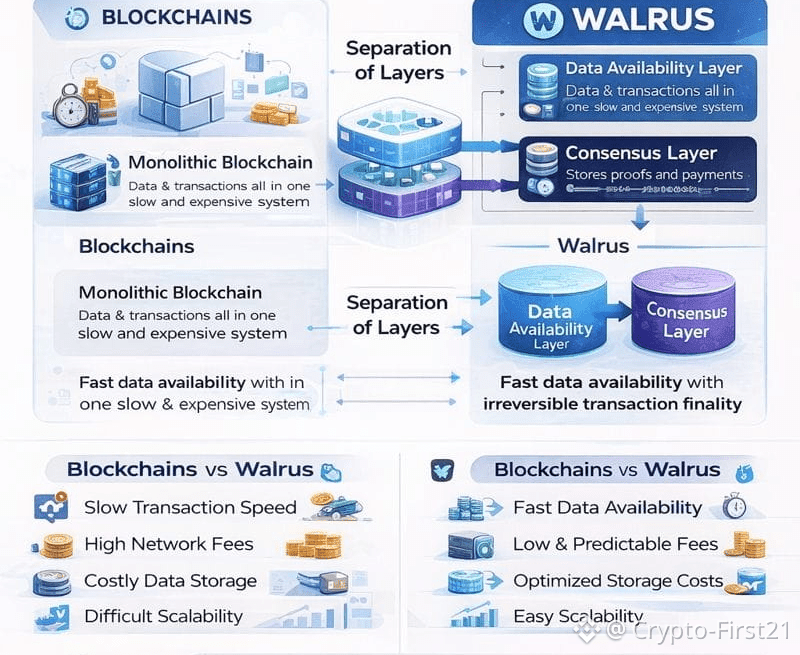
There is a longer story here as well. As we move from speculation to services with blockchains, some of these decisions will increasingly resemble decisions in traditional systems, but with decentralization as a guiding principle. Availability and finality are separated as a hallmark of a maturing industry, learning from the lesson that specialization leads to better results.
On a personal note, I find this trend rather quietly exciting. Suddenly, it seems less like the next great performance milestone is the goal and more like the next great lesson in how to build durable digital infrastructure. The quieter infrastructure is, the less users mind it, and the better we might actually be doing.
Ultimately, what Walrus does is not only add another layer, it highlights one that was always lacking. It provides availability its own place in allowing blockchains to breathe, expand, and evolve, indicating that maybe one day decentralization and usability will advance together.

