

Walrus is redefining how decentralized ecosystems think about data storage by introducing a purpose-built layer for large-scale, verifiable blob storage. Instead of forcing blockchains to carry heavy data loads they were never designed to handle, Walrus creates a specialized network where large files live off-chain but remain cryptographically verifiable and tightly integrated with on-chain logic. This separation of execution and storage unlocks a new level of scalability for Web3 applications.
A key part of this design is the role of intermediary services that help users interact with the storage network more efficiently. These services act as bridges between familiar web technologies and decentralized infrastructure. Rather than requiring every end user to directly manage encoding, distribution, and certification steps, these intermediaries streamline the process while still operating in a trust-minimized environment.
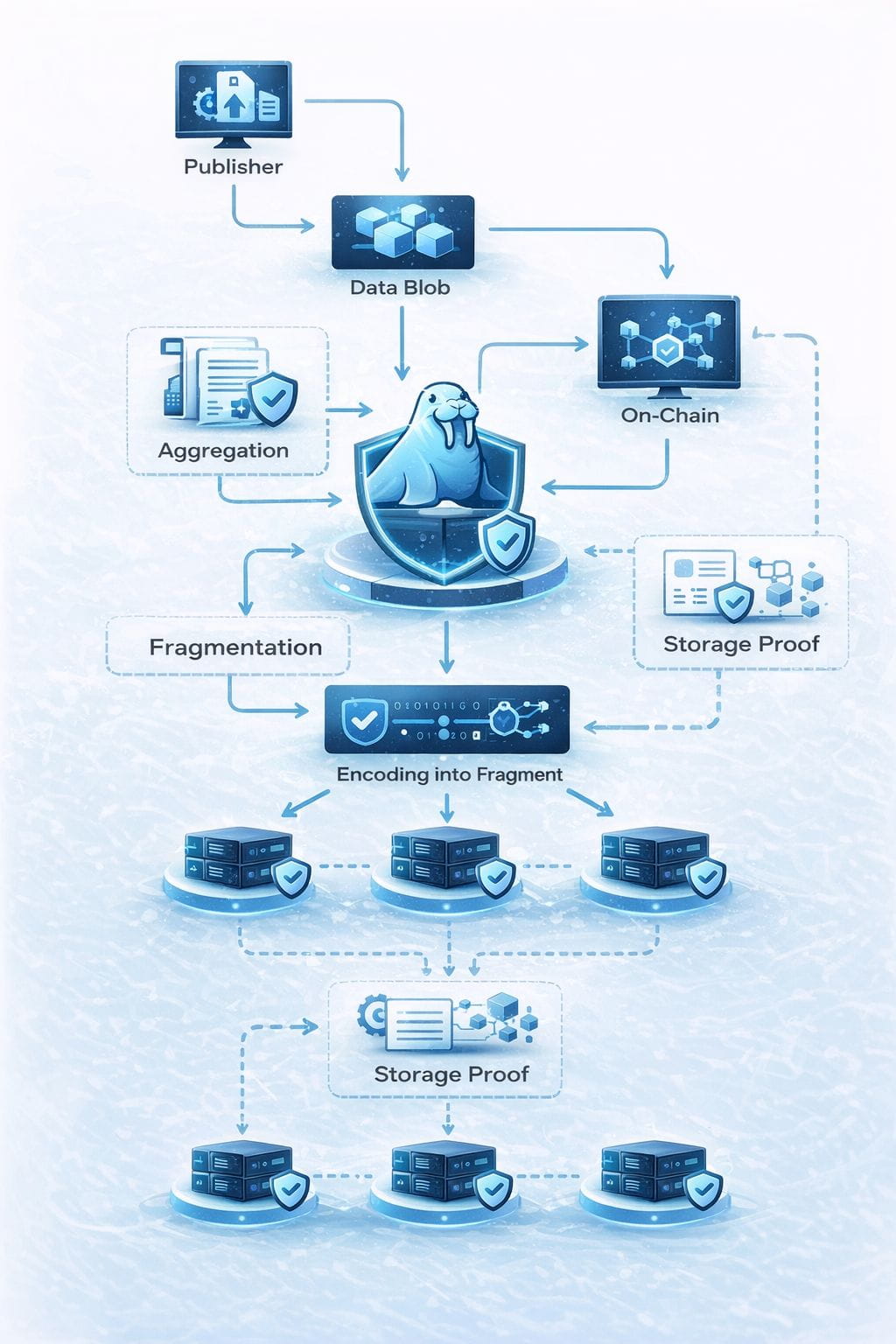
When a user wants to store a blob, the data can be sent through standard internet protocols, making the experience feel similar to uploading a file to a traditional cloud platform. Behind the scenes, however, the data is transformed. The blob is broken into smaller fragments, encoded with redundancy, and prepared for distribution across a decentralized set of storage nodes. This encoding ensures that the original data can be reconstructed even if some pieces become temporarily unavailable.
Once the data is divided into fragments, those fragments are distributed across independent storage operators. Each operator is responsible for holding a portion of the encoded data. To prevent dishonesty or data loss, these operators produce cryptographic attestations proving they have received and stored their assigned fragments. These attestations are not just informal confirmations — they are structured proofs that can later be verified.
The next step is aggregation. Instead of burdening the blockchain with numerous small proofs from individual storage nodes, these attestations are combined into a compact certificate. This certificate represents a collective guarantee that the data has been properly stored across the network. It becomes a key piece of evidence that the blob is available within the decentralized storage layer.
After the certificate is formed, the necessary on-chain interactions are performed. This links the off-chain stored data to on-chain records, creating a verifiable reference point. From that moment on, applications and users can rely on cryptographic proofs and on-chain events to confirm that a specific blob has been stored and is retrievable.
Importantly, these intermediary services are optional. Advanced users can interact directly with the storage network and the underlying blockchain if they choose. This keeps the system open and permissionless. However, for most applications, using these services significantly reduces complexity and bandwidth requirements, making decentralized storage more practical for mainstream use.
Even though these intermediaries make the system easier to use, they are not blindly trusted. The protocol is designed so that users can independently verify correct behavior. By checking on-chain records tied to a blob’s availability and comparing cryptographic identifiers derived from the data itself, users can confirm that what was promised is actually stored. This auditability is central to Walrus’s security model: trust is replaced with verification.
Another important aspect is that different participants in the system — including intermediaries and end users — are not assumed to be honest by default. The protocol anticipates that some actors may behave incorrectly or even maliciously. Security guarantees are built around cryptographic proofs, redundancy, and economic incentives rather than reputation. At the same time, the system acknowledges that certain guarantees are strongest when honest users rely on well-behaved service layers, and it provides tools for users to audit those layers.
This architecture makes Walrus especially powerful for data-heavy decentralized applications. Social platforms can store user-generated media without central servers. Games can keep large asset files in a decentralized environment. AI projects can reference training data and model artifacts in a verifiable way. NFTs can point to rich media that is not just hosted somewhere, but provably stored in a decentralized network with long-term availability in mind.
By combining erasure-coded storage, cryptographic certification, optional service layers, and on-chain verification, Walrus delivers a storage model that is both user-friendly and trust-minimized. It bridges the gap between Web2-style usability and Web3-grade security. As decentralized applications grow more complex and data-intensive, Walrus stands out as a foundational layer that enables the next generation of scalable, data-rich Web3 experiences.

