

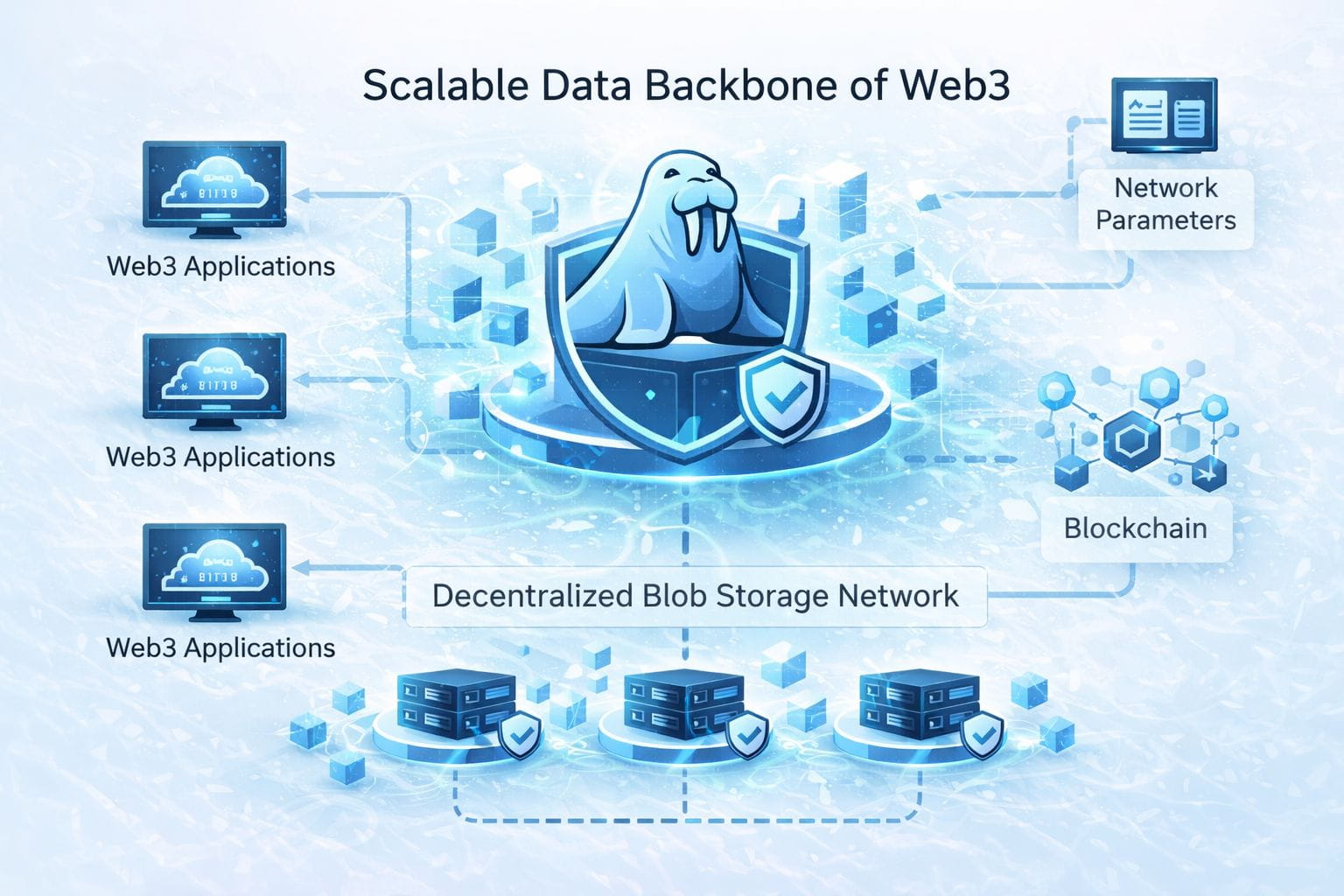
Walrus is rapidly positioning itself as a foundational data availability and storage layer designed to support the next generation of decentralized applications. While many Web3 systems concentrate on transaction throughput and smart contract execution, Walrus focuses on an equally critical but often overlooked challenge: how to store large volumes of data in a decentralized, verifiable, and economically sustainable way.
One of the most important aspects of Walrus is its multi-network architecture, which allows the protocol to evolve safely while supporting real-world usage. The production network is built to deliver reliable, long-term storage for live applications. It operates alongside a mature smart contract ecosystem, ensuring that stored data can be cryptographically linked to on-chain logic. This enables developers to create applications where large files live off-chain but remain provably tied to on-chain state.
Alongside the production environment, there is a dedicated testing network where new features, performance improvements, and protocol changes can be evaluated under realistic conditions before being rolled out widely. This separation between production and testing environments ensures stability while still allowing rapid innovation. Developers can experiment with new storage flows, encoding strategies, and economic mechanisms without putting live user data at risk.
For builders who want even more control, it is possible to run local instances of the storage network together with a local blockchain environment. This is extremely valuable for development and debugging. Teams can simulate full storage lifecycles — from data upload and encoding to proof generation and on-chain certification — without depending on public infrastructure. This accelerates development cycles and lowers the barrier to entry for teams building data-intensive decentralized applications.
Walrus is also defined by a set of carefully chosen network parameters that shape how storage is provisioned and maintained. The storage network is divided into a large number of shards, which helps distribute load and improve parallelism. By spreading data responsibilities across many segments of the network, Walrus avoids central bottlenecks and improves resilience. Even if some parts of the system experience downtime or malicious behavior, the overall network can continue functioning.
Time in the network is organized into epochs, which serve as accounting and coordination periods for storage commitments. The duration of these epochs differs between environments, allowing the testing network to iterate more quickly while the production network emphasizes stability and predictability. This design helps developers observe how economic incentives, storage proofs, and operator behavior evolve over time.
There is also a defined limit on how far into the future storage can be prepaid. This creates a balance between long-term guarantees and system flexibility. Users can secure data availability for extended periods, but the protocol still retains the ability to adapt its parameters and economics as technology and demand evolve. This approach supports sustainability rather than locking the system into rigid, long-term assumptions.
The combination of sharding, epoch-based accounting, and bounded storage commitments creates a framework where capacity can scale with participation. As more storage providers join, the network can increase its effective storage space and throughput. This horizontal scalability is essential for supporting applications that deal with media, AI datasets, gaming assets, and other large data types that would overwhelm traditional on-chain storage models.
From a developer’s perspective, these network structures are largely abstracted away through tooling and APIs. Builders interact with a system that feels straightforward — uploading blobs, receiving certificates, and referencing data from smart contracts — while the underlying protocol coordinates distribution, proof collection, and lifecycle management across many independent operators.
Walrus’s architecture reflects a broader shift toward modular blockchain design. Instead of trying to force execution, consensus, and heavy data storage into a single layer, responsibilities are separated. The blockchain secures logic, ownership, and financial state. Walrus secures the data itself, ensuring it remains available and verifiable. Together, they form a powerful foundation for applications that need both trustless logic and large-scale data handling.
As decentralized applications grow more sophisticated, the demand for reliable, scalable storage will only increase. By combining production-ready infrastructure, fast-moving testing environments, developer-friendly local setups, and carefully tuned network parameters, Walrus provides a robust framework for meeting that demand. It is not just a storage network — it is a core data layer designed to make truly data-rich Web3 applications practical at scale.

