
I didn’t see Walrus as a product. I saw it as a pattern.
To begin with, it seemed indirect—through apps that manifested atypical. NFTs that didn’t shatter when hosting services altered. AI datasets that flowed immovable, frictionless, and unproven. On-chain systems that tethered large outputs and disregarded external liability. There seemed to be some intellect that sat underneath and held these structures together.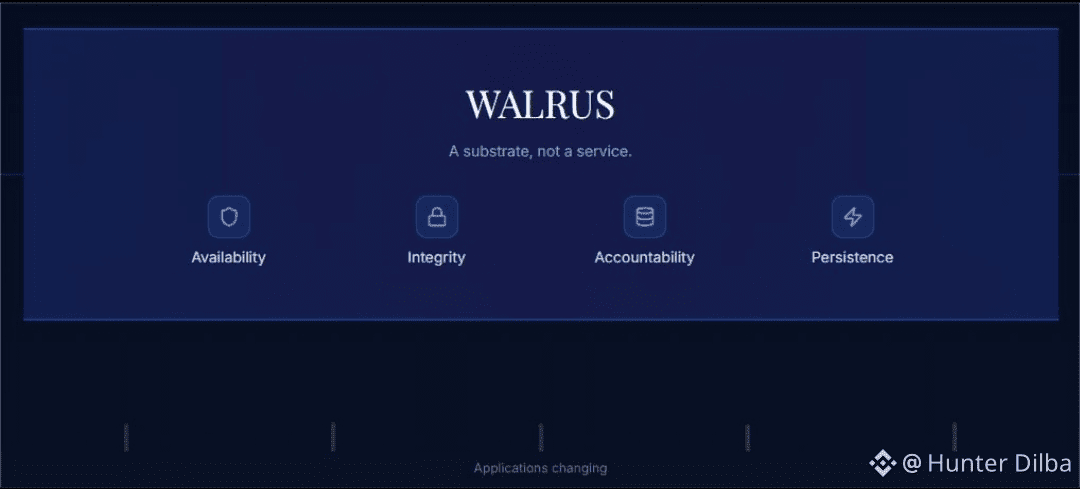
Following that trace, I got to Walrus.
What surprised me known most it’s not the price, it’s the value. Walrus does not frame themselves as a products. It’s more of an ecosystem. One that assumes the data, as applications, will outlive the trends and the chains themselves. That assumption, not externally visible, fundamentally reorients all built on top of it.
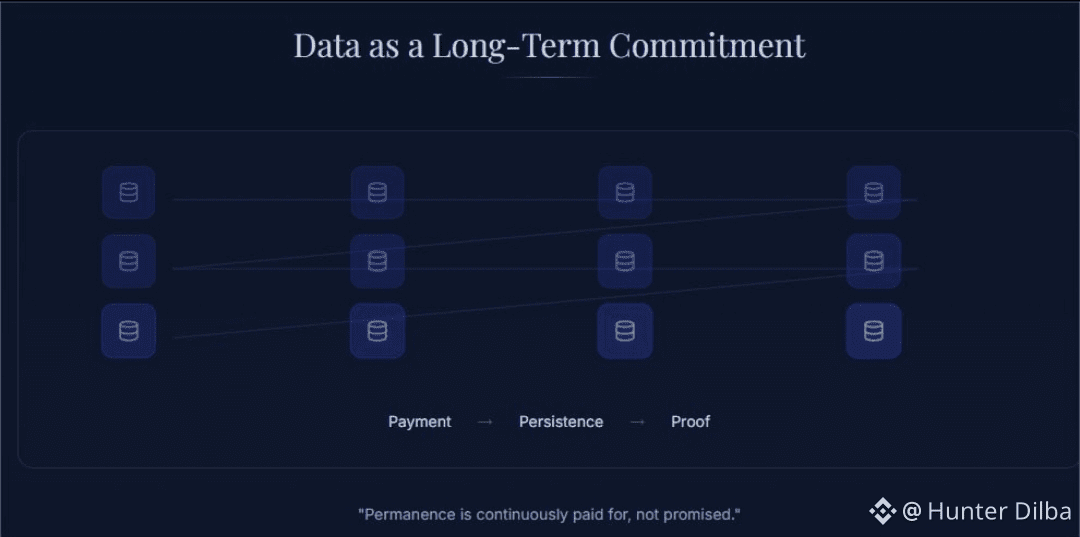
Data as a Long-Term Commitment
Most systems treat data as just another thing. You store it somewhere, reference it loosely, and hope to survive the link. In practice, this has made Web3 brittle. Applications decay not because logic fails, but because the data they depend on disappear, mutates, or become unverifiable.
Walrus treats data as an asset.
By breaking data into pieces, encoding it, and distributing it to an incentive-aligned network, it assumes information deserves the same amount of durability as capital. Storage is not cheap because there is a promise of being permanently stored. It is permanently stored because the system is constantly paying for it.
With this in mind, it is obvious Walrus is not about the amount of data it can hold, but rather about how long it can hold data. It is made for a world where data has to be accessible for a long time, and the original creator is no longer around to provide it.
A Substrate, Not a Service
Services compete against each other. Substrates last longer.
Walrus does not attempt to be different by offering user-facing features. It differentiates in how little it asks from applications. Developers can operate with little trust, users can trust the platforms, and the network itself. Walrus ensures availability, integrity, and accountability.
This is important because Web3 is progressing towards a more complex system with flooring dependencies. AI requires datasets with clear and provable history. Digital identity systems need immutable records. Decentralized systems need assets that cannot be changed when incentives shift.
Walrus positions itself beneath this complexity. It is not a marketplace; it is ground truth infrastructure.
Economic Gravity Without Spectacle
The WAL token does not try to tell a story about a potential future. It enforces one.
Incentives are structured for uptime, correctness, and continuity. Validators are rewarded for consistency, not volume. Stakers do not speculate on attention, they back stability. Governance is slow and careful, knowing that a system on top of a storage infrastructure cannot sustain volatility disguised as innovation.
When looking at this system, its economics feel less like crypto and more like the funding of a public infrastructure, expressed as programmable logic. A set of roads does not need to be marketed. A set of power lines does not chase narratives. They endure because they are paid to endure.
Walrus adopts that philosophy unapologetically.
Where AI and Decentralization Quietly Converge
The more intriguing aspect of Walrus is visible when AI-native workflows are examined in conjunction with Walrus.
Datasets on Walrus store availability and integrity proofs. These can be referenced on-chain, programmatically monetized, and audited, earning new formats of AI coordination over time where models can be trained on data proven to be persistent and economically safe.
This is not a feature to put in a headline. This is a value of the system that, when looking ahead a sufficiently long timeframe, will be apparent.
Commercial Persistence
What Walrus ultimately optimizes for is the persistence, not just of data, but of meaning.
In decentralized systems, meaning is eroded when records disappear, links break, or contexts are lost. Walrus is one of the few systems where the persistence of meaning is treated as a moral constraint. If something is referenced, it must be available. If it is available, it must be persistent. If it is persistent, it can be verifiable, and if it is verifiable, it can be trusted over time.
This creates a strong feedback loop where the applications on Walrus are built with a long-term mindset because the infrastructure anticipates long-term scrutiny.
Few systems attempt to do this and even fewer do this as a deliberate goal.
The Calm Foresight It Provides
In this case Walrus, provides an option to not focus on al one direction.
This includes futures such as:
knowledge systems which are permanently unmodifyable,
systems of identity that contain information that cannot be changed.
digital environments whose records are never lost,
AI ecosystems that can clarify when and what it was trained on.
None of these possibilities need Walrus to capture attention. They need it to be consistent, unexciting, and unimaginative.
In the case of Walrus, this is possibly its greatest positive aspect.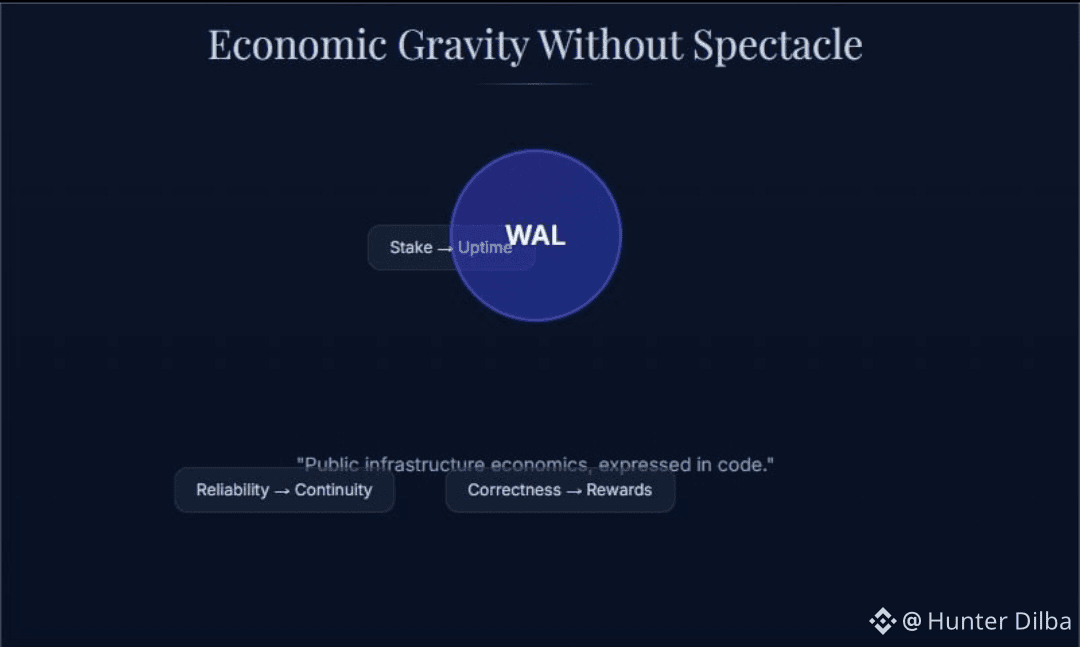
Conclusion: Systems That Do Not Vanish
Most crypto systems are built for events, whereas Walrus is built for what comes after.
After the launch.
After the hype.
After the creators leave.
After the applications are upgraded.
After the ecosystem alters its direction.
After the data loses its relevance.
Considering Walrus from this viewpoint, it is apparent that its primary merit is not the most recent tech. It is the most recent alignment with waiting periods. It doesn't demand trust. It builds itself to be present when trust is required.
In an industry obsessed with velocity, that lack of trust is the most significant concern with Walrus.