
Privacy has always sounded like freedom in crypto. The idea that you can move value without anyone watching feels powerful, especially for people who came into this market early. But after years of watching projects rise, struggle, and disappear, one truth is becoming harder to ignore. In real financial systems, proof matters more than disappearing completely. And that shift is exactly where Dusk is quietly positioning itself.
Most blockchains started by assuming transparency was enough. Every transaction visible, every balance traceable. For speculation, that worked. For real finance, it didn’t. Institutions, funds, even serious long-term investors do not want their positions, strategies, or counterparties exposed on a public ledger. At the same time, regulators are not willing to accept systems that cannot prove basic legitimacy. This is where many privacy chains hit their wall.
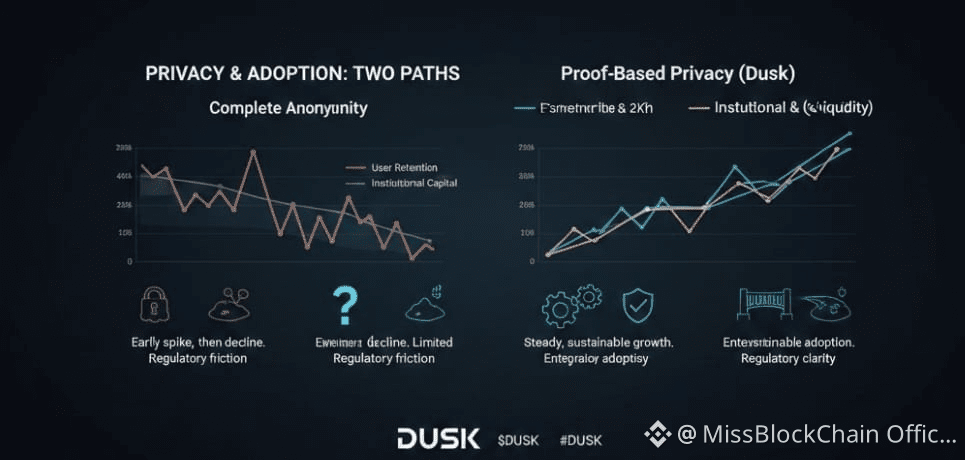
Complete anonymity sounds ideal until it starts limiting who can participate. When a network cannot show that transactions follow legal and financial rules without revealing sensitive data, exchanges become cautious, institutions stay away, and liquidity remains thin. Over time, users drift away not because the tech is bad but because the ecosystem never grows up and this is the retention problem privacy chains rarely talk about.
Dusk approaches privacy from a different angle. Instead of trying to hide everything forever, it focuses on cryptographic proof. Transactions remain confidential, but the system can still prove that rules are followed and this difference sounds subtle, but it changes everything. With zero-knowledge proofs built into the core design, Dusk allows someone to demonstrate that a transaction is valid, compliant, and properly structured without exposing identities or financial details.
This matters more than most traders realize. Markets are not just charts and price action. They are trust networks. Liquidity comes from participants who feel safe operating at scale. When funds, asset issuers, and financial institutions look at a blockchain, they ask one question first: Can this system protect sensitive data while still standing up to audits and regulation? Dusk was built to answer yes.
The technical architecture supports this philosophy. Privacy is not bolted on later. It is native. Confidential smart contracts, private asset issuance, and selective disclosure are part of the base layer. Instead of forcing users to choose between privacy and legitimacy, Dusk treats proof as the bridge between the two.
A simple real-life comparison helps. Imagine two marketplaces. In the first, no one knows who anyone is and there is no way to verify if trades are legal. Activity may spike early, but serious participants eventually leave. In the second, participants remain private, but the system can prove trades meet regulatory standards when required. Over time, the second marketplace attracts deeper capital, more stable activity, and long-term users. Dusk is clearly building the second type.
Recent network developments reinforce this direction. Mainnet has been live since January 7, 2026, DuskEVM mainnet activated shortly after, Hedger Alpha is live enabling confidential yet auditable transactions, and the NPEX partnership is progressing toward DuskTrade (launch planned for 2026) to bring €300M+ in tokenized securities on-chain compliantly. These are not speculative experiments; they are deliberate steps toward real-world financial use cases.
From an investor’s perspective, this design choice reduces risk in an understated way. Networks that rely on absolute anonymity face constant uncertainty around access, listings, and legal pressure. Networks built around proof can adapt. They can integrate with traditional finance without sacrificing their core values. That adaptability is often what determines which projects survive multiple market cycles.
There is also an emotional layer to this shift. Many early crypto users associate regulation with control and loss of freedom. That fear is understandable. But proof does not mean surrender. It means maturity. It means building systems that protect individuals while allowing the broader economy to interact safely. Dusk does not reject privacy ideals. It refines them into something sustainable.
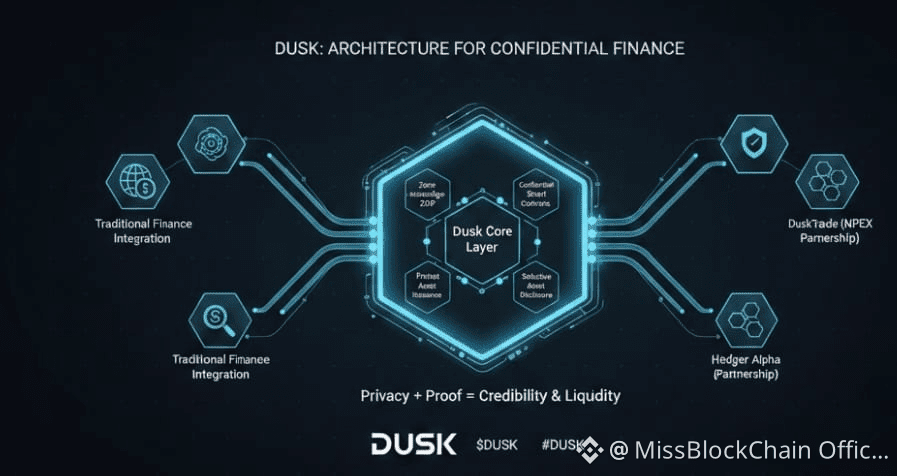
Retention is where this becomes visible. Users stay where there is liquidity, development, and relevance. Developers build where there is clarity. Capital flows where risk is understood. Privacy chains that ignore this reality struggle to keep momentum. Dusk’s emphasis on proof creates an environment where users can remain private without isolating themselves from the financial world.
The broader trend is clear. Markets are moving toward privacy with accountability. Traders may not see it on a daily chart, but it shows up in who is building, who is partnering, and who is willing to commit long-term resources. Dusk sits squarely in that transition zone, not chasing extremes, but solving the problem most projects avoid.
If you are evaluating privacy-focused assets, it is worth looking beyond surface narratives. Ask how privacy is achieved. Ask whether the system can prove compliance without exposing users. Ask whether institutions could realistically operate there five years from now. These questions matter more than slogans.
Dusk’s approach suggests a future where privacy is not about hiding from the world, but participating in it on your own terms. That distinction may not move prices overnight, but it is exactly the kind of foundation that outlasts market cycles.
In a space where many projects promise invisibility, Dusk quietly focuses on credibility. And in real financial systems, credibility is what keeps people coming back.