
When blockchains talk about payments, the discussion usually starts with speed.
Transactions per second, confirmation times, and throughput dominate the narrative. But for real-world payment systems — especially those built around stablecoins — speed alone is not enough.
Banks, enterprises, and payment operators don’t adopt infrastructure that works most of the time. They require systems that behave predictably under pressure, recover cleanly from failures, and provide clear guarantees around execution and finality. In practice, payments demand operational guarantees, not just performance metrics.
Why Speed Alone Fails in Production
High throughput looks impressive in benchmarks, but payment systems operate in live environments with real consequences. Network congestion, fluctuating fees, re-organizations, or inconsistent execution logic quickly turn “fast” chains into unreliable ones.
For merchants settling invoices, payroll providers distributing salaries, or remittance services handling cross-border flows, unpredictability introduces operational risk. Delays cause reconciliation issues. Variable fees break cost models. Unclear finality undermines trust.
In payments, consistency comes before speed.
What Operational Guarantees Actually Mean
Operational guarantees are concrete system properties, not marketing language:
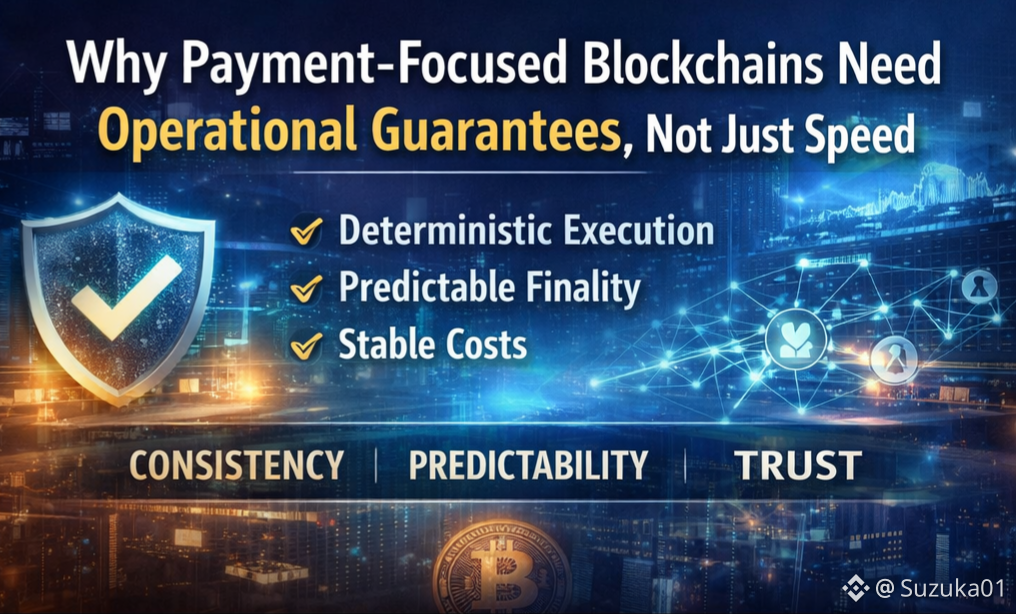
Deterministic execution — the same transaction always produces the same outcome
Predictable finality — clear and stable confirmation timelines
Stable cost structure — no surprise fee spikes
Defined failure behavior — errors are handled consistently
Without these guarantees, payment systems remain experimental.
Plasma’s Payment-First Design
Plasma approaches stablecoin infrastructure from a different starting point. Instead of adapting a general-purpose blockchain to payments, it is designed around stablecoin transfers as a primary use case.
This focus drives key architectural choices: controlled execution environments, deterministic processing, and infrastructure optimized for sustained transaction volume rather than short-lived spikes. Gasless USDT transfers further remove cost uncertainty, allowing businesses to operate without constantly managing fees.
The goal is not peak performance — it is predictable behavior.
Separating Execution From Settlement
A core design choice in Plasma is the separation between execution speed and settlement guarantees.
Transactions are executed in an environment optimized for determinism and throughput, while cryptographic checkpoints are anchored to Bitcoin. This allows Plasma to deliver fast, reliable user-facing performance while preserving long-term security and auditability.
For payment systems, this balance matters: quick confirmations for operations, backed by immutable settlement records.
Bitcoin Anchoring as an Operational Backstop
Anchoring transaction history to Bitcoin is not a branding exercise. It acts as an operational backstop.
In enterprise and regulated environments, historical integrity is critical. Audit trails must be tamper-resistant, and disputes require verifiable records. By committing checkpoints to Bitcoin, Plasma ensures transaction history cannot be altered without rewriting the Bitcoin ledger itself.
This adds an extra layer of assurance for high-volume payment flows.
Real-World Scenario: Payment Operators at Scale
Consider a payment processor handling thousands of stablecoin transactions per hour across regions. On congested networks, confirmation delays and unpredictable fees introduce friction at every step.
With Plasma, transactions finalize quickly and consistently. Execution remains deterministic. Costs stay stable. Operators don’t need complex fallback logic or constant monitoring of network conditions.
The system behaves like infrastructure, not an experiment.
Why Operations Teams Care More Than TPS
Developers often evaluate blockchains by tooling and flexibility. Operations teams evaluate them by failure modes.
They ask different questions:
What happens under peak load?
How predictable is settlement?
Can transaction history be audited months later?
How clean is reconciliation?
Plasma’s design directly addresses these concerns by prioritizing reliability and predictability over generalized flexibility.
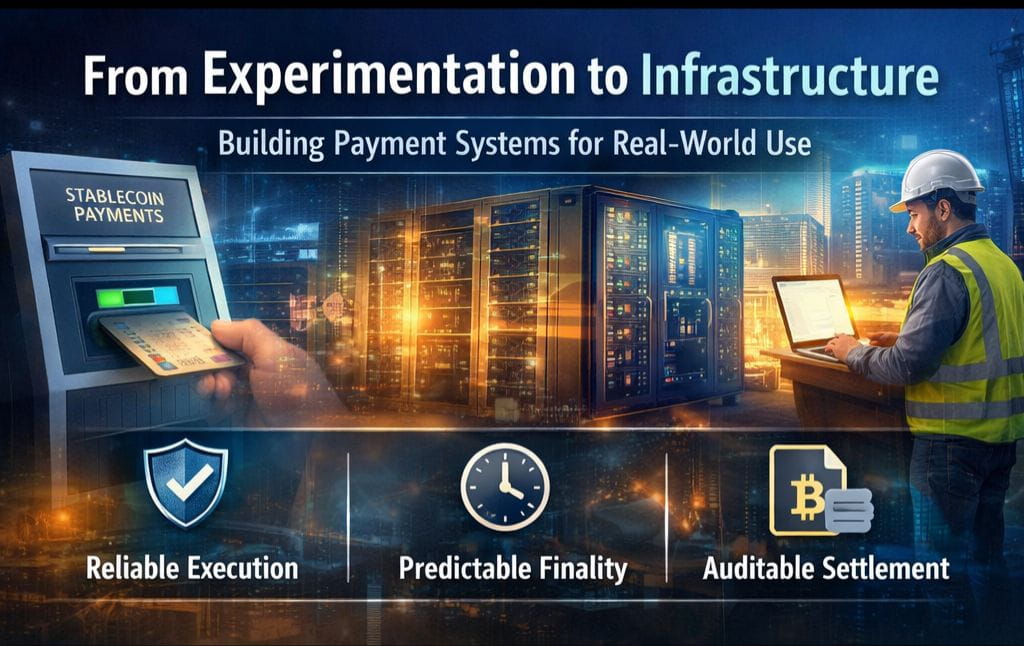
From Experiments to Infrastructure
For stablecoins to achieve real adoption, payment rails must feel dependable. Users should not need to understand consensus mechanics or network conditions to trust a transaction.
By focusing on deterministic execution, predictable finality, stable costs, and secure settlement, Plasma moves blockchain payments from experimentation to usable financial infrastructure.
CONCLUSION
Speed makes demos impressive. Operational guarantees make systems usable.
Plasma’s payment-first design shows that reliable stablecoin infrastructure is built not by chasing higher TPS, but by engineering consistency, predictability, and trust into every layer of the system.
That focus is what enables real-world adoption — and what separates payment infrastructure from experimental blockchains.

