
We are standing on the edge of a quiet revolution in the cryptocurrency space, one that is fundamentally changing who, or rather what, the primary user of a blockchain is supposed to be. For the last decade, every protocol, wallet, and decentralized application was built with a human being in mind. We designed interfaces for human eyes and optimized transaction speeds for human patience. But the next great wave of economic activity will not come from people tapping on screens; it will come from autonomous AI agents making decisions, executing trades, and settling payments on our behalf. In this new reality, the chains that survive will not just be the ones that are fast, but the ones that are intelligent enough to understand the intent behind the transaction. This is where Vanar Chain is quietly positioning itself as the inevitable infrastructure for this machine-to-machine economy.
To understand why Vanar is becoming the default choice for this shift, we have to look at the limitations of the current landscape. Imagine for a moment that you hired a brilliant financial advisor, but every time you walked into their office, they had absolutely no memory of who you were or what you discussed yesterday. You would have to re-introduce yourself, explain your financial goals from scratch, and provide your documentation all over again, every single time. This is exactly how legacy blockchains function today. They are powerful, secure, and often fast, but they are effectively amnesiacs. They record the transaction you make right now, but they retain no context, no history, and no understanding of why that transaction happened. For a human user, this is annoying; for an AI agent trying to execute complex, long-term strategies, it is a paralyzing dominance constraint.
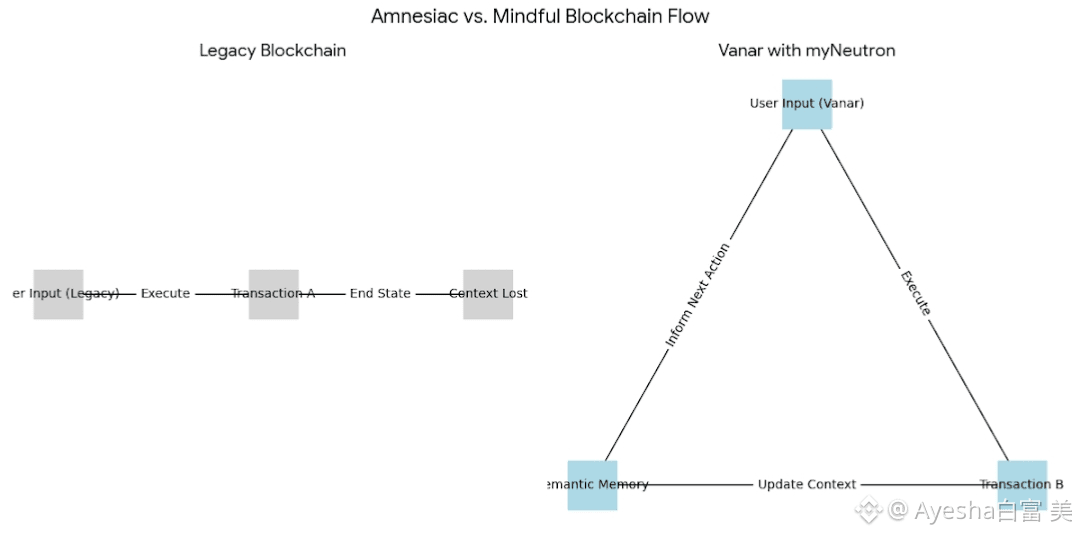
Vanar has taken a radically different approach by building what we might call a nervous system into the blockchain itself. Through its myNeutron layer, the network possesses semantic memory. Returning to our analogy, using Vanar is like finally meeting a financial advisor who not only remembers your name but recalls the conversation you had three months ago, understands your risk tolerance, and knows exactly how today’s decision fits into your five-year plan. This context is vital because AI agents require data continuity to function effectively. They cannot operate in a vacuum. By embedding this memory directly into the infrastructure, Vanar allows agents to retain their "thought process" on-chain, transforming the network from a simple ledger of cold numbers into a dynamic environment of context and reasoning.
This capability becomes even more critical when we talk about money. We often forget that AI agents, unlike chat bots, are economic actors. They need to pay for data, pay for computing power, and settle transactions with other agents. They do not have bank accounts, and they certainly cannot navigate the clunky, visual interfaces of traditional crypto wallets. They require a settlement layer that is compliant, frictionless, and logically sound. Vanar provides the rails for this automated commerce. Because the chain is built with tools like Kayon, which offers on-chain reasoning and explainability, an enterprise can trust an agent to handle funds. It ensures that when money moves, there is a verifiable logic trail behind it, providing the safety net that institutional players need before they let algorithms manage their capital.
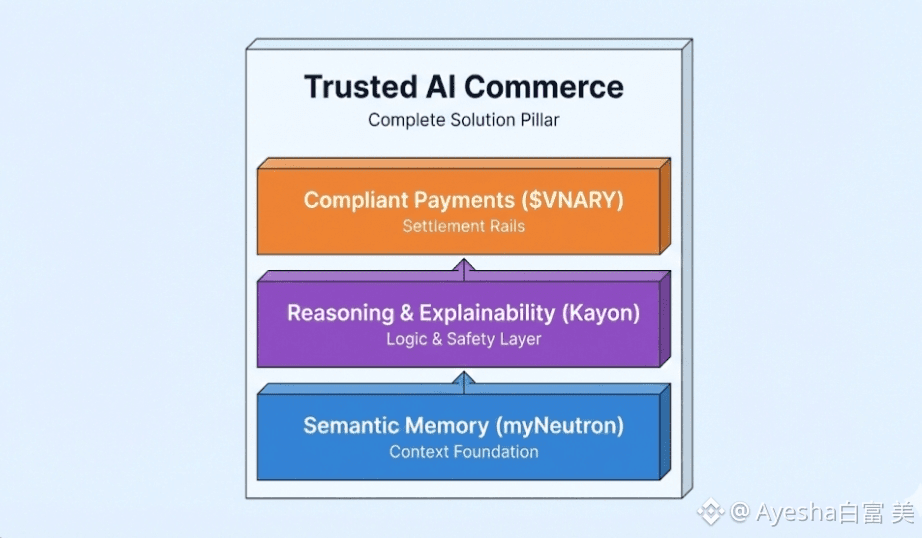
The beauty of this architecture is that it does not try to replace the entire Web3 ecosystem but rather seeks to upgrade it. With Vanar’s technology becoming available cross-chain, starting with integrations on Base, it is exporting this intelligence to where the liquidity already lives. It is acknowledging that while other chains might be excellent highways for traffic, Vanar provides the navigation system and the trusted banking infrastructure that allows the cars to drive themselves. We are moving away from the era of speculation and into the era of utility, where the most valuable networks will be the ones that can support the billions of micro-transactions generated by the AI workforce of tomorrow. Vanar is not just waiting for this future to arrive; it has already built the foundation for it.
