We’ve all been there. You click a link to an old article, a cool image, or a piece of history you bookmarked three years ago, and you’re greeted by the most annoying error code in existence: 404 Not Found.
For decades, the internet has had a memory problem. We treat it like a permanent library, but it’s actually more like a whiteboard—easily erased, controlled by a few massive companies (Amazon, Google, Microsoft), and fragile. If a server goes down or a company stops paying its bill, that data vanishes.
But in 2026, that narrative is finally flipping. Enter Walrus ($WAL), the decentralized storage network that isn’t just trying to compete with the cloud—it’s trying to replace the foundation of how we store the world’s digital history. And unlike the complicated, clunky crypto projects of the past, Walrus is designed to be the invisible infrastructure you actually want to use.
The "Blob" Revolution
At its core, Walrus solves a problem that plagued early blockchains: they are terrible at storing big things. Bitcoin and Ethereum are great for storing numbers (like your bank balance), but try to store a high-resolution video or a complex AI model on them, and you’ll either bankrupt yourself with fees or crash the network.
Walrus introduces the concept of "Blobs" (Binary Large Objects) to the decentralized world in a way that actually works.
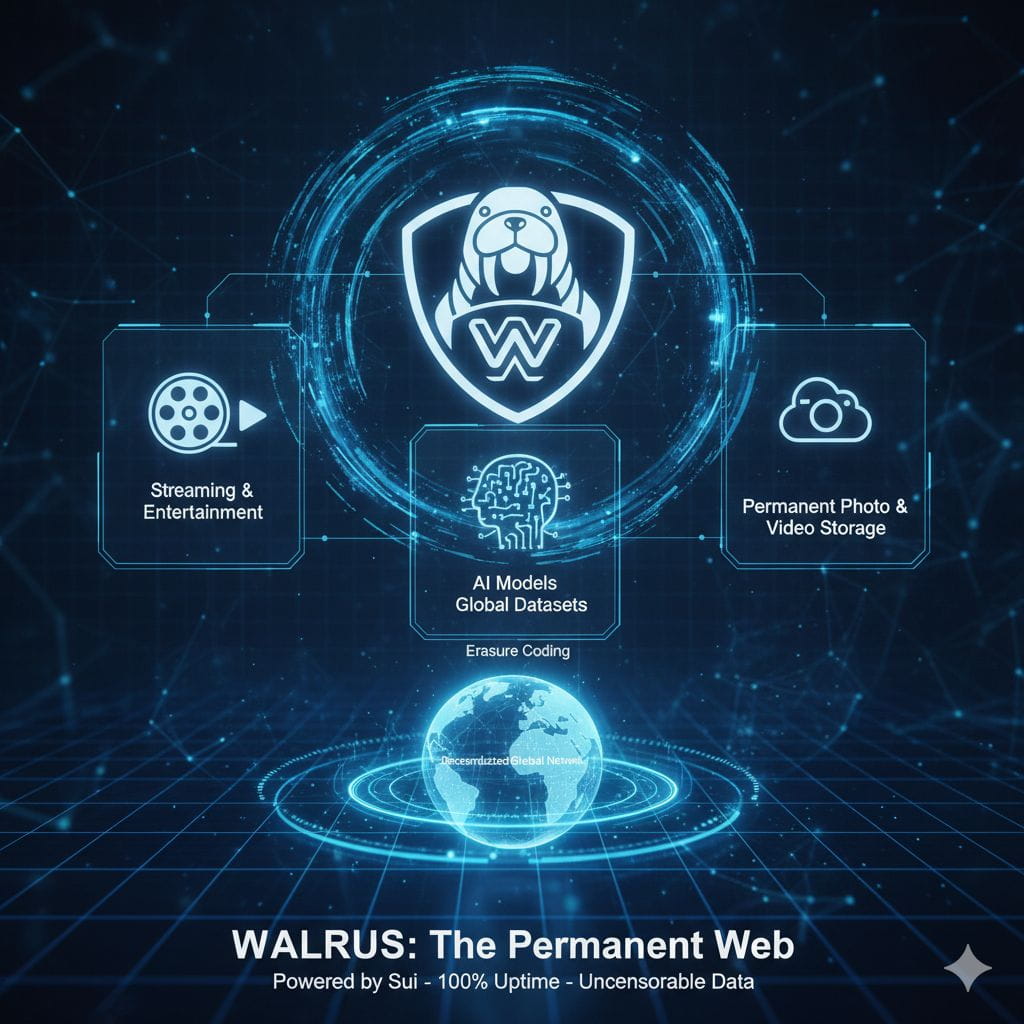
Think of traditional cloud storage like a massive warehouse owned by one guy. If he loses the key or decides he doesn't like you, your stuff is gone. Walrus is different. It takes your file—say, a 4K movie—and uses a technology called Erasure Coding (specifically their "RedStuff" algorithm).
Imagine taking a photograph, shredding it into 100 pieces, and scattering those pieces across 100 different safe houses around the world. But here’s the magic: you only need any 20 of those pieces to reconstruct the perfect, original photograph.
This means a massive chunk of the network could go offline, get hacked, or burn down, and your data would still be instantly retrievable. It is resilience by design.
The Sui Connection: Why Speed Matters
You can’t talk about Walrus without talking about its "big brother," Sui.
Walrus was built by Mysten Labs, the same team behind the Sui blockchain. In the past, decentralized storage (like Arweave or Filecoin) often felt isolated—great for archiving, but slow to interact with. Because Walrus is integrated directly with Sui’s high-speed smart contracts, your data becomes programmable.
For a user in 2026, this is huge. It means:
NFTs that never die: Your digital art isn't just a link to a Google Drive file that might break; the image itself lives on Walrus, forever bound to the token.
AI with a memory: As AI agents become more common, they need a place to store their learning models. Walrus gives them a cheap, neutral "brain" that no single corporation can switch off.
Streaming without buffering: Because of how efficient RedStuff is, Walrus is one of the first decentralized networks capable of streaming media smoothly, threatening the dominance of centralized CDNs.
The $WAL Token: The Fuel of the Library
So, where does the WAL coin fit in? It’s not just a speculative asset; it’s the utility bill for this new internet.
Storage Purchasing Power: To store data on Walrus, you pay in WAL. The protocol automatically adjusts pricing to ensure it remains cheaper than AWS or Google Cloud, creating a natural demand for the token as more apps are built.
Governance: WAL holders decide the future of the protocol. In a world where we worry about censorship, having the community control the rules of storage is vital.
Staking and Security: Node operators stake WAL to prove they are trustworthy. If they lose your data, they lose their stake. It’s a financial promise that keeps the network honest.
Why "Normal" People Should Care
You might be thinking, "I don't care about nodes or blobs; I just want my photos to be safe." And that is exactly why Walrus is winning.
For the first time, developers are building apps that feel like Web2—fast, easy, slick—but have the superpowers of Web3. You might use a photo backup app on your phone that looks like iCloud, but under the hood, it’s using Walrus. You pay a one-time fee to store your memories forever, rather than a monthly subscription that holds your data hostage.
The 2026 Outlook
As we look at the landscape in early 2026, the integration of Walrus has turned the "theoretical" value of crypto into "tangible" utility. We are seeing decentralized social media platforms where you own your posts, music streaming services where artists are paid directly without a middleman taking 30%, and scientific archives that can never be censored by a government.
Walrus isn't just a hard drive. It’s a declaration that in the digital age, memory should be public, permanent, and owned by the people who create it.
So, the next time you save a file, ask yourself: Is it in a warehouse owned by a corporation, or is it broken into a hundred unbreakable pieces, living freely on the Walrus network?
The future of memory is here, and it's decentralized.