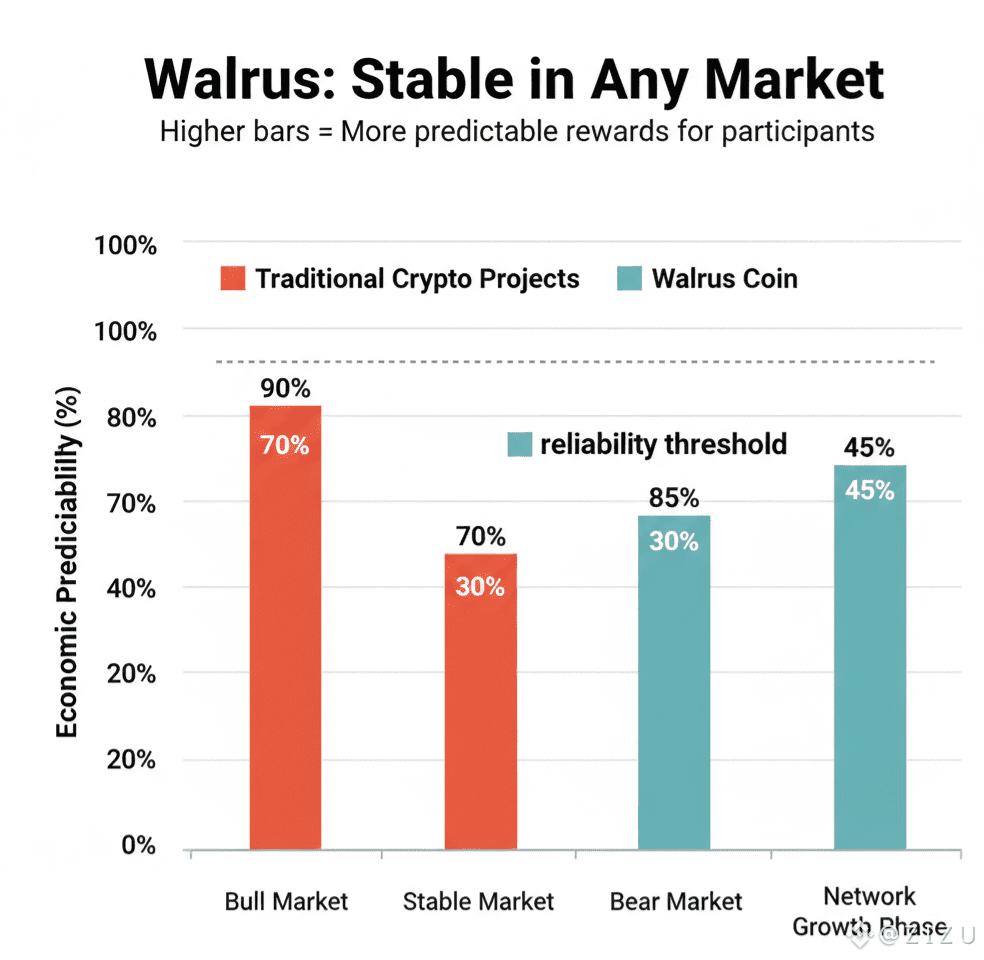
The cryptocurrency landscape is infamous for its unpredictability. From sudden price swings to hype-driven pump-and-dump cycles, volatility is often seen as the default state rather than the exception. Most projects, intentionally or not, design systems that thrive on speculation, early adoption incentives, or opaque tokenomics. While these mechanisms can drive short-term attention and growth, they often come at the expense of stability, usability and long-term viability.
This is why I find Walrus Coin particularly remarkable. Unlike the majority of crypto projects, Walrus places economic predictability at the core of its design. To me, this is not just a technical choice, it is a statement of intent. By tying rewards and incentives directly to meaningful, measurable contributions, Walrus creates a system where participants are rewarded for consistent behavior and real value creation, rather than timing the market or capitalizing on hype. For instance, storage providers earn based on uptime, reliability and correctness of their contributions, rather than on speculative factors. This alignment between effort and reward establishes an environment where participants can plan and operate with confidence, knowing that their input is recognized fairly and predictably.
One of the aspects I personally appreciate about Walrus is that economic predictability does not equate to rigidity. The system is designed to scale dynamically as storage needs expand. As demand grows, the protocol adjusts rewards and requirements in a way that maintains balance and avoids chaotic swings. This flexibility ensures that the network can evolve organically without sacrificing stability. From my perspective, this is a critical differentiator: many projects claim to support growth, but they often tie scaling mechanisms to speculative incentives, which inadvertently fuels volatility. Walrus, on the other hand, demonstrates that a network can expand responsibly while preserving economic integrity.
Volatility, especially in infrastructure-focused networks, can be more than just an inconvenience, it can be dangerous. When compensation fluctuates unpredictably, storage providers or other participants might feel compelled to cut corners, reduce reliability or exit the system entirely. In such scenarios, the network’s fundamental trustworthiness erodes, creating a fragile environment that is ill-suited for long-term adoption. Walrus addresses this challenge directly by designing incentives that reward sustained performance rather than opportunistic behavior. In my opinion, this principle is one of Walrus Coin’s most underappreciated strengths, yet it is arguably one of the most critical.
Another significant consequence of economic predictability is adoption. Developers, organizations and even other blockchain projects are more likely to build on top of a network when they can forecast costs, reliability and availability. With Walrus, the clarity of incentives and the transparency of the system make planning much simpler. I personally believe this predictability will play a pivotal role in driving adoption over time, as stability in core infrastructure is often a prerequisite for serious, real-world use cases. Unlike networks that fluctuate wildly with market sentiment, Walrus offers a foundation that developers can trust.
Ultimately, what sets Walrus Coin apart is its recognition that long-term network health requires more than technological innovation, it requires sound economic design. By prioritizing predictable incentives and tying rewards to tangible contributions, Walrus cultivates a resilient, scalable and trustworthy ecosystem. From my perspective, this combination of stability, fairness and utility is rare in the cryptocurrency space and represents a model for what infrastructure-focused blockchain networks should aspire to be.
In a market often dominated by volatility and short-term thinking, Walrus Coin reminds us that thoughtful economic engineering can safeguard the integrity of a decentralized system while simultaneously enabling sustainable growth. I see it as an example of how a well-designed protocol can move beyond hype and speculation to become essential infrastructure, networks that participants can rely on today, tomorrow and well into the future.