
Walrus can feel a little technical at first glance, but at its heart it is trying to solve a very human problem. We are creating more videos, richer apps, and larger datasets than ever before, and most of that lives on cloud servers that we simply have to trust. Walrus steps in as a storage focused protocol on the Sui blockchain and says that it will help you keep this data available, verifiable and affordable, while still letting you build the apps and communities you care about.
The WAL token is the fuel that pays for storage, secures the network through staking, and gives the community a voice in governance. You can think of Walrus as a shared library for large digital files and WAL as the membership card that keeps the lights on and the shelves full.
This is the same expert view as before, now told in a warmer and more approachable way, while keeping the depth and detail.
When we look at the project focus we see that Walrus is centered on one clear mission, which is making large data programmable and dependable. Instead of treating files as an afterthought, it puts storage at the center. Videos, game assets, application frontends, big datasets and training files are handled as blobs, which are large binary objects that the protocol knows how to protect. You can picture it like this. A developer wants to launch a social app where users share short videos. On a normal blockchain that is almost impossible because big files are expensive and slow to store. With Walrus, those videos become blobs that live in a storage network designed for that exact job, while smart contracts on Sui point to these blobs, manage access, and connect them to tokens, rewards or governance. The project is very intentional about its goals and it wants to make large data cheap enough that builders can use it without constant fear of fees, it wants to keep data available and verifiable even when some machines fail or misbehave, and it wants to treat storage as programmable so that people can build markets, rules and tools around data itself. There is a lot of deep research behind this, but the motivation is simple, because data should not be locked in a single company server and should instead live in a shared space that many apps and communities can trust.
Walrus fits into trends and conditions that many people can feel in their daily digital life. First, the web is moving from simple token transfers to rich and data heavy experiences, because decentralized apps now want to serve music, interactive frontends, in game assets and detailed analytics. Many teams quietly fall back to centralized storage because traditional blockchains are not built for all that weight, and Walrus catches those heavy files and keeps them in a shared and verifiable layer instead. Second, artificial intelligence is hungry for high quality data, and training sets, logs, and model outputs can quickly reach massive sizes. Projects need somewhere to put that data where everyone involved can check that it still exists, has not been tampered with, and can be shared under clear rules, and Walrus is designed to feel like home for those kinds of artificial intelligence driven data markets. Because Walrus runs on Sui but can be used by many ecosystems, it can become a quiet backbone that a lot of different projects lean on at the same time.
From a legal and regulatory view, Walrus is better understood as infrastructure than as a classic financial product. The protocol organizes how data is stored and proven, rather than running a central exchange or holding customer funds. The WAL token does introduce familiar questions of compliance and listing, especially for exchanges and institutional users, yet the presence of a formal foundation and backing from serious investors suggests that the team has taken regulatory conversations seriously and is trying to build something that can last, rather than a short lived speculative moment. For everyday users, the practical points are straightforward, because how you acquire and trade WAL will usually be governed by the rules in your region, the content you store may need to respect local data and content laws, and businesses building on Walrus should treat this as infrastructure analysis and still seek proper legal advice. The overall feeling is that Walrus aims to be a responsible piece of technology rather than a loop hole.
The privacy story is explained in a simple but layered way. Walrus is very honest about privacy, since by default blobs stored on Walrus are public and the protocol itself focuses on availability and integrity and wants to be sure that data stays there and stays correct. When privacy is needed, it is added in layers. A simple example helps. Imagine you want to store medical research records that should only be read by a small group. You would encrypt the files on your own device first and then upload the encrypted blobs to Walrus. The network keeps those blobs safe and available, but nobody can see the contents without the decryption keys. To make this easier, Walrus integrates with tools like Seal that help manage keys, access rules, and secret data on Sui, and that combination lets you create things like token gated content, private messaging, or paid data subscriptions without making the storage layer itself overly complex. The balance looks clear, because availability and metadata are open and auditable, content can be fully opaque to anyone without keys, and access rules can live on chain so users can see the policy even if they cannot see the data. This approach respects both transparency and confidentiality in an understandable way.
Trust in Walrus does not come from a big central server but from how the network is built. Blobs are sliced into many small pieces called slivers using a clever form of erasure coding, and those slivers are then spread across a large set of storage nodes. Even if many nodes vanish or act badly, the original data can still be reconstructed from the remaining pieces. Sui is used as the coordination layer that keeps track of which nodes should store which blobs, how long they should store them, and what they get paid, and it also records proofs that the nodes are actually holding the data they promised to hold. Economics and technology support each other, since storage operators receive rewards for doing honest work, WAL staking lets people back operators they believe in, and misbehavior can be punished so there is a cost to cheating. The result is a network where trust is earned through math, incentives and audits rather than simply by asking you to believe a brand.
The objectives, vision and people behind Walrus all point in the same direction. Walrus has a clear long view and the team wants it to become the neutral storage layer that lives underneath many different applications, chains and artificial intelligence systems. You can think of it as a quiet utility provider, like electricity or water, except for data. The objectives include making it easy for any developer to store and use big data in a programmable way, enabling new markets for data where ownership, revenue sharing and rules are transparent, and supporting communities that want their content to live beyond any one company or server. Mysten Labs, with its strong background in distributed systems and cryptography, helped shape the protocol, while the Walrus Foundation focuses on long term stewardship, funding builders, and guiding growth. That split shows a mature mindset, with research and protocol design on one side, and community and ecosystem care on the other. When a team sets out goals like this and supports them with patient research and ecosystem work, it sends a comforting message that they are here to build something that serves you for years, not just months.
Transparency and steady updates play a big part in how Walrus relates to its community. For many users, trust grows when they can see how a project thinks, and Walrus leans into this. The protocol is described in open technical papers that anyone can read, and documentation explains how the pieces fit together. Public updates share news about funding, partnerships and technical milestones. This openness helps three groups at once, because developers can understand how things really work, users can see that the project is moving and improving, and partners and exchanges can perform deeper due diligence. Instead of asking people to guess what is happening, the team makes a genuine effort to keep the story visible.
Community, support and a human touch are also central to how Walrus presents itself. Even the most elegant protocol fails if people feel lost when they try to use it, so Walrus tries to be approachable even with a very advanced core. Guides, examples and tools are written to show step by step how to upload blobs, reference them from smart contracts, or build simple frontends backed by Walrus storage. Community channels give builders a place to ask questions, share experiments, and learn from one another. You can imagine a new developer who is curious but unsure, starting with a simple sample project that stores images on Walrus, then using clear docs and a friendly community to move to more confident work with videos, datasets, or full application assets. That journey from confusion to confidence is something the project clearly appreciates and tries to support.
Security and reliability are presented as a calm backbone for your data rather than as flashy promises. Security in Walrus is about quiet and reliable guarantees. On the availability and integrity side, erasure coding and authenticated data structures work together so that data remains recoverable even when many nodes fail, clients can verify that the data they download matches what was originally stored, and storage challenges keep nodes honest even when networks are busy or slow. On the confidentiality side, Walrus encourages best practice rather than shortcuts, and sensitive content is encrypted before upload while tools like Seal help manage keys and access rules in a structured way. That means even if a storage node is compromised, the attacker sees only encrypted blobs and not raw user data. For builders and users this creates a sense of calm, because you know there is a clear story for availability, correctness and privacy, and you are not forced to rely on blind faith.
Scalability and integration are handled with the expectation that data volumes will grow dramatically. Walrus is designed with this growth in mind and instead of pushing every byte through a single bottleneck, it spreads the load intelligently. Blobs are sharded across many nodes and Sui is used mainly for coordination and payments, not for storing the blobs themselves. This means that as more users and applications arrive, the network can add more storage operators and capacity in a natural way. Integration is deliberately flexible, because on Sui blobs show up as native objects so smart contracts can use them directly, web developers can read content through familiar web style interfaces and combine Walrus with content delivery networks, and other chains and systems can treat Walrus as a storage back end and simply store references rather than copying data. This makes Walrus feel less like a closed island and more like a bridge between worlds.
Documentation and everyday support show quiet respect for the community. Good documentation is often an underrated sign of care, and Walrus does well here. The docs do not just list functions but walk you through concepts, security advice, practical flows and common patterns. There are sections aimed at people who are just exploring, and deeper parts for those who want to understand the finer points of encoding, recovery or integration. The combination of public papers, guides, example projects and community questions and answers gives users many ways to learn. Whether you prefer to read theory, copy a code sample, or ask another human directly, there is a path for you.
Innovation and research are not just words in a slide deck for Walrus, because the project quietly lives them. The encoding and storage protocols are based on serious work in distributed systems and the aim is to reduce storage overhead and bandwidth cost while still recovering data reliably when something goes wrong. This is not just about clever math for its own sake, it is about making real applications cheaper and safer. For example, using erasure coding allows Walrus to keep multiple effective copies of data without literally storing the full file many times, and when nodes fail, only the missing parts need to be recovered rather than the entire dataset. For someone running a data heavy app, that translates into lower costs and faster recovery when the unexpected happens. This blend of theory and real world benefit is one of the most admirable parts of the project.
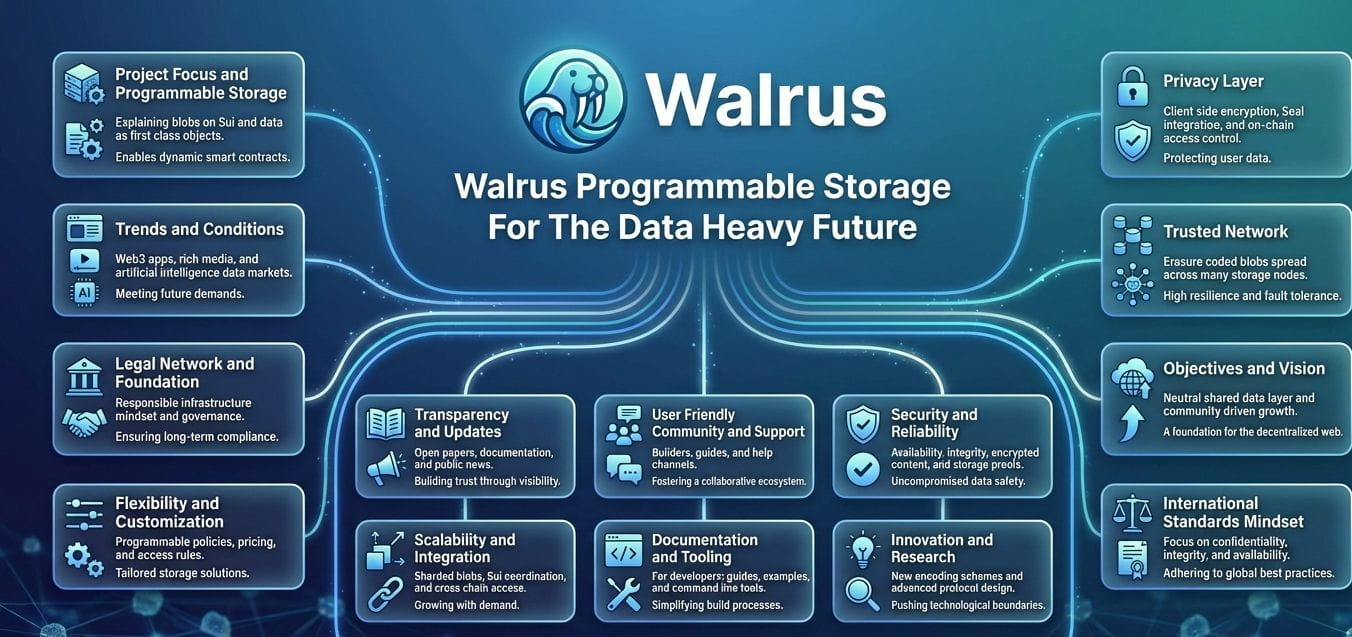
Flexibility and customization let Walrus meet different needs with grace. No two projects are the same, and Walrus respects that reality. Developers can choose different patterns for how long data should live, who can access it, and how it is monetized. Some communities may want permanent archives, while others might want content that expires. Some artificial intelligence projects may want complex revenue sharing for dataset usage, and others may want simple and open sharing. By treating blobs as programmable objects and offering tools to manage access and payment logic, Walrus lets these different stories coexist. Instead of forcing everyone into one rigid model, it gives them building blocks and sends the message that the network will support their design. This flexibility is especially valuable for international teams that must navigate different cultural norms, business models and regulations while still sharing a common storage layer.
The mindset regarding international standards and responsible practice is also clear. Even without waving a specific certificate, Walrus follows an approach that lines up with well known security and reliability principles. It clearly separates confidentiality, integrity and availability and gives a thoughtful answer to each one, it uses verifiable data structures to avoid trusting servers blindly, and it encourages client side encryption, which is a widely respected pattern for protecting sensitive information in shared environments. For organizations that care about compliance, this makes Walrus easier to evaluate, because the building blocks look familiar even if they are arranged in a fresh way for the world of decentralized storage and programmable data.
Perhaps the most reassuring thing about Walrus is that its long term vision, quiet growth and stability feel genuine. The presence of a dedicated foundation, ongoing research, and careful ecosystem building all point to a long term mindset. Growth is expected to be steady rather than explosive, and as more projects in media, artificial intelligence and finance discover that they need affordable and trustworthy blob storage, Walrus can quietly absorb that demand. WAL as a token then reflects real usage of the network, not just speculation. The vision is simple and comforting, since Walrus wants to become part of the invisible infrastructure that lets people build ambitious apps without being held hostage by a single cloud provider. If that happens, millions of users may benefit even if only a small fraction of them ever learns the protocol name.
When you step back, several qualities make Walrus truly special. It treats large data as a first class citizen rather than as an afterthought, it combines serious research with simple and honest explanations, it respects privacy by design using encryption and access control where they make sense, it invites developers and communities in with clear docs, examples and real support, and it is structured for long life with a foundation and ecosystem that care about stability. For readers and builders, the message is encouraging. If you are dreaming about apps, communities or artificial intelligence systems that depend on heavy data, you do not have to choose between central cloud comfort and pure decentralization pain, because Walrus and WAL offer a middle path where storage is programmable, reliable and shared, and where your work and your users are genuinely respected.


