
Imagine your body's circulatory system, but with a critical flaw. Sometimes, a drop of blood takes three seconds to travel from your heart to your fingertip. Other times, it takes three hours. You'd never know if oxygen would arrive on time. Survival would be chaotic, and complex activity would be impossible.
This is the challenge institutions face in a blockchain ecosystem without Predictable Finality. It’s not just a technical metric; it's the reliable plasma of the digital economy—the essential medium that carries, secures, and settles value with unwavering certainty. For traditional finance to truly flow into crypto, they need a system they can trust not just with their assets, but with their ledgers, their regulators, and their reputations.
1. Beyond Confirmation: Finality as a Financial Constant
In the physical world, a settled payment is absolute. In crypto, "settlement" has been a spectrum. You might have 95% confidence after six blocks, but for a multi-billion dollar institution, 95% isn't a grade—it's a catastrophic risk.
Predictable Finality changes the game by providing a time-certain, mathematically-guaranteed point of no return for a transaction. It’s the moment when a transaction is irrevocably etched into the ledger's history. This isn't about speed alone; it's about guarantee. It transforms blockchain from a promising experiment into a dependable settlement layer.
2. The Institutional Trifecta: Compliance, Accounting, and Reconciliation
This guaranteed settlement unlocks three fundamental pillars for institutional operation.
Compliance & Audit Trails You Can Take to Court: Regulatory frameworks like the EU's MiCA and operational standards like Anti-Money Laundering (AML) demand immutable, verifiable audit trails. With predictable finality, the "effective settlement time" becomes a hard timestamp. An auditor or regulator can pinpoint the exact moment an asset changed hands, creating a compliance narrative as robust as those in traditional markets. It turns blockchain data from helpful evidence into legally defensible fact.
Accounting Clarity: Moving Beyond "Intangible Assets": Today, many institutions struggle with crypto accounting. Under standards like U.S. GAAP, volatile cryptocurrencies are often treated as indefinite-lived intangible assets, while the treatment of stablecoins hinges on redemption rights and reserve quality. This creates foggy balance sheets. Predictable finality cuts through this fog. When settlement is guaranteed and instantaneous for accounting purposes, it clarifies the nature of the asset held. It strengthens the argument for treating certain digital assets (like payment stablecoins used for settlement) closer to cash equivalents or financial instruments rather than vague intangibles. This is crucial for accurate financial reporting and investor confidence.
The End of the Reconciliation Nightmare: In traditional finance, teams spend nights and weekends reconciling ledgers between banks, custodians, and internal systems. Each party's "state of truth" is slightly out of sync. A blockchain with predictable finality provides a single, shared, and time-certain state of truth. When an institution knows transaction X was finally settled at 14:23:05 UTC, every internal and external system can align to that moment. The costly, error-prone process of reconciliation evaporates, replaced by real-time ledger alignment.
Visualizing the Flow: From Chaos to Certainty
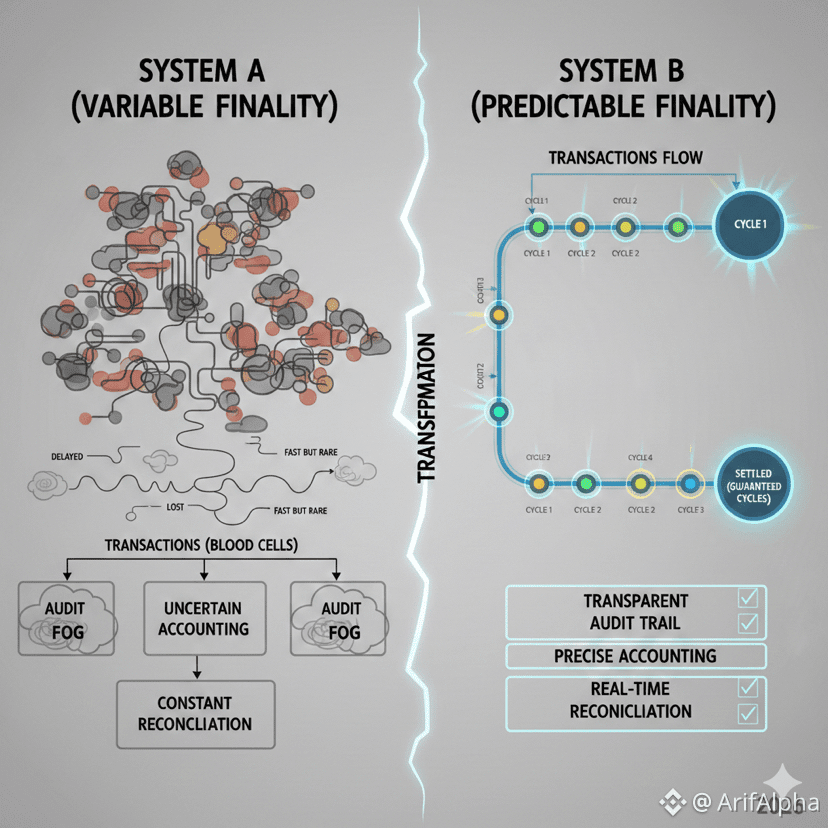
To understand the transformative effect, consider this analogy comparing a system with unpredictable settlement to one with predictable finality.
System A (Variable Finality): Like an unpredictable circulatory system. Transactions (like blood cells) move erratically. Some arrive quickly, others are delayed. The system is functional but unreliable for complex, time-sensitive operations. It creates audit fog, accounting uncertainty, and constant reconciliation work.
System B (Predictable Finality): Like a healthy, rhythmic circulatory system. Transactions flow predictably and are settled in guaranteed cycles. This creates a transparent, audit-ready trail, allows for precise accounting treatment, and enables perfect, real-time reconciliation between all parties.
3. Building on a Foundation of Trust
For institutions, trust is not given; it's engineered. Predictable finality is a core engineering principle for that trust. It enables:
Automated, Risk-Free Treasury Operations: Corporations can programmatically manage crypto assets with precise settlement windows.
Real-Time Collateral Management: DeFi lending and borrowing can serve institutional clients when collateral movements are guaranteed, not just probable.
Regulator Confidence: Clear settlement timelines make supervisory oversight simpler and more effective.
The Path Forward: Integrating the Vital Sign
Adopting this isn't just about choosing a blockchain; it's about integrating a new vital sign into the institution's financial health monitor. The questions evolve from "Is the network fast?" to "Is the finality timebound and guaranteed?" Portfolio dashboards won't just show asset prices, but will track settlement finality status as a key metric of system health.
The promise of blockchain for finance was never just about removing intermediaries. It was about creating a more efficient, transparent, and trustworthy foundation for global value exchange. That foundation cannot be built on probabilistic settlement. It requires the certainty, the rhythm, and the reliability of predictable finality—the true lifeblood of institutional crypto.
What’s the first operational process in your organization that would be revolutionized by having a single, time-certain source of truth for transactions? Share your thoughts below.
#PredictableFinality #InstitutionalCrypto #Web3Education #CryptoEducation #ArifAlpha