

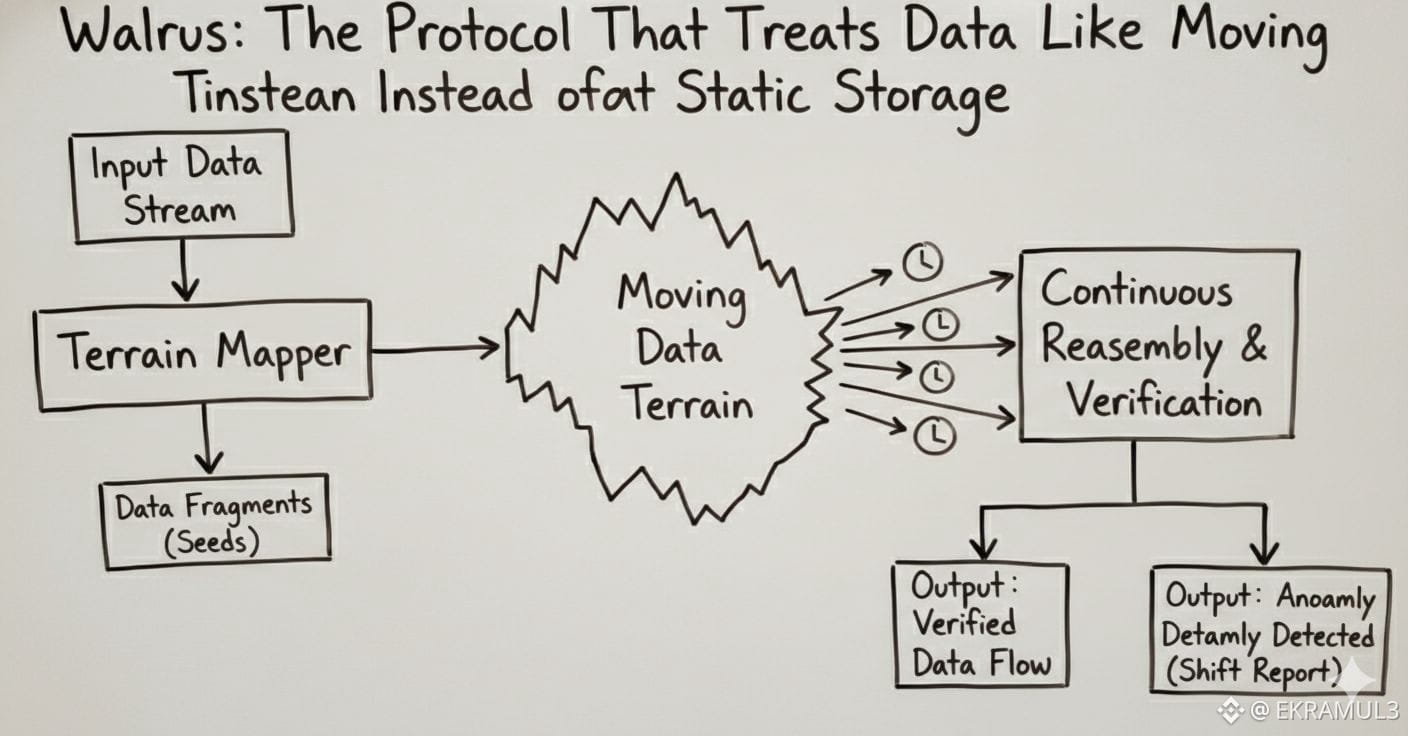
 Most blockchain systems still imagine data as something that gets written once and then sits there forever like an archived PDF collecting dust. But modern applications do not behave like that. AI workloads shift. Social graphs expand. NFTs update their metadata. Games generate temporary assets. Enterprises produce audit trails that need to survive across execution cycles. In this reality, data is not furniture you store somewhere; it’s terrain that changes shape with time and usage.
Walrus embraces this reality. Instead of forcing developers to choose between “store permanently” or “store off-chain and hope nothing breaks,” Walrus introduces a storage layer on Sui where data can evolve, renew, expire and be re-verified over time. This makes storage more like a managed runtime process than a passive warehouse.
Static Storage vs. Moving Terrain
Traditional decentralized storage solutions treated storage as a one-time event: pay once, upload once, replicate heavily, hope operators keep serving it. Walrus flips the model. It introduces leasing and renewal as native mechanisms. Data remains available not because someone promised longevity, but because a renewable economic contract continues to justify its existence.
This approach changes incentives. Storage operators earn as long as data remains relevant. Users pay as long as the data continues to matter. When data loses value, it can gracefully expire instead of being subsidized forever. Permanence becomes a choice, not a burden.
Terrain Explains Why Time Matters
Terrain moves with external forces. In data systems, those forces are:
usage frequency
update cycles
economic value
application context
regulatory retention windows
Walrus allows developers to match storage duration to these forces. AI datasets might need five months of persistence. NFT metadata might need eight years. Chat logs might need two days. Permanent archiving is not always desirable; sometimes it’s wasteful.
By treating data as terrain, Walrus acknowledges a missing realism in decentralized infrastructure: useful data has a lifespan.
Storage as Process, Not Object
The real innovation is not storage itself, but continuous verification. Walrus enforces data availability using cryptographic proofs submitted over time. Operators stake WAL tokens, renewals trigger fee flows and failures produce penalties. This transforms data persistence from a background assumption into a supervised protocol function.
Sui plays a critical role here. Instead of storing the data itself, Sui stores:
proof schedules
access rights
ownership metadata
lease status
penalty triggers
This relationship resembles an operating system managing memory: the OS doesn’t hold the full data, it orchestrates access and guarantees.
Why Moving Terrain Matters for Application DesignThis model unlocks new application classes that were blocked by rigid storage assumptions:
AI-native apps need checkpoint persistence
Social systems need continuity without permanence
Stateful games need resumable assets
Enterprise systems need verified retention windows
Data markets need auditable supply
NFT ecosystems need mutable metadata
Without a terrain-like approach, developers are forced back to centralized cloud hosts or data silos, destroying the purpose of decentralization.
Economic Alignment is the Real Breakthrough
Walrus ensures:
operators earn for persistence
leases create predictable continuity
proofs enforce accountability
WAL becomes a unit of retention cost
expiry reduces network burden
This turns persistence into an economically measurable resource class the same way compute, blockspace and I/O became resource classes in traditional computing.
Why This Signals a Shift for Sui
Sui already solved high-performance execution. What it lacked was residency the ability for data to stay alive beyond a transaction window. Walrus supplies that missing cold-memory layer, making Sui feel less like a blockchain and more like a platform capable of sustaining long-lived applications.
Moving from static storage to dynamic terrain is not just a metaphor it marks the point where blockchains stop recording events and start hosting systems.


