


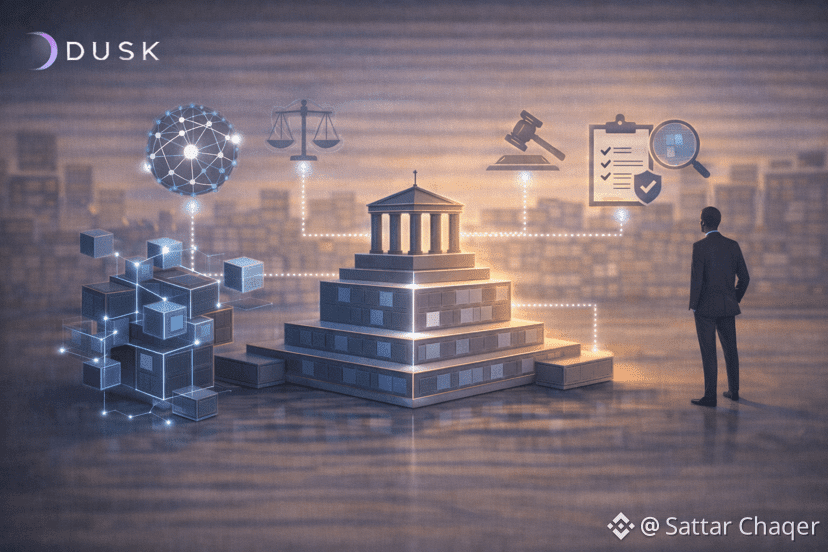
One of the quiet failures of many blockchain systems is not technical. It’s interpretive.
They work on-chain, but they become difficult to explain off-chain — to regulators, auditors, legal teams, or institutions that need clarity before they need decentralization. When interpretation fails, adoption stalls, no matter how advanced the technology is.
Dusk was built with this problem in mind.
From the beginning, Dusk assumes that its actions will need to be explained to parties that do not speak crypto. Courts, compliance officers, regulators, and financial institutions do not evaluate systems based on ideology. They evaluate them based on behavior, guarantees, and accountability.
This shapes the architecture.
In traditional finance, systems are designed to be legible under review. Transactions must be traceable without being publicly exposed. Rules must be enforceable without manual intervention. Privacy must exist alongside auditability, not instead of it.
Public blockchains broke this balance by making transparency absolute. Everything is visible, but not necessarily understandable. Raw data is public, yet interpretation becomes harder, not easier. This creates friction in regulated environments, where clarity matters more than openness.
Dusk does not try to solve this with dashboards or permissions layered on top. It approaches the issue at the protocol level.
Instead of exposing raw transaction details, Dusk focuses on proofs. Instead of asking participants to explain themselves after the fact, the system is designed to demonstrate compliance as it operates. This shifts interpretation from human judgment to cryptographic verification.
That difference matters.
A system that relies on interpretation is fragile. It depends on trust, context, and consistent human behavior. A system that produces verifiable outcomes reduces ambiguity. When questions arise, answers are already embedded in how the system works.
This is especially important for tokenized assets.
Real-world financial instruments come with obligations that extend beyond the network. Ownership creates rights. Transfers create liabilities. Issuance creates disclosure requirements. If a blockchain cannot express these realities clearly, it becomes unsuitable for serious use, regardless of performance.
Dusk assumes that decentralization alone is not enough. Decentralized systems still need to be interpretable under law.
This is why Dusk often avoids extremes. It does not push radical transparency, and it does not hide activity behind opacity. It operates in the space where actions can be private, but outcomes can still be verified and explained.
That balance makes the system less permissive, but more durable.
Many blockchains optimize for permissionlessness and composability, trusting that interpretation can be handled later. Dusk assumes the opposite: if interpretation is not built in, the system will be rejected before it ever matters.
This is not a philosophical stance. It is a practical one.
Financial infrastructure does not succeed because it is exciting. It succeeds because it behaves predictably when reviewed by people who are trained to find flaws.
Dusk was built to survive that review.