
A good chain should feel like a good lift.
You press a button, the door shuts, you arrive. You do not stare at a timer. You do not wonder if the lift heard you. The best lift is the one you stop noticing.
Many on-chain apps still feel like the opposite. Tap, wait, refresh, wait again. That gap is small on paper, but huge in the mind. In games, it breaks flow. In shops, it breaks trust. In apps that need quick feedback, it breaks the habit loop.
Vanar Chain aims to shrink that gap to something most people accept without thinking. Three seconds is not a magic trick. It is a clear choice with a clear goal, make actions feel close to real time, while keeping the tools and code builders already know.
This is for builders, product leads, and token holders who want to judge what “3-second blocks” really means, why it matters, and how Vanar tries to reach it without forcing teams into a full rewrite.
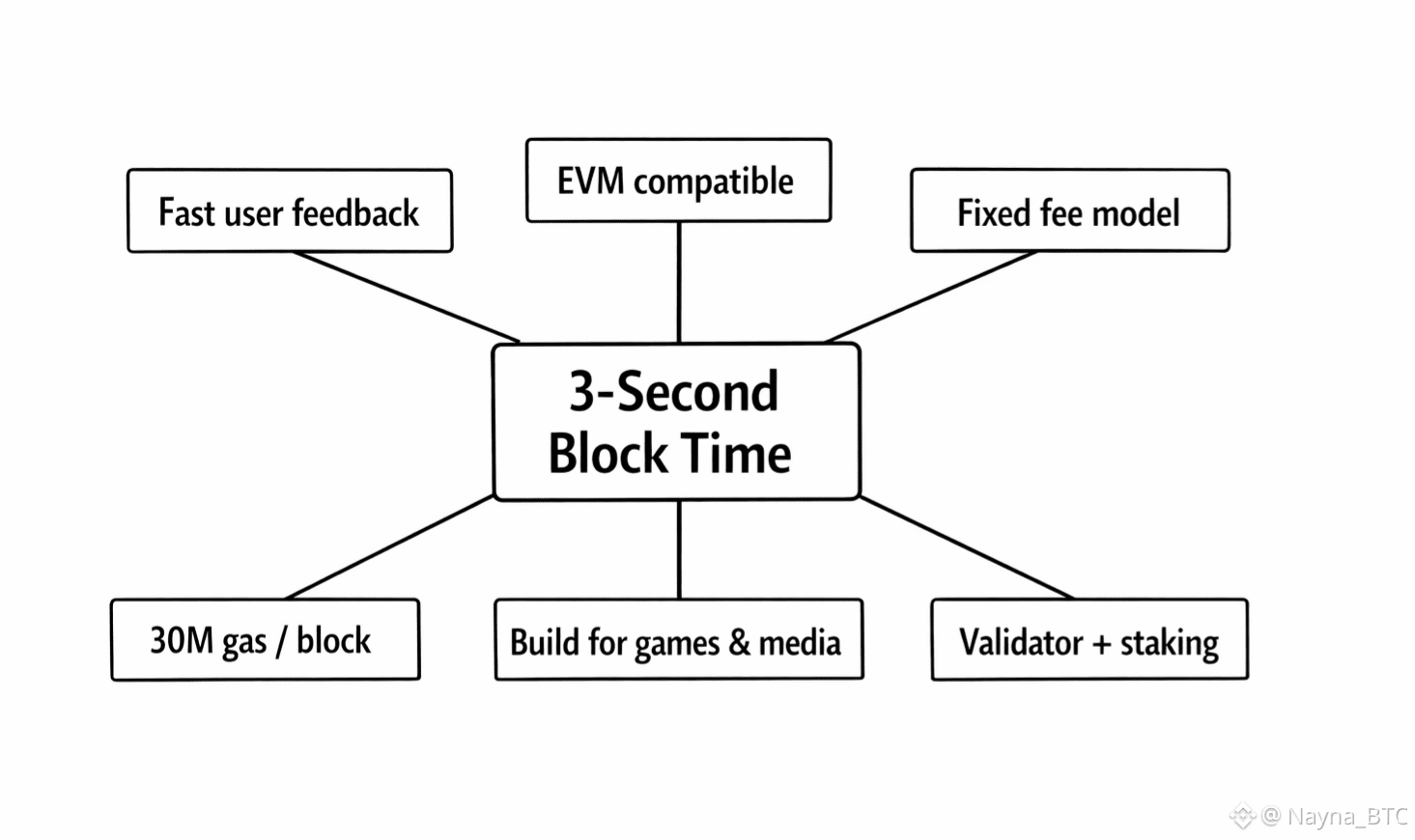
Why 3 seconds is a product choice, not a trophy
Speed is only useful when it removes doubt.
Doubt shows up in plain moments: A player buys an item, but it does not show up right away. A creator mints an asset and wonders if it worked. A user signs a prompt and then stares at a spinner with no idea what is next. A brand runs a drop and needs “yes or no” fast, or the funnel dies.
A shorter block time tightens that loop. It cuts the time between an action and proof. In practice, it also changes how teams build. When the chain answers faster, apps can rely less on “maybe it will land soon” tricks and more on real state updates.
Three seconds is also a sane target. It is quick enough to feel smooth, but not so extreme that every part of the system must be rebuilt from scratch.
The trade most people miss, faster blocks stress the whole system
Block time is not one knob. When blocks arrive more often, the network must handle more frequent updates, more chances for small timing gaps, and more pressure on how nodes share new blocks.
This is where many “fast chain” stories fail. They chase a number, then quietly drop dev comfort, or change core rules so much that ports turn into rewrites.
Vanar’s path is different. It stays EVM compatible, then tunes the parts that shape user wait time and fee feel. That mix matters. If a chain is fast but fees swing hard, the app still feels unstable. If fees are steady but blocks are slow, the app still feels sleepy.
Vanar pairs its 3-second block target with design choices meant to keep both speed and cost usable for real apps: a higher gas limit per block to handle more work in each block, and a fixed-fee model meant to keep costs more steady in dollar terms. The point is not to claim “endless scale.” The point is to keep the user feel steady under normal use.
Performance without giving up EVM comfort
When builders hear “compatible,” they usually mean one thing: “Will my stack work?”
Vanar focuses hard on that question. The chain is built in a way that aims to keep smart contracts and tooling in the same family many teams already use. That lowers friction. It also protects past work: audits, libraries, and battle tested patterns still matter.
Compatibility is not only about code that compiles. It is also about the small rules that shape real outcomes: How are tx ordered when things get busy? How does the fee model behave under load? Do common tools behave the way builders expect?
Vanar’s fixed-fee approach also links to ordering and fairness. When fees are not set by a bidding war, the chain can lean more on clear ordering rules. That may sound like a minor detail, but ordering rules shape how fair the chain feels in the moments users care most, big drops, busy games, and crowded mints.
What three seconds changes for the user
The main win is not “faster blocks.” It is fewer broken moments.
When feedback comes fast and often, users stop second guessing. They stop retrying. They stop leaving the screen to check if something happened. That changes churn.
Where the 3-second rhythm shows up most
- A wallet action feels like a short pause, not a long wait.
- A mint flow feels like “done,” not “did it fail?”
- In-game actions can settle in the same beat as play.
- Shops and ticket style apps can confirm a buy before the user loses focus.
- Small actions start to make sense when fees stay steady enough to plan around.
This is where Vanar’s speed and fee stance link together. Three seconds alone is not enough. The chain also needs costs that feel stable, or users will still hesitate.
VANRY, and why block time ties into token design
Speed turns into token design the moment you ask: who pays for block space, who secures the chain, and how do rewards work when blocks come often?
VANRY is the gas token on Vanar. That matters because every design choice about block time, fees, and rewards runs through the gas token.
Vanar also sets a max supply figure and a long issuance plan where new tokens are released over time through block rewards. The way rewards are planned, including how much goes to validators and other parts of the system, is built to fit the chain’s block rhythm. Fast blocks mean more blocks, so the reward math must be tuned to that pace, not copied from a slower network.
Vanar also links staking to chain roles. Community staking is tied to validator selection and voting, which connects token holders to how the network is run.
The practical takeaway is simple: VANRY is not a side asset. It is the fuel, and it is part of the chain’s long-run balance.
A clear start for validators, with a path for growth
Vanar describes a hybrid model that starts with a more guided validator set and also includes a path for outside validators through a mix of track record and community choice.
For teams shipping real apps, that clarity matters. It tells you what the chain is optimizing for in the near term: uptime, clean ops, and steady block output. It also signals how the network plans to widen over time.
You can see that idea in action when known node ops join as validators. That is not the only signal that counts, but it is a real one.
Day two reality, fast blocks change ops work
Porting code is day one. Running in prod is day two.
Three-second blocks can change the pace of your whole pipeline: Indexers process blocks more often. Alerts need to catch issues sooner. Apps that wait “N blocks” must rethink what N means. If fees are tied to token price, the update loop must be solid.
Vanar’s fixed-fee design depends on that kind of plumbing. If the chain aims to keep fees steady in dollar terms, it needs a clean way to track price and update fee values at set times. That is not marketing. That is a piece of the machine that must keep working when traffic spikes.
What builders should verify before shipping
- Your contracts behave as expected under EVM rules, with no odd edge cases.
- Your indexer and backend can keep up with a quicker block stream.
- Your app UX treats confirms as a short loop, not a long wait.
- Your fee logic matches the chain’s fixed-fee model, so quotes stay stable.
- Your “wait N blocks” logic is set with time in mind, not habit.
Why this focus is timely in 2026
User patience has changed. Two big trends push chains toward faster, steadier confirms.
First, stablecoins keep growing as a real payment rail. People now expect value transfer to feel close to instant.
Second, games and media apps keep moving on-chain in pieces, not as full “on-chain only” titles, but as features: items, passes, skins, rights, and rewards. Those features work only when the chain does not slow the loop.
Some market views now talk about stablecoins reaching very large total supply by the end of 2026. Some also project big growth in blockchain gaming revenue in the years ahead. Forecasts are not facts, but the direction is clear: more users, more small actions, more need for quick feedback and stable cost.
Vanar’s 3-second goal fits that demand. It is not chasing a brag line. It is shaping a chain around the pace real apps need.
VANRY market context, keep it practical
As of late January 2026, VANRY has traded around the low fractions of a cent, roughly in the $0.007 to $0.009 range, with daily volume often in the low single-digit millions of dollars. Market cap figures vary by source and timing, but have often sat in the tens of millions.
Those numbers do not “prove” anything. They simply set a baseline. For holders, the real question is whether usage grows into the design goals: more apps shipping, more users staying, and more value moving through the network in a way that keeps fees and confirms steady.
Three things worth tracking over time
- Growth in on-chain use, and whether the fee model stays steady as use rises.
- Validator set growth and staking activity, since that shapes security and ops.
- Builder support, tools, docs, and real apps that stay live, not just demos.
The core idea, stated plainly
Vanar Chain’s 3-second block time is about removing doubt from user actions.
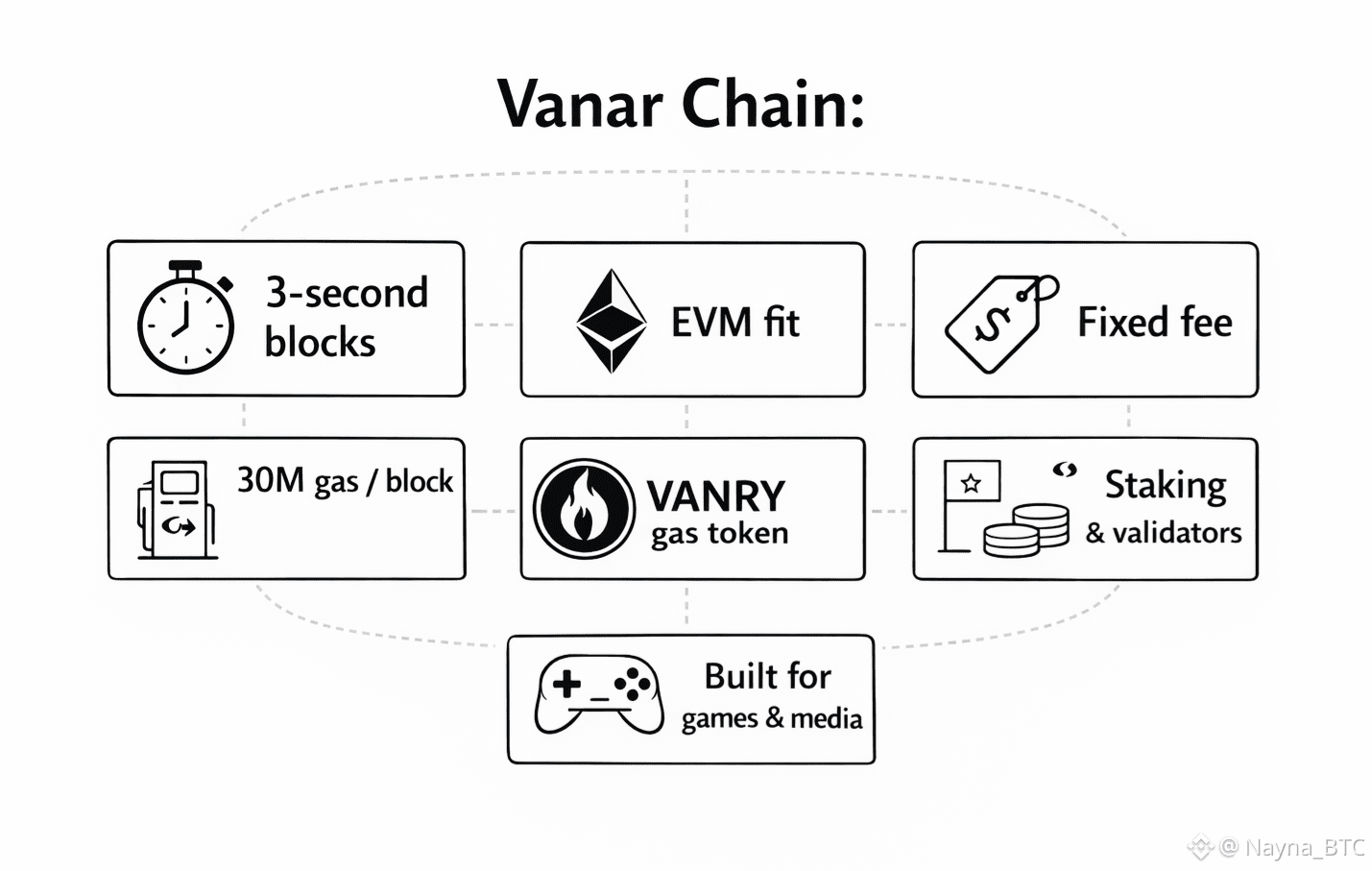
The chain is aiming for a simple balance: speed that feels natural, fees that feel steady, and EVM comfort so builders can ship without losing years of work. If you build apps where timing is part of trust, games, shops, creator tools, then that balance matters more than any headline number.
