



For most of the internet’s history, data lived in the background. It was collected, copied, backed up, and forgotten, treated as an operational necessity rather than a strategic asset. Its value was assumed to come later, once processed, modeled, or monetized by centralized platforms that promised reliability in exchange for control. That bargain held for a while. Then AI arrived, and suddenly the weakest assumptions of the digital economy were exposed.
Intelligent systems do not merely consume data; they depend on it continuously. Memory is not a convenience for AI, it is identity. Context is not a feature, it is functionality. When data disappears, becomes unverifiable, or degrades over time, intelligence does not simply slow down, it breaks. In this new environment, data stops behaving like exhaust and starts behaving like capital. Walrus is built on that realization.
Rather than asking how to store more data cheaply, Walrus asks a more fundamental question: how do you create an environment where data can persist, be proven, governed, and reused without relying on trust in a single operator? The answer leads away from familiar cloud abstractions and toward infrastructure where durability itself becomes programmable and economically enforced.
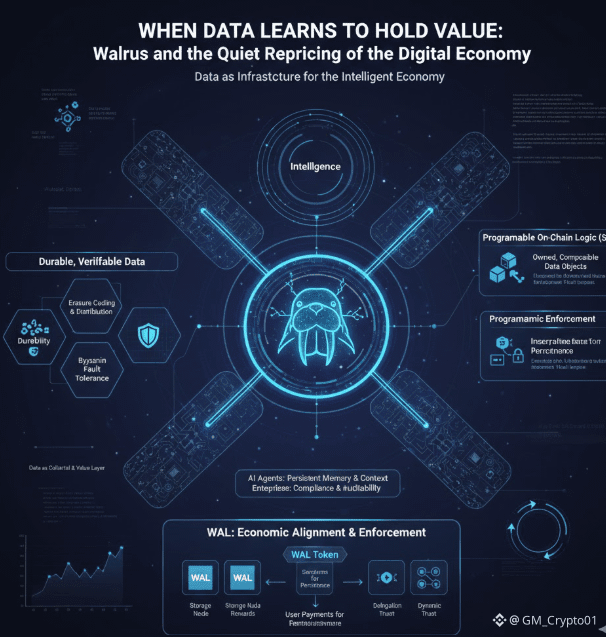
At the heart of Walrus is a rejection of the idea that decentralization must come at the expense of reliability. Early decentralized storage systems often forced users to choose between ideological purity and practical guarantees. Walrus collapses that false choice. By encoding data using erasure coding and distributing it across the entire network, the protocol ensures that availability does not depend on any single node behaving well. Even if parts of the system fail or act adversarially, data remains retrievable. Durability is not promised; it is mathematically enforced.
This matters because AI workloads are unforgiving. Training data, historical logs, embeddings, and model states are not ephemeral. They must survive upgrades, migrations, and long time horizons. Walrus treats these datasets not as files to be parked, but as long-lived objects with economic weight. Storage overhead is kept deliberately efficient, avoiding the waste of full replication while maintaining Byzantine fault tolerance. The result is a system that can scale without turning storage into a financial bottleneck.
Where Walrus begins to feel fundamentally different is in how it integrates storage with on-chain logic. On Sui, storage space itself becomes an owned, composable resource. Data blobs are not opaque files hidden behind APIs; they are on-chain objects whose existence and availability can be verified by smart contracts. This transforms storage from a passive layer into an active participant in application logic. Retention rules, access permissions, deletion conditions, and proof of availability can all be enforced programmatically.
For AI agents, this is a quiet breakthrough. An agent that can reason about whether its memory exists, whether it will persist, and under what conditions it can be accessed is an agent that can operate autonomously over long periods. Enterprises benefit in a different way. Compliance, auditability, and governance move from legal assurances into infrastructure guarantees. Data does not just exist; it can be proven to exist.
Economic alignment is what holds this system together. WAL tokens are not decorative incentives layered on top of storage. They are the mechanism through which reliability is rewarded and enforced. Storage nodes earn rewards for maintaining availability. Users pay for services that actually deliver persistence. Delegation allows broader participation without requiring everyone to run infrastructure. Committees rotate, incentives rebalance, and trust becomes dynamic rather than assumed.
This is where Walrus quietly redefines the idea of a data economy. When storage is verifiable and programmable, data itself becomes something that can be governed, transferred, and monetized without losing integrity. Datasets can persist across applications. AI systems can build memory without fear of silent decay. Markets can form around data availability rather than speculative access rights.
The broader implication is that data begins to resemble collateral. Not in the narrow financial sense, but in its role as a backing layer for value creation. Just as financial systems rely on assets that can be verified and secured, AI systems rely on data that can be trusted to remain intact. Walrus provides that foundation. It does not promise intelligence; it makes intelligence viable.
What makes this especially relevant today is the convergence of AI, decentralized infrastructure, and real economic usage. Models are growing larger, agents are becoming autonomous, and enterprises are increasingly uncomfortable with opaque storage guarantees. The question is no longer whether decentralized storage can work, but whether it can meet the standards required by systems that operate continuously and at scale. Walrus answers that question not with spectacle, but with architecture.
The WAL token’s role reflects this maturity. Its value is not derived from narrative cycles, but from participation in a system where data availability has measurable consequences. As more applications rely on persistent, verifiable storage, demand becomes structural rather than speculative. This is the difference between infrastructure and experimentation.
Seen from this angle, Walrus is less about competing with cloud providers and more about redefining what storage means in an intelligent economy. It treats data as something that must endure, be governed, and remain accessible under pressure. It assumes that the future will be filled with agents that remember, systems that reason across time, and enterprises that require proofs rather than promises.
In that future, data cannot be cheap and disposable. It must be durable, accountable, and economically aligned. Walrus is quietly building for that world, one where data holds value not because it is scarce, but because it is reliable. When intelligence becomes the primary driver of economic activity, the infrastructure that protects memory becomes foundational. Walrus is not chasing that future. It is preparing for it.