
Walrus is not another decentralized storage project. Rather than storing files, it is building a programmable, verifiable, and interoperable data layer which can be used as a base of next-generation Web3 and AI applications.
What Makes Walrus Different: Programmable Assets of Data.
Old Systems of decentralization storage as IPFS just disseminates files among nodes. Walrus transforms data into on-chain objects which can be owned, manipulated and automated by smart contracts. These are objects that exist within the Sui blockchain which is the control plane of metadata, economic coordination, and proofs. Data is always off-chain in nodes but must always have an on-chain identity.
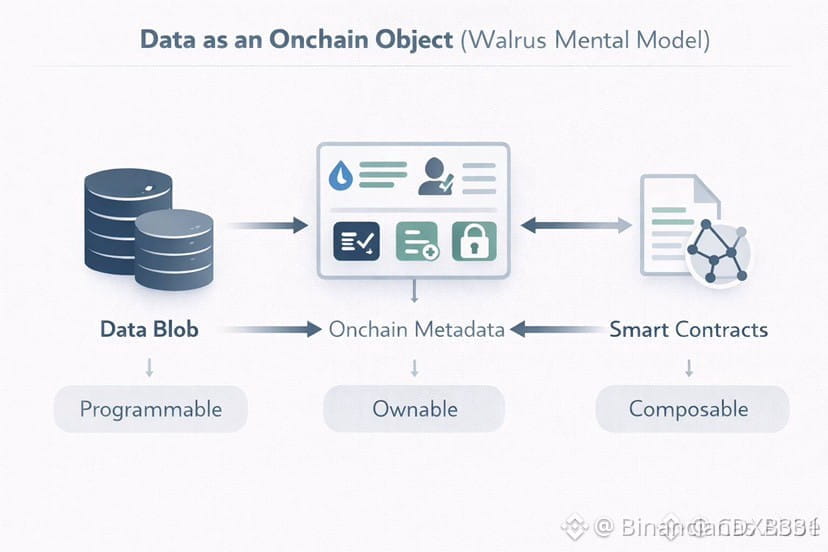
This implies that developers will not only be able to access stored files and storage capacity as mere stuff in a bucket, but rather, use it as a resource that can be connected to decentralized applications - e.g. automate renewals, access gates, build data markets, and create access tiers.
A Powerful Motor under the Hood: Red Stuff and Self-Healing Storage.
In its simplest form Walrus solves a profound technical problem, which is to efficiently, reliably and cheaply store large binary files (so-called blobs) in a decentralized network. Walrus does not use complete replication (which involves copying all the files into a large number of machines) but rather a high-level erasure coding scheme (Red Stuff) that divides data into fragments (also called slivers) whose redundancy is not as high as a naive replication but still so high that node failures are highly tolerated.
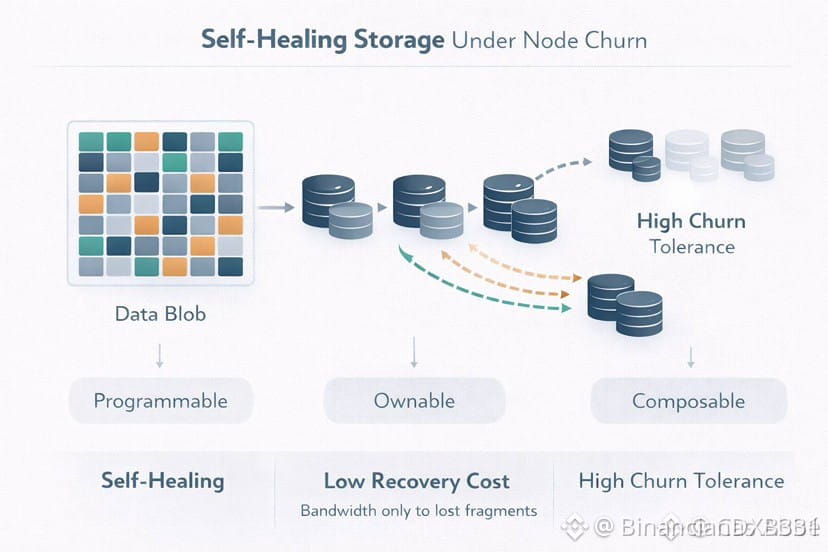
An important scholarly observation in this context is that Red Stuff also recovers self-healing with bandwidth proportional only to the lost data, not the whole file - an improvement over most of the previous decentralized storage designs which incurred higher recovery costs.
This is not only an academic innovation but it implies that Walrus can sustain high churn (nodes joining/leaving) without compromising availability, which is a frequent issue with decentralized networks.
Incentivized Proofs of Availability: Checking on Storage Is not Fake.
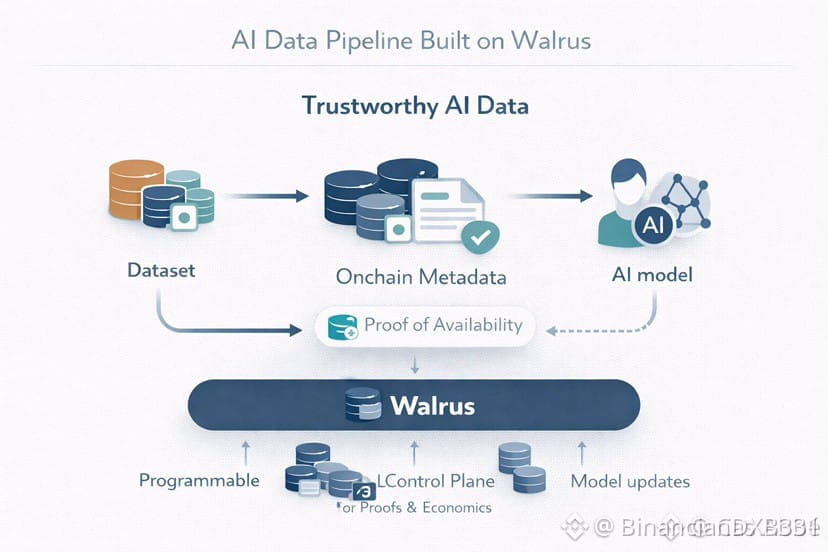
Walrus has one distinctive feature: the Incentivized Proof of Availability (PoA) system. Rather than availability being available to trust or a few period checks, Walrus establishes a system in which the nodes periodically produce evidence that they continue to have data and the values are updated on the ledger of Sui. Such on-chain certificate is a publicly verifiable audit trail, which any app can consult.
This does not only increase reliability but it also generates a market signal that stored information is, in fact, present and available which is something needed under the condition that data is to be purchased, sold, or manipulated by automation and AI agents with confidence.
Chain-Agnostic Builders and interoperability
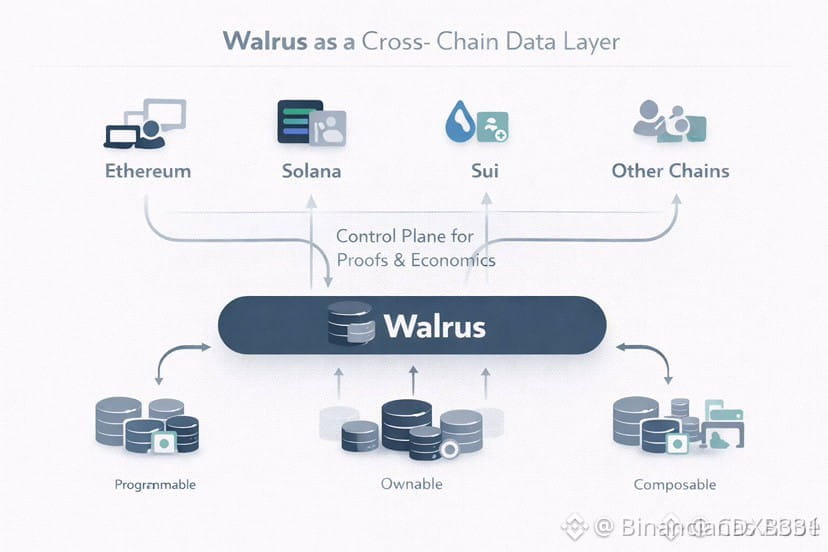
Walrus does not deal exclusively in Sui apps. Although it uses Sui on the control plane and proofs, Ethereum or Solana developers can use Walrus via SDKs, and integrate siloed chains into a single data layer.
This cross-chain friendliness causes Walrus to be a candidate of a universal data layer in Web3 - where cross-chain apps share the same storage primitives but not replicate the infrastructure.
WAL Token: Economic Stability, Incentives, and Payments.
The native WAL token has a major dual role:
Storage storage data Users pay in advance in WAL to store data over a set period of time. The fixed price is then allocated to storage nodes and stakers over time to tie the economy to the continued services and not to lump sums.
Staking and Security Storing WAL can only be engaged in through staking and thus economic misbehavior would be unappealing. Other protocols even burn some of the charges to establish deflationary pressure as volume is used.
Walrus has community incentives, airdrops through soulbound NFTs, and ecosystem grants, which aim not only to be speculated upon, but to be used over time and to create network effects.
Use Cases: Into Data Markets and Beyond Files.
Although the initial applications operated on a basis of pure file storage with specific reference to storing huge files, the actual applications under development are more extensive and long-range:
1- AI Data Pipelines: AI agents have the capability of storing datasets and model snapshots with demonstrably available metadata, which may be used as a reliable source of data feeds to learn and make inferences.
2- Decentralized Media: Metadata and media can be stored in an NFT project and content platform in a verifiable and censorship-resistant way.
3- Programmable Access Markets: Storage objects can be pegged to access rules and allow data markets such that access or usage can be purchased or rented as a result of the terms of a smart contract.
4- Multi-Chain Tools: Developers of other chains can utilize Walrus to skip the creation of storage layers and have a common infrastructure that will be useful to most ecosystems.
The Strategic Vision: Data That Does Not Sit, But Works.
The most fundamental change in the narrative when it comes to Walrus is the transition in thinking to view storage as a back-end one-way service to one that is first-class programmable. This is not a matter of file storage, but rather, it is a question of data being able to be owned, communicated with, and economically interacted with on-chain.
This introduces completely new categories of decentralized applications: AI agents can prove their training data, data marketplaces can have storage that can be fractionalized, multi-chain services can have storage that is unified into a common layer.
Real life Signals and Momentum.
Walrus already acquired substantial funding resources ( $140M of crypto VCs) and collaborations that demonstrate confidence on the market. It is already gaining real developer attention and especially in fields such as AI and media and is expanding to integrations that address actual performance bottlenecks such as latency and retrieval speed.
Even market taste is indicative of an increased preference of utility over hype - analysts point out that when Walrus merely functions properly and quietly, it may be one of the building blocks of Web3 infrastructure in years to come.
Walrus is more than a decentralized storage, but a data infrastructure layer that allows programs to build on storage, as well as verifiable and interoperable across blockchains. Its economic, encoding, basis, ecosystem enablement innovations are preparing the foundation of Web3 data marketplaces and AI-prepared storage, no longer file hosting, but programmable data as a blockchain primitive.