
There is a certain loneliness baked into the modern internet. We scroll, we click, we consume, yet so much of what we create online does not truly belong to us. Accounts disappear. Games shut down. Platforms change rules overnight. Years of passion dissolve into forgotten servers. Vanar is born from that ache — the unspoken frustration of a digital life that feels meaningful but fragile — and from a desire to finally give permanence to what people love.
Vanar does not arrive as a spectacle. It does not try to overwhelm with jargon or intimidate with complexity. Instead, it feels like someone who has been quietly watching how people actually live online — how they play after work, how they collect memories in digital form, how they express identity through games, art, and shared worlds. And then, very deliberately, it builds technology around that reality rather than asking reality to bend to technology.
At its heart, Vanar is a Layer-1 blockchain, but that description barely scratches the surface of what it is trying to heal. It is designed for real-world adoption not as a slogan, but as a philosophy. The team behind it comes from games, entertainment, and brand ecosystems — spaces where emotion decides success. In those worlds, if something feels cold, users walk away. If it feels alive, they stay. That understanding shapes every layer of Vanar.
The ambition to bring the next three billion people into Web3 is often repeated across the industry, but Vanar approaches it with unusual humility. It assumes most people do not want to “learn blockchain.” They want experiences that feel natural. They want technology that respects their time. They want systems that remember them, not exploit them. This is where Vanar’s AI-native foundation quietly changes the equation. By allowing decentralized applications to store context and meaning — not just transactions — Vanar moves closer to something deeply human: systems that adapt to people instead of people adapting to systems.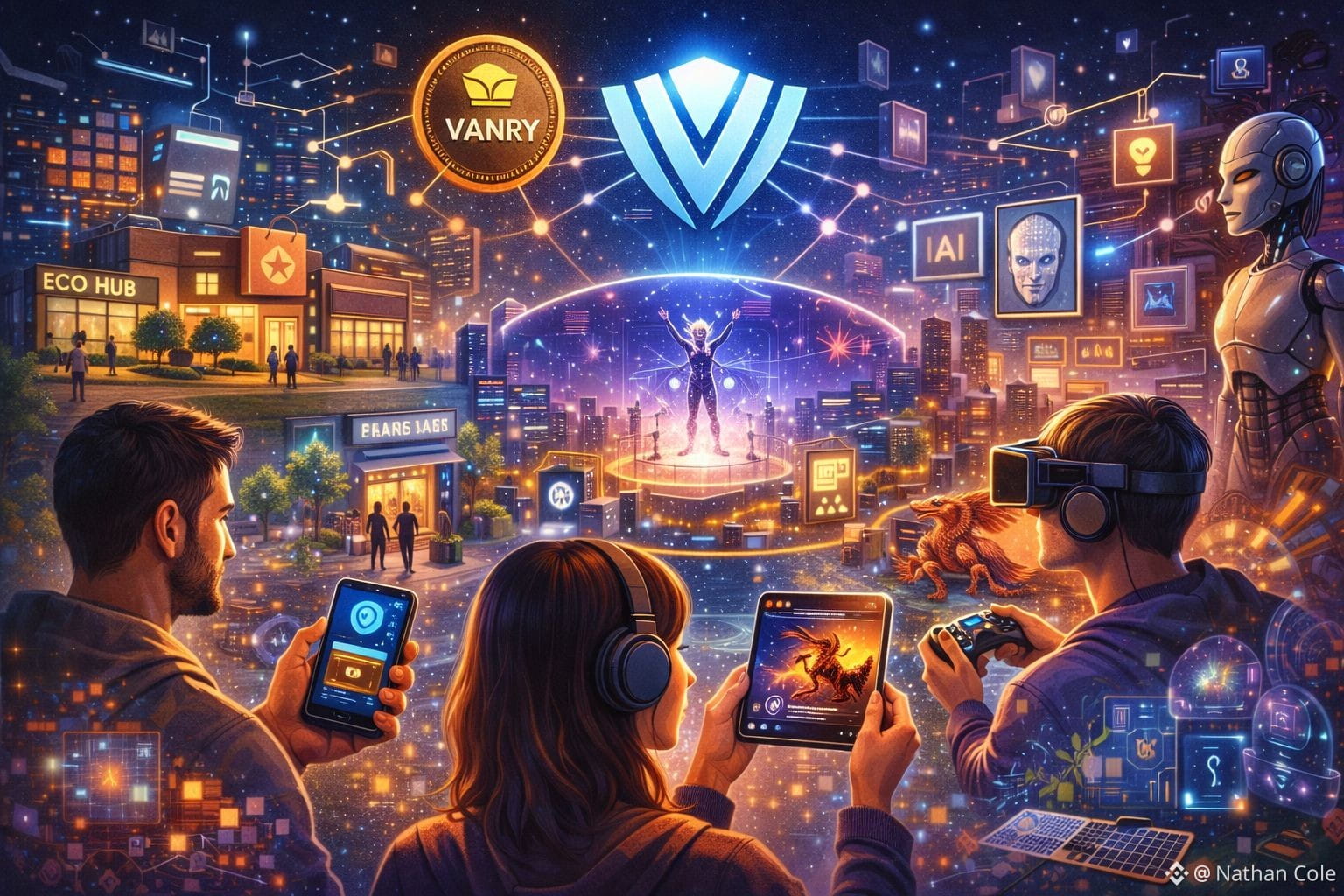
Powering this ecosystem is the VANRY token. On the surface, it fuels transactions, staking, and network security. But emotionally, it represents something else entirely: participation with consequence. VANRY is not meant to be a detached financial instrument; it is a signal that being part of this network carries responsibility and belonging. Holding it is not just about value — it is about alignment with a shared future.
That future becomes tangible through living products, not promises. The Virtua Metaverse is where Vanar’s vision takes its first real breath. Here, digital ownership feels intimate. Collectibles are not trapped in wallets as lifeless proofs; they are displayed, animated, and experienced. Walking through Virtua feels less like navigating software and more like entering a space where memories are allowed to exist. It restores something many did not realize they lost — the emotional connection to digital belongings.
Alongside it grows the VGN games network, built for players who have always known the pain of starting over. New game, new grind, zero carryover. VGN gently challenges that cycle. It imagines a world where effort persists, where time spent mastering a game does not vanish when trends shift. Where play can become legacy. For millions of gamers worldwide, this is not a technical upgrade — it is a validation of their passion.
Vanar’s attention to sustainability adds another quiet layer of trust. In a time when people are increasingly aware of the environmental cost of innovation, Vanar positions itself as carbon-conscious and efficiency-focused. It understands that mass adoption is not only about access, but about conscience. People want to feel good about the systems they support, even if they never read the technical documentation.
Of course, hope must coexist with honesty. Vanar, like any ambitious blockchain, faces real tests: decentralization, governance, security, and long-term resilience. These questions are not weaknesses; they are necessary growing pains. What matters is transparency — public documentation, verifiable on-chain data, and a community that is invited into the conversation rather than kept at arm’s length. Trust is not demanded here; it is slowly earned.
What makes Vanar emotionally compelling is not that it claims to change everything, but that it respects what already matters to people. It does not try to redefine play, creativity, or identity. It protects them. It offers permanence where there was fragility, ownership where there was dependence, continuity where there was loss.
Imagine a player realizing that the hours spent in a game have not disappeared into nothingness. Imagine a creator seeing their work live, move, and remain accessible across time. Imagine a brand experience that feels less like marketing and more like participation. These moments are small individually, but together they form something powerful — a digital life that feels worth investing in emotionally.
Vanar is not just building infrastructure. It is responding to a quiet human desire: to feel seen, remembered, and respected in digital spaces. If Web3 is ever going to feel like home rather than an experiment, it will be because projects like Vanar chose empathy over spectacle.
This is not a loud revolution. It is a patient one. And sometimes, the most meaningful changes begin exactly that way.
