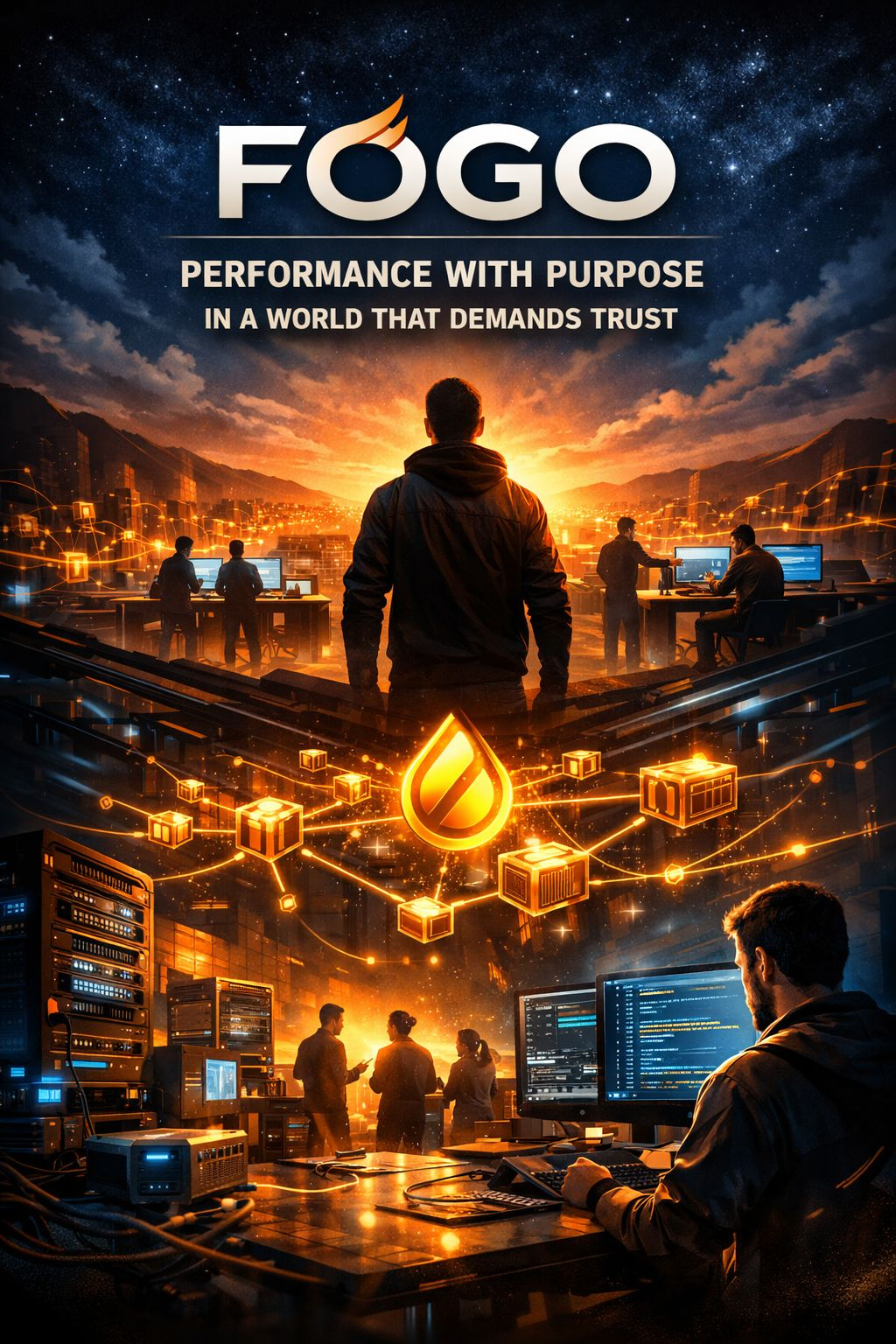
There is something deeply human about building infrastructure. We build roads so people can move. We build bridges so people can connect. In the digital world, we build blockchains so people can trust without asking permission. Fogo was created in that spirit. It is a high performance Layer 1 blockchain built on the Solana Virtual Machine, but behind those technical words is a very simple intention. Make something strong enough to carry real lives.
For years, blockchains promised freedom, ownership, and transparency. And they delivered many breakthroughs. But as more people arrived, cracks began to show. Networks slowed down under pressure. Fees rose when demand surged. Developers faced limits that forced compromises. Users felt uncertainty when transactions took too long or cost too much.
Fogo did not appear out of nowhere. It came from a growing realization that performance and trust must live together. A network cannot just be fast. It must be reliable. It cannot just attract attention. It must hold up when attention fades. That is the space Fogo stepped into.
Why Fogo Exists
Every project begins with discomfort. Someone notices a problem that keeps repeating. In the case of Fogo, the problem was not simply speed. It was the feeling that decentralized systems were struggling to keep pace with real world expectations.
Modern users are used to instant feedback. They tap a screen and expect a result. When a blockchain feels slow or unpredictable, it creates hesitation. That hesitation spreads. Developers feel it. Investors feel it. Communities feel it.
Fogo exists because people wanted a foundation that could support serious applications without constant compromise. By using the Solana Virtual Machine, Fogo embraces an execution model designed for parallel processing. Instead of handling transactions one by one in a long line, the system can process many at the same time when they do not conflict with each other. This unlocks a different level of responsiveness.
If technology is going to support global finance, digital identity, gaming, art, and social systems, it must feel natural to use. Fogo was designed with that belief at its core.
Inside the Engine Room
Imagine stepping into the engine room of a vast digital ship. You hear a steady rhythm. Machines are working in coordination. Nothing feels chaotic, even though thousands of processes are happening every second.
At the heart of Fogo are validators. These are individuals and organizations who run the network software. They confirm transactions, produce blocks, and protect the ledger. They lock up tokens as a commitment to honest behavior. If they break the rules, they risk losing that stake. That is how economic incentives become security.
The Solana Virtual Machine allows smart contracts to declare what data they will touch before execution. This transparency makes parallel processing safe. The network can see which transactions can run together without conflict. The result is higher throughput without sacrificing order.
Fees play a quiet but important role. They prevent spam and compensate validators. Because Fogo is designed for high capacity, it reduces the competition for block space that often drives costs higher on other networks. Users experience this as stability. They send a transaction and it behaves as expected.
Design Decisions and Alignment
Every blockchain encodes values into its architecture. Fogo’s emphasis on performance reveals a belief that decentralized systems must serve everyday needs, not just niche experiments.
But speed alone is not enough. Decentralization matters. Governance matters. Incentives matter.
Validators are rewarded for participating honestly. Developers are welcomed through compatibility with the Solana Virtual Machine environment. This lowers the barrier to building. It means teams familiar with that ecosystem can create or expand without starting from zero.
Governance is another layer of trust. Token holders typically have a voice in protocol upgrades and changes. When governance works well, it feels balanced. It avoids reckless changes while still allowing evolution. If governance becomes captured or opaque, the foundation weakens.
We’re seeing across the industry that long term survival depends less on hype and more on careful alignment. Incentives must reward behavior that strengthens the network rather than exploits it.
What Metrics Really Mean
It is easy to look at surface numbers and feel impressed. High transaction counts. Large volumes. Price movements on exchanges like Binance. These figures attract attention, but they do not always tell the full story.
A spike in transactions might be automated activity rather than genuine use. Large value locked in applications might be driven by temporary rewards. Token price increases might reflect speculation more than adoption.
I’m more interested in deeper signals. How widely distributed is validator participation. How concentrated is stake. Are developers consistently building and updating projects. Do users return even when incentives fade.
If It becomes clear that people stay because the system works, that is meaningful. Sustainable growth feels quieter. It is steady rather than explosive.
Hidden Risks and Fragile Points
No system is invincible. High expectations create high pressure. If a network built on speed experiences outages or prolonged congestion, the disappointment can be sharp.
Validator centralization is another concern. If too much control rests in too few hands, decentralization becomes fragile. True resilience requires diversity in participation.
Smart contract risk also exists. Even if the base layer is secure, applications built on top can contain vulnerabilities. When something goes wrong, users often do not separate application failure from protocol failure. Trust can suffer quickly.
The most serious threat would be a breakdown of integrity. If governance decisions felt unfair. If transparency faded. If insiders gained quiet advantages. That kind of failure damages more than technology. It damages belief.
A Human Closing
Fogo is ultimately a story about people who wanted better foundations. It is about engineers who believed performance and decentralization could coexist. It is about communities who expect reliability rather than excuses.
They’re the validators who stake their capital to protect the network. They’re the developers writing code late into the night. They’re the users who choose to trust a system they cannot physically see.
We’re seeing an industry mature. The excitement remains, but so does the awareness that infrastructure must be dependable. Attention from major exchanges like Binance can amplify visibility, but visibility is not the same as trust.
Trust grows quietly. It grows when transactions confirm smoothly. When fees remain stable. When governance feels fair. When communication is honest.
If Fogo continues to honor its design principles and nurture its community, it can become more than a high performance chain. It can become a reliable layer in a world that increasingly depends on digital foundations.
In the end, technology succeeds not when it dazzles us, but when it supports us. And if Fogo remembers that it was built for people first, then its strength will not just be measured in throughput. It will be measured in confidence.