
Some blockchain projects begin with noise. Others begin with a need. Fogo feels like it belongs to the second category. When I look at the evolution of decentralized infrastructure, I see a pattern repeating itself. New networks promise speed, lower fees, and massive scalability, yet when real users arrive, performance becomes inconsistent, costs fluctuate, and developers start searching for alternatives. Fogo seems to grow out of that realization. It is not trying to prove that fast chains are possible. That part has already been demonstrated. Instead, it is trying to answer a deeper question. Can performance become dependable enough that people stop worrying about it?
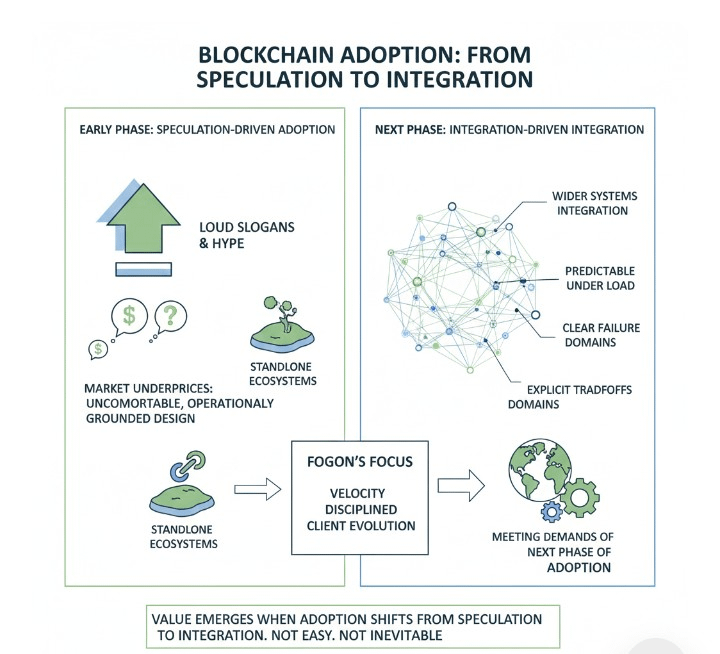
That question matters more than it sounds. Infrastructure only succeeds when people forget it's there. When systems become invisible, when they simply work, they turn into foundations rather than experiments. Fogo’s vision appears rooted in that idea. They are building not just for impressive benchmarks but for the moment when applications rely on the network daily without fear of sudden congestion or unexpected breakdowns. That shift from performance to reliability signals a more mature phase of blockchain development.
One of the clearest reflections of this philosophy is their decision to build around the Solana Virtual Machine. This choice is less about copying another ecosystem and more about acknowledging what already works. The Solana Virtual Machine allows transactions to execute in parallel rather than one at a time. Instead of forcing every operation to wait in a single queue, multiple processes run simultaneously. This dramatically increases throughput and reduces the chances of bottlenecks forming during heavy usage. But beyond the technical advantage, the decision carries strategic weight. Developers already understand the execution model. Tooling already exists. Educational resources are available. By adopting a familiar environment, Fogo lowers the barrier to entry for builders and reduces the friction that often slows new ecosystems.
This approach also hints at a broader vision for interoperability. If multiple networks share execution standards, applications can move more freely between them. Liquidity becomes less trapped. Developers gain flexibility. Users benefit from a more connected digital economy. Fogo’s choice suggests they are thinking not just about launching a network but about participating in a larger infrastructure layer that stretches across the Web3 landscape. The future of blockchains may depend less on isolated ecosystems and more on shared technical foundations, and Fogo appears to be positioning itself within that future.
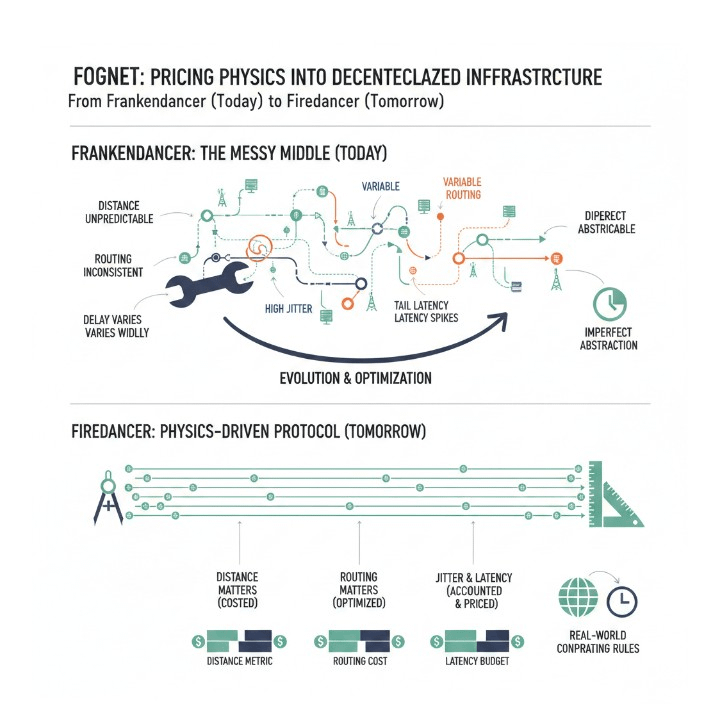
Underneath the visible features of the network lies a carefully balanced architecture. High performance blockchains are not just about processing transactions quickly. They must coordinate execution, validation, and state propagation across a distributed network of participants. If one of these layers becomes inefficient, the entire system feels it. Fogo’s design seems focused on keeping these components aligned so that speed does not come at the cost of stability. Transactions are processed in parallel, validators confirm them efficiently, and network communication aims to prevent data congestion from spreading across nodes. The intention is not to chase extreme peak numbers but to maintain consistent throughput under real-world conditions.
That emphasis on consistency matters. Many systems perform well under ideal circumstances but struggle when real demand arrives suddenly. Social trends, market volatility, or major application launches can drive unpredictable spikes in activity. A network designed for theoretical capacity may falter during those moments. Fogo’s strategy appears to recognize that true adoption happens in bursts, not in smooth growth curves. By optimizing for sustained performance rather than isolated benchmarks, the network prepares itself for the messy reality of human behavior and market cycles.
The long-term consequences of these design decisions extend beyond technology. They influence how ecosystems form. When developers trust that a network will remain stable, they are more willing to build applications that require consistent uptime. When costs and execution times remain predictable, businesses can integrate blockchain infrastructure into real services rather than experimental pilots. Over time, this reliability attracts communities that stay through market downturns rather than disappearing when trends shift. Strong infrastructure creates gravitational pull. Projects begin to cluster around systems that feel dependable, and that clustering effect often determines which networks endure.
Measuring progress in this context requires looking beyond superficial statistics. High transaction counts or large wallet numbers may create impressive headlines, but they rarely reveal whether a network is truly healthy. More meaningful indicators lie deeper. Developer retention shows whether builders continue to trust the platform after initial deployment. Stable performance during periods of high demand demonstrates resilience. A diverse range of applications signals that the network can support multiple use cases rather than relying on a single trend. These signals reflect structural strength rather than temporary popularity.
At the same time, Fogo’s path is not without challenges. High performance networks often face tradeoffs related to hardware requirements. If validator participation demands expensive infrastructure, decentralization can weaken as fewer participants are able to join. Maintaining a balance between speed and accessibility will remain a crucial test. Too much emphasis on performance can centralize control, while too much focus on accessibility can limit scalability. Navigating that tension requires continuous adjustment rather than one-time solutions.
User behavior introduces another unpredictable variable. Technology alone rarely drives adoption. People move toward systems that feel intuitive, communities that feel welcoming, and ecosystems that offer tangible benefits. Even a technically superior network must compete with established habits and social networks. Encouraging migration requires more than efficiency. It requires storytelling, incentives, and the slow formation of trust. Adoption unfolds over time rather than through sudden breakthroughs.
Regulation also shapes the environment in which blockchain infrastructure evolves. Governments around the world are refining how they approach digital assets, decentralized finance, and data sovereignty. Networks must adapt to these evolving frameworks while preserving openness and innovation. Compliance may require adjustments to governance structures, validator participation models, or data transparency practices. Projects that prepare for regulatory change rather than react to it often position themselves for greater longevity.
Market dynamics add another layer of complexity. Liquidity tends to concentrate where activity already exists. New networks must attract enough attention to create self-sustaining ecosystems. Without sufficient capital flow, even technically strong platforms can struggle to maintain momentum. This reality forces projects like Fogo to think carefully about incentives, partnerships, and developer support. Infrastructure alone does not create ecosystems. Communities, capital, and applications must grow together.
Despite these uncertainties, Fogo’s journey feels grounded in a steady vision rather than a rush toward immediate recognition. The project seems to treat blockchain not as a speculative experiment but as a form of digital infrastructure that must earn trust gradually. That mindset aligns with the broader maturation of the industry. Early blockchain narratives focused on possibility. Today the conversation increasingly centers on reliability. The systems that shape the next decade will likely be those that deliver consistent performance rather than occasional brilliance.
I find something compelling in that quiet ambition. Instead of promising to change everything overnight, Fogo appears to be building something meant to endure. It reflects a belief that real technological revolutions often happen slowly. Roads, power grids, and communication networks did not transform society through single dramatic moments. They became indispensable through steady refinement and widespread trust. Blockchain infrastructure may follow a similar path.
If Fogo succeeds, its impact may not come from sudden visibility but from gradual integration. Applications may begin to rely on it without users even noticing. Developers may treat it as a dependable environment rather than an experimental frontier. Businesses may incorporate it into their operations without needing to explain the underlying mechanics. That kind of quiet adoption represents the ultimate validation for infrastructure. When systems fade into the background, they have truly become part of daily life.
The future of blockchain will likely be shaped by projects willing to think beyond immediate metrics and short-term hype. Fogo’s approach suggests a commitment to that longer horizon. By focusing on compatibility, consistent performance, and ecosystem trust, it aims to become more than another fast network. It aims to become a reliable layer in the digital world’s foundation.
Belief plays a role in every technological journey. Builders must believe that patient design will outlast rapid experimentation. Communities must believe that reliability matters more than novelty. Investors and developers must believe that systems built carefully can eventually shape entire industries. Fogo’s story feels like it draws strength from that kind of belief. Not the loud confidence of speculation, but the steady conviction that meaningful infrastructure is worth the effort.
Resilience, after all, is what turns projects into platforms and platforms into legacies. If Fogo continues to refine its architecture, nurture its developer ecosystem, and navigate the evolving regulatory and market landscape, it may find itself not just participating in the blockchain future but helping define it. And the networks that define the future are rarely those that arrive first. They are the ones that stay, adapt, and keep working long after the excitement fades.