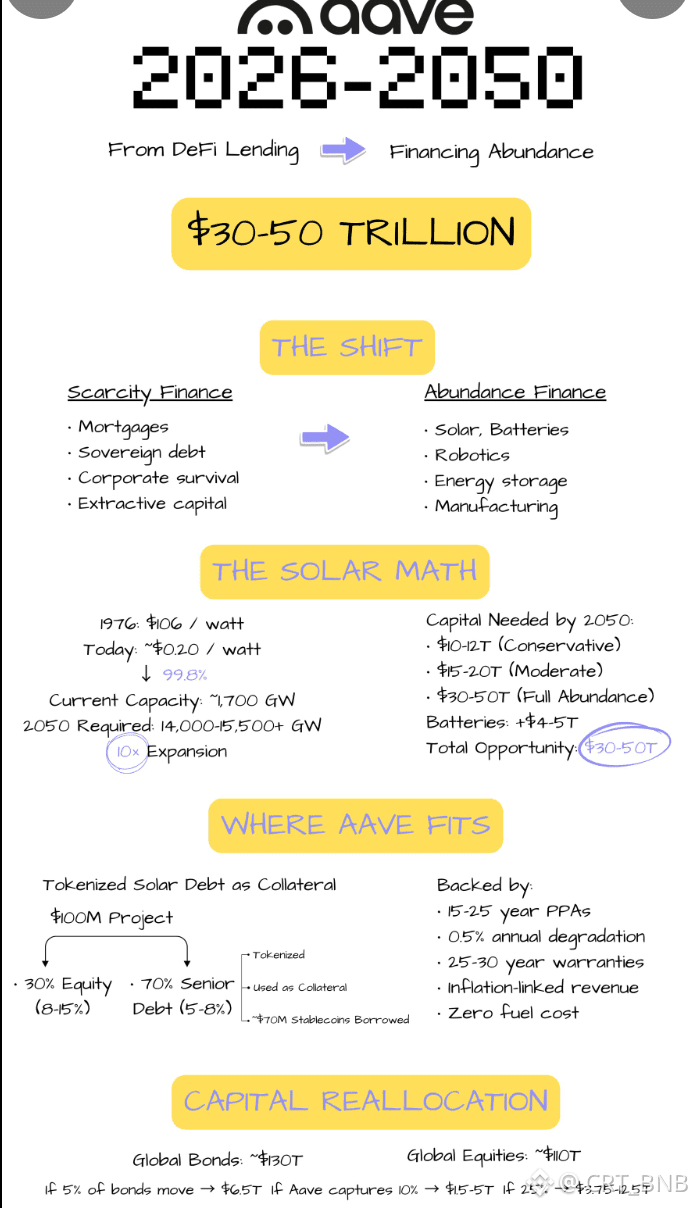
On February 15, 2026, @StaniKulechov didn’t drop a product update.
He dropped a 25-year thesis.
Not about APYs.
Not about incentives.
Not about token emissions.
About abundance.
Aave’s roadmap to 2050 isn’t tactical.
It’s civilizational.
And the number attached to it?
$30–50 trillion.
🟣 The Core Idea: From Scarcity to Abundance
For centuries, finance funded scarcity.
• Land
• Oil
• Mortgages
• Sovereign debt
• Corporate survival
These are backward-looking assets.
They extract.
They preserve existing systems.
Stani argues the next cycle of capital isn’t about preserving scarcity.
It’s about financing abundance.
Abundance is when something once expensive becomes cheap and available to billions.
Books.
Phones.
Internet.
Compute.
Now?
Energy.
Storage.
Robotics.
Food production.
Manufacturing.
🟣 Why Solar Is the Anchor
Solar is the cleanest example of abundance economics.
1976: $106 per watt
Today: ~$0.20 per watt
That’s a 99.8% collapse.
Every doubling of cumulative production cut costs 20–25%.
(Swanson’s Law.)
Same story with:
• Batteries (↓98%)
• Semiconductors (10B× cheaper per transistor)
• Genome sequencing (↓99.999%)
Economies of scale don’t just reduce cost.
They unlock new markets.
But there’s a catch:
Someone must fund the expensive early units
so the cheap future becomes possible.
That’s where finance comes in.
🟣 The Scale of What’s Needed
Current global solar capacity: ~1,700 GW
Required by 2050: 14,000–15,500+ GW
That’s a 10× expansion.
Current annual solar investment: ~$400B
Required through 2050:
• Conservative: $10–12T
• Moderate: $15–20T
• Full abundance case: $30–50T
Add batteries:
$4–5T additional.
Total opportunity:
$30–50 trillion in abundance assets.
Bigger than JPMorgan + BlackRock combined.
🟣 The Funding Gap
Today, ~$600B annually goes into solar + batteries.
That’s massive.
But not enough.
To reach net zero and enable energy abundance:
Capital allocation must scale dramatically.
Traditional finance is constrained:
• Infrastructure funds lock capital for decades
• Illiquidity limits allocations
• Secondary markets are weak
A pension might allocate 3–5% to infrastructure.
But 15–20% if it were liquid.
Liquidity is the unlock.
🟣 Where Aave Fits
Aave doesn’t want to “invest in solar.”
It wants to become the credit layer for tokenized abundance assets.
Example:
A $100M solar project debt is tokenized.
Typical structure:
• 30% equity (8–15% return)
• 70% senior debt (5–8% return)
That $100M tokenized portfolio is used as collateral.
A developer borrows ~$70M in stablecoins instantly.
Minutes, not months.
Depositors earn yield backed by:
• 15–25 year PPAs
• Creditworthy offtakers
• Zero fuel cost
• Inflation-linked revenue
• Mature, insured infrastructure
Not emissions.
Not reflexive loops.
Real cash flows.
🟣 Why Solar Is Ideal Collateral
Solar is financeable because:
• Predictable irradiance
• 0.5% annual degradation
• 25–30 year warranties
• 70–85% leverage standard
• Minimal obsolescence risk
• Inflation hedging built in
Recession doesn’t stop sunlight.
Inflation doesn’t raise fuel costs.
Geopolitics doesn’t block photons.
It behaves like a bond.
But antifragile.
🟣 The Bigger Capital Reallocation
Global bonds: ~$130T
Global equities: ~$110T
If 5% of bond capital flows into tokenized solar:
$6.5T unlocked.
If Aave captures just 10% of abundance financing:
$1.5–5T collateral expansion.
At 25% share:
$3.75–12.5T.
This transforms Aave from a DeFi lender
into one of the largest infrastructure financiers on Earth.
🟣 Solving DeFi’s Core Problem
DeFi already solved supply.
Global capital aggregation works.
The problem is demand.
Crypto-native collateral is scarce.
RWAs are stuck around ~$20B.
Stani’s thesis:
Tokenizing existing tradable assets is incremental.
Tokenizing abundance assets is exponential.
Bring onchain assets that don’t have ISIN numbers.
Solar farms.
Battery portfolios.
Robotics infrastructure.
That’s how DeFi scales.
🟣 Stablecoins Backed by Abundance
This also solves another bottleneck:
Local stablecoin demand.
EUR and GBP stablecoins struggle because there’s little onchain
borrowing demand.
Solar farms are geographically distributed.
You can tokenize EUR-denominated solar debt.
Borrow in EUR.
Create local-currency yield.
Distribute via:
• Aave App
• Aave Pro
• Aave Kit
Green, future-proof yield for retail and fintech users.
🟣 Scarcity Assets vs Abundance Assets
Scarcity-backed finance:
• Mortgages depend on location premium
• Sovereign debt depends on tax extraction
• Corporate debt depends on margin pressure
Abundance-backed finance:
• Drives cost down
• Expands productive capacity
• Compounds with scale
Every dollar invested in solar reduces future energy costs.
Every reduction unlocks more GDP.
More GDP → more demand → more solar → lower cost.
Positive feedback loop.
Scarcity assets weaken as they scale.
Abundance assets strengthen.
🟣 The Strategic Context
This vision aligns with:
• Aave V4 (modularity + efficiency)
• Horizon permissioned RWA markets (~$550–580M deposits, targeting $1B+)
• GHO expansion
• Refocus on core lending (retiring Avara umbrella, shutting Family wallet)
It’s not a product roadmap.
It’s a direction of travel.
🟣 The Real Bet
Stani says something critical:
Open access is commoditized.
Neutral platforms race to thin margins.
Aave must be opinionated.
List assets that fund the future.
Back abundance.
Be the growth engine of civilization-scale infrastructure.
🟣 The 25-Year Roadmap in One Line
From 2026 to 2050,
Aave wants to transition from lending against crypto scarcity
to financing global abundance.
If abundance scales,
Aave scales with it.
And if Aave captures even a fraction of $30–50 trillion,
this isn’t just DeFi growth.
It’s financial system reorganization.