When I hear a roadmap promise “greater decentralization,” my first instinct isn’t optimism — it’s scrutiny. Not because decentralization isn’t valuable, but because in practice it’s often treated as a milestone you announce rather than a property you continuously defend. The word shows up in slide decks long before it shows up in operational reality. And users, whether they realize it or not, can feel the difference.
The real question isn’t whether a network claims decentralization. It’s who still holds the levers when things go wrong.
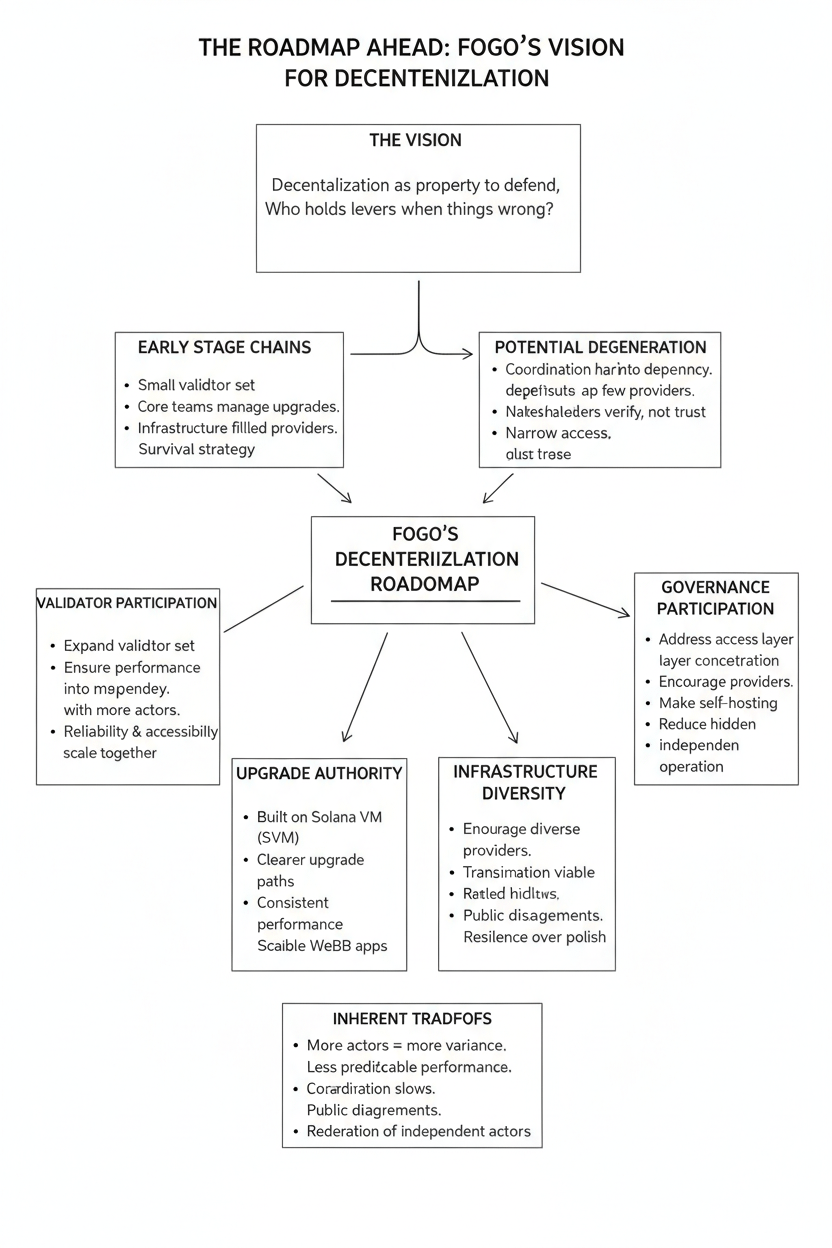
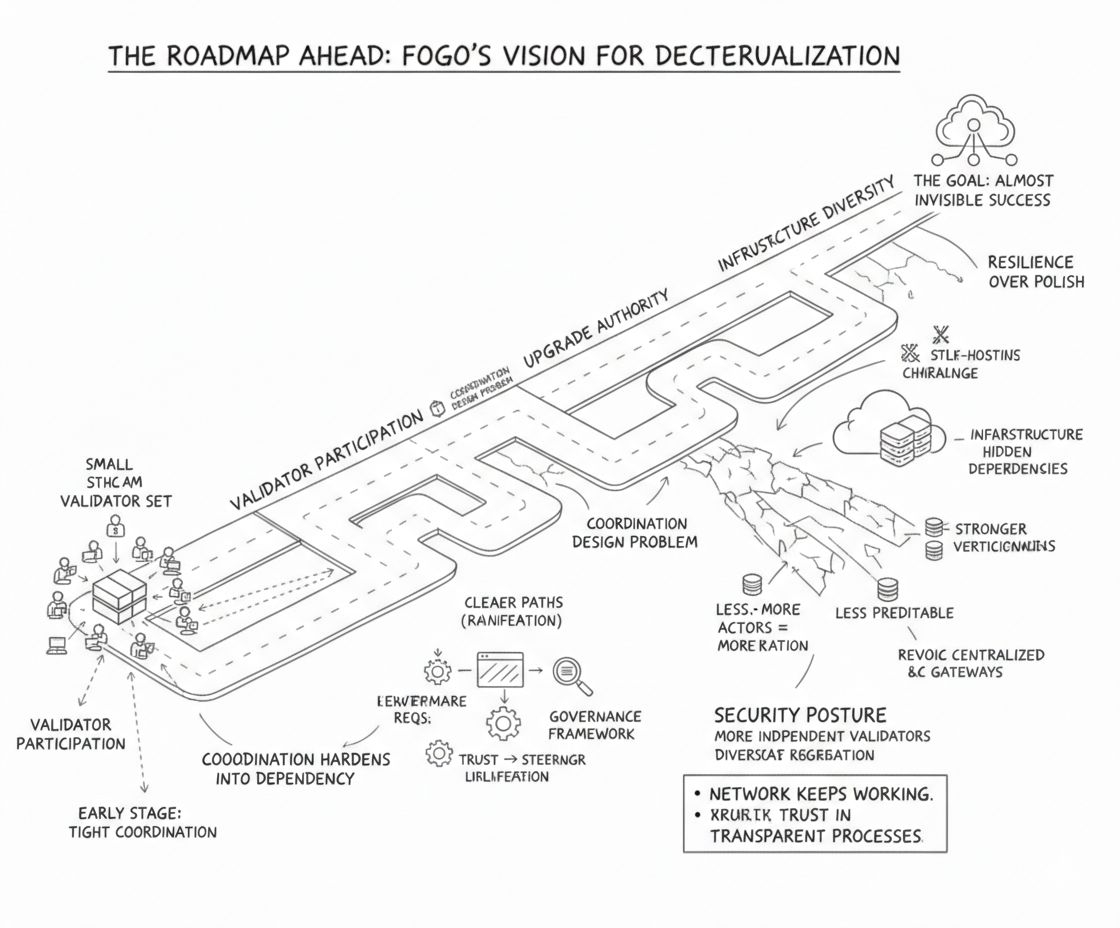
In earlier-stage chains, coordination is tight by necessity. A small validator set, core teams managing upgrades, infrastructure providers filling gaps — these aren’t failures of design; they’re survival strategies. But over time what begins as coordination can quietly harden into dependency. Tooling defaults to a few providers. Governance participation narrows to insiders. Performance optimizations favor those with specialized access. The network remains technically open yet practically gated.
A roadmap that aims to decentralize has to confront these realities. Expanding validator participation isn’t just about lowering hardware requirements it’s about ensuring the network remains performant when more independent actors join. Permissionless access is meaningless if only well capitalized operators can reliably meet uptime expectations. True distribution demands that reliability and accessibility scale together, not in opposition.
There’s also the question of upgrade authority. In many ecosystems, the power to ship critical changes sits with a small coordination group, even when governance frameworks exist on paper. Emergency patches, parameter tuning, and feature flags become informal control surfaces. They’re justified in the name of safety — often rightly — but each exception trains the ecosystem to expect central intervention. Over time, that expectation becomes a dependency loop: users trust the network because someone is steering it, and steering continues because users expect stability.
If Fogo’s roadmap is serious about decentralization, the challenge isn’t removing coordination; it’s distributing it without degrading response time. That means clearer upgrade paths, transparent signaling around changes, and mechanisms that allow stakeholders to verify — not just trust — how decisions are made and executed.
Infrastructure concentration is another quiet fault line. Even in nominally decentralized systems, RPC endpoints, indexing services, and relayers often converge around a handful of operators. This isn’t a conspiracy; it’s an efficiency outcome. Developers choose what’s reliable and well-documented. But when most traffic flows through a narrow set of gateways, those gateways become de facto control points. Rate limits, censorship pressure, outages, or subtle prioritization policies can shape user experience more than the protocol itself.
A credible decentralization roadmap has to address this layer, not just consensus. Encouraging diverse infrastructure providers, making self-hosting viable, and reducing hidden dependencies are as critical as expanding validator counts. Otherwise decentralization exist at the base layer while centralization reappear at the access layer invisible to most users but decisive in moments of stress.
Governance participation present a similar paradox. Token weighted voting promises openness yet turnout often remain low and influence concentrate among a few large holders or coordinated groups. The result is governance that is technically decentralized but socially-narrow. If roadmap milestones focus only on enabling governance mechanics without cultivating broad participation, decision-making power will remain clustered even as the interface looks inclusive.
Decentralization, then, is as much a coordination design problem as it is a technical one. Incentives must reward independent operation not just passive holding. Information must be accessible enough for smaller participants to act confidently. And governance processes must balance efficiency with legitimacy fast enough to respond to threats but inclusive enough to maintain trust.
There’s a tradeoff here that roadmaps rarely spell out: more actors introduce more variance. Performance becomes less predictable. Coordination slows. Disagreements surface in public. From a product perspective, this can feel like regression. Users accustomed to seamless upgrades and instant fixes may interpret decentralization as instability. The network, in turn, must decide whether it values resilience over polish — and how to communicate that shift without eroding confidence.
Security posture also evolves as control disperses. A tightly managed system can enforce uniform standards a decentralized one must assume uneven practices. Validator misconfigurations, delayed upgrades, and heterogeneous infrastructure introduce new attack surfaces. The roadmap can’t treat decentralization as purely additive each step outward redistributes risk and demands stronger verification, monitoring and fallback mechanisms.
This is where decentralization becomes less about ideology and more about operational discipline. It requires designing systems that remain coherent when no single actor is in charge, and that fail gracefully when parts of the network diverge. The goal isn’t eliminating trust — that’s impossible — but ensuring trust is placed in transparent processes rather than opaque operators.
If the roadmap succeeds, the visible outcome won’t be a press release declaring victory. It will be subtle: more independent validators without performance collapse, more infrastructure diversity without fragmentation, more governance participation without paralysis. Users may never notice the shift directly. What they’ll notice is that the network keeps working — through volatility, through outages, through disagreement — without requiring a central hand to steady it.
That’s the paradox of real decentralization: when it works, it’s almost invisible.
So the question worth asking isn’t whether Fogo can distribute roles across more participants. It’s whether the system can preserve reliability, clarity, and accountability once it does — and whether, under real stress, the network behaves like a federation of independent actors or quietly recenters around the few who can act the fastest.