
Fogo promises blistering speed and low latency by running the Solana Virtual Machine on a purpose built Layer 1 that targets trading and financial use cases. That promise means very fast confirmations and an execution environment designed for professional liquidity and high frequency activity. The protocol’s architecture leans on the same building blocks that make Solana fast — cryptographic clocks for ordering transactions and a BFT style voting layer that quickly locks in blocks — which in practice produces confirmations that feel immediate and final to users and apps.
But speed is only one side of the coin. The other side is certainty — the kind of certainty that keeps treasurers, auditors, general counsel and judges sleeping at night. Finality in code is a technical event: validators vote a block into the ledger and the network accepts it as canonical. Finality in law is a different animal. It is the moment a court will treat a transfer as irreversible the moment that legal systems say it is irreversible. When money is large and positions are leveraged the difference between “practically irreversible” and “legally irreversible” is not academic; it is existential.
Imagine you are the CFO of a trading firm. A large position is netted and a transfer is broadcast on Fogo. The order appears confirmed in milliseconds and your trading engine treats it as settled. Now imagine a rare but real shock: a validator software bug, a governance rollback, or an aggressive coordinated attack. If the ledger is rewound or a corrective replay happens, your firm could be left with an unintended exposure that the market has already priced. That scenario is why institutions do not buy finality only with speed. They demand legal certainty and predictable dispute paths that make a reversal practically impossible from a legal and regulatory perspective.
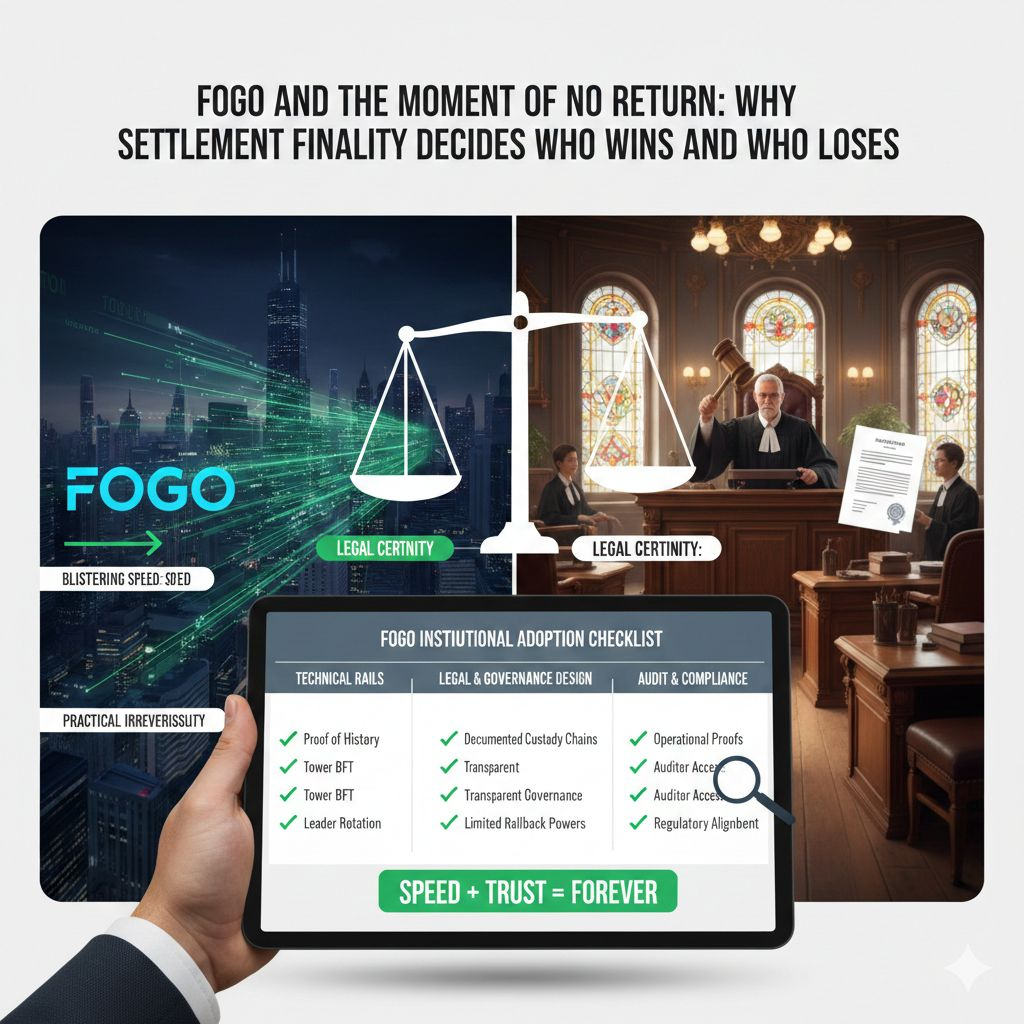
On the technical side the pieces that create confidence on a chain like Fogo are clear. Proof of History or equivalent timestamping gives a canonical ordering of events. A Tower BFT style voting mechanism makes a vote increasingly expensive to reverse as time passes and votes accumulate. Leader rotation and efficient propagation protocols reduce the window for competing forks. Those three elements together push the probability of meaningful reorganization extremely low under normal operation. Engineers and ops teams therefore treat finality as a practical guarantee not an abstract hope.
On the legal side the landscape is shifting but not uniform. In regulated markets the Settlement Finality Directive and similar policy frameworks exist to declare the moment of settlement and to insulate settled transfers from insolvency clawback. Regulators and lawmakers across jurisdictions are actively rethinking how DLT systems fit into those frameworks and how to define the “moment of finality” when the system is not a centralised exchange or a licensed clearing house. Until statutes and case law explicitly recognize a given DLT instance the legal finality of an on chain transfer depends on contracts custody arrangements and judicial interpretation. That creates variability in enforceability that cannot be solved by speed alone.
Because legal recognition matters so much, robust adoption of a high performance chain by banks and custodians usually requires three practical controls. First custody must be crystal clear. Who holds the private keys under what contractual terms. Second governance must be transparent and tightly constrained; emergency powers that can rewrite history introduce legal fragility. Third there must be a clear set of operational proofs for a court to read — immutable signed validator votes transaction inclusion proofs and a documented history of chain operation. When those elements align the chain’s technical finality becomes compelling evidence to courts and counterparties, making commercial reliance realistic. When they do not align every fast confirmation is a conditional promise not an absolute transfer.
Failures do happen, and how a protocol handles them determines the downstream legal story. A transient network partition can create temporary competing forks that require reorgs when connectivity heals. A catastrophic software bug may force coordinated patches and state fixes. Governance choices such as “do we roll back after a major exploit” are social decisions with legal consequences. If a rollback becomes part of the governance toolkit then users must price that governance risk into contracts and auditors must treat settlement as contingent. If governance is strictly limited and technical finality is defended as immutable then legal counsel can make a stronger case in favor of irreversibility. The distinction is the difference between a system that promises speed and one that promises security of title.
Dispute resolution in the world of DLT sits at the crossroads of cryptography and law. On chain artifacts give you cryptographic inclusion proofs validator vote histories and timestamps that are powerful evidence. Off chain contracts define expectations custody and remedies. Courts evaluate both. In practice disputes start on chain with evidence but finish off chain in contract negotiation litigation or insolvency proceedings. That reality means a market participant cannot simply point to a block hash and win; they must show how that hash maps to legally recognized control and how local insolvency or property rules treat that control. Bridges between on chain evidence and off chain remedies remain the critical infrastructure institutions need to trust a ledger with big money.
Accounting and financial reporting are where the abstract becomes real and visible. International accounting guidance has already said that typical crypto holdings are treated as intangible assets under IFRS unless the facts suggest otherwise. Auditors now ask pointed questions about custody confirmation controls rollback risk and whether an entity truly controls the economic benefits of the asset. If a chain’s settlement can be legally unwound auditors may require delayed recognition stronger disclosures or more conservative valuation and impairment testing. For institutions that must publish quarterly results that uncertainty can change capital treatment funding terms and even regulatory capital calculations. The accounting view therefore forces protocol designers and product teams to think in terms of “legal settlement plus evidentiary robustness” not only “throughput and latency.”
Regulators are actively moving from discussion to action. Recent policy work in the EU and commentary from financial supervisors signal a desire to bring DLT systems inside the same finality rules that govern traditional post trade infrastructure. That effort may standardize the moment of finality for systems that meet criteria such as governance transparency operational resilience and statutory designation. The practical effect is that a high performance chain that achieves those criteria could gain a much stronger claim to legal finality than one that does not. Conversely a chain that forgoes those investments may remain technically excellent but legally precarious for institutional flows.
What does all this mean for people who must make decisions today Risk managers operations legal teams and auditors must read a Fogo transaction on two parallel tracks. The first track is the technical trail: block inclusion validator votes and network health metrics that prove the transaction happened in the canonical history. The second track is the legal trail: custody agreements governance charters and jurisdictional laws that prove that the canonical history is legally protected against reversal and insolvency clawback. Only when both trails are strong can a transfer be treated as final without reservation. If either trail is weak you have speed without safety and that is not a condition under which large institutions will route serious flows.
In plain emotion charged language, here is the core tradeoff you must feel in your chest when evaluating a fast L1 like Fogo. There is exhilaration when trades settle in milliseconds and liquidity breathes. There is dread when a tiny, improbable chain event could undo a pile of value. The sensible posture is neither blind optimism nor reflexive fear but informed urgency. Build the technical rails yes but design custody governance and legal wrappers even harder. Demand auditability. Demand clear allocation of loss in every counterparty agreement. That is how the thrill of speed becomes the solidity of trust.
Practically speaking partners should insist on a checklist before treating fast confirmations as final for institutional flows. Insist on documented custody chains and third party attestation of key controls. Require proof that governance cannot unilaterally rewrite history except under narrowly defined and pre announced emergency rules. Insist on transparent validator decentralization metrics and historical stability reports. Ensure your legal agreements specify governing law dispute resolution venues and allocation of reversal risk. And make sure auditors have access to the operational evidence they need to form an opinion. When those boxes are ticked the ledger’s technical finality starts to approximate legal finality and institutions can begin to move significant balance sheet exposure onto chain with confidence.
Finally the balance sheet consequences are concrete. If legal finality is accepted accounting recognition flows naturally for custodial and self custody models. If finality is conditional then recognition may be delayed revenue or gains may be contingent and impairments could be more likely. Disclosures will swell. Capital and liquidity planning must factor in the small but systemic possibility of reorg related losses. Those are not abstract footnotes; they are decisions that change investor perception credit lines and in extreme cases market solvency. Good technical design reduces these probabilities. Good legal design makes the probabilities irrelevant. The two together are what turns a fast chain into infrastructure that institutions can bet their balance sheets on.
Fogo is a technical leap in a world that craves speed. Whether it becomes a legal and financial leap depends on the surrounding architecture lawyers design auditors accept and regulators endorse. For users and institutions that fear and hope in equal measure the message is simple and urgent: move quickly on performance but move deliberately on finality. Build for the instant thrill of execution and for the long slow work of legal certainty. That is the only way a high performance L1 becomes not only fast but forever.
If you want I can convert this into a formal risk memo with a governance checklist legal clause templates and an accounting disclosure draft or produce a slide deck that you can show to your board and auditors. Which deliverable do you want next