
I keep coming back to the line “Frankendancer today, pure Firedancer tomorrow,” because it’s one of the rare roadmap statements in crypto that actually feels honest. It doesn’t promise instant perfection. Instead, it openly acknowledges a messy transition phase. And in infrastructure work, that middle phase is where most projects either quietly slow down or break in public.
If you read $FOGO as just another “fast chain,” you miss what’s really being attempted. A more accurate interpretation is that they’re trying to price real-world physics directly into the protocol. Not as a metaphor — as an operating constraint. Distance matters. Routing matters. Jitter matters. Tail latency matters. Once you stop pretending the internet is a clean abstraction, the entire design space shifts.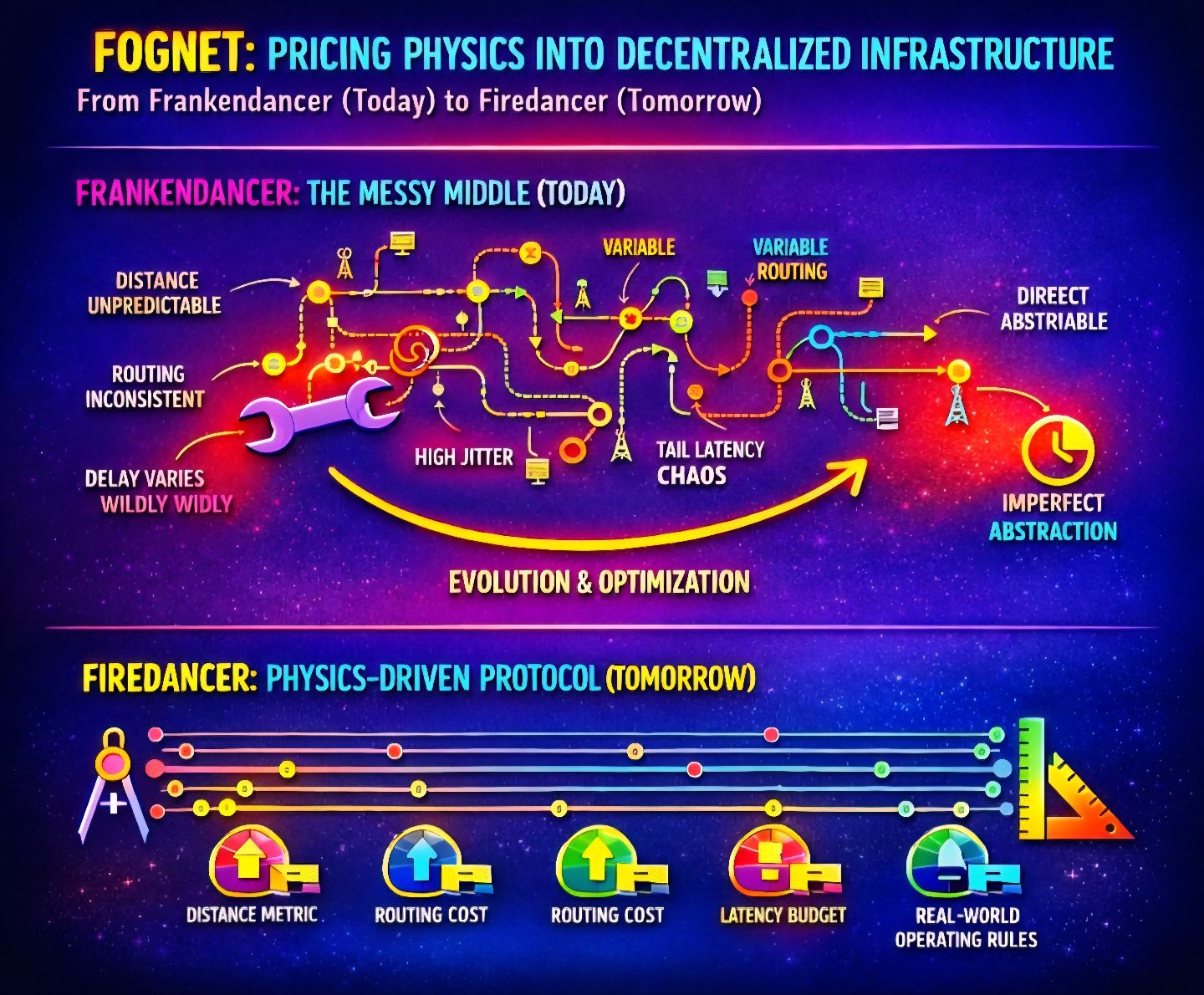
Most chains treat latency like a dial you can simply turn: optimize the VM, tweak networking, reduce block times, publish a better number. But if validators are spread across continents, you’re still bound by the speed of light and the unpredictability of real networks. Averages can improve while variance remains — and in systems where timing affects outcomes, variance is what causes real problems. Liquidations, order matching, settlement flows — these are all sensitive to inconsistency, not just raw speed.
Fogo’s “zones” concept feels like a protocol-level admission that geography isn’t optional. By tightly co-locating validators, consensus messages spend less time traveling. At the same time, rotating zones prevents the network from being permanently tied to a single region or jurisdiction. It’s not a perfect solution, but it starts from how networks actually behave rather than how we wish they behaved.
The curated validator model fits into the same realism. It understandably raises eyebrows — curated can sound like closed — but there’s an operational truth underneath. In ultra-low latency environments, weak participants don’t just affect themselves; they introduce drag for everyone. If the goal is millisecond-level cadence, pretending that any hardware in any location will perform equally is unrealistic. Either operational standards are enforced, or the slowest honest participant sets the ceiling.
That doesn’t mean curation is risk-free. It introduces governance, capture, and perception risks. The burden is on the project to ensure selection doesn’t become permanent gatekeeping. But from an engineering standpoint, curation isn’t cosmetic — it’s part of the performance model.
The validator client transition tells a similar story. “Frankendancer” might sound playful, but it represents an incremental migration strategy. Moving directly to a fully Firedancer stack would be risky. Hybrid stages allow improvements to ship while preserving stability where it matters. This kind of phased evolution isn’t glamorous, but it’s how serious performance engineering usually works.
Even the low-level implementation details — process isolation, CPU pinning, minimizing scheduler noise, fast packet I/O paths — point to a focus on controlling jitter, not just boosting throughput. Speed isn’t a single metric; it’s a distribution. A system that’s fast most of the time but occasionally stalls is effectively slow for developers building time-sensitive applications, because they must design for worst-case behavior.
That’s where the real structural value may lie — not in headline TPS numbers, but in predictable behavior under stress. Congestion, bursts of activity, and adversarial conditions are where infrastructure is truly tested. If Fogo can maintain stability in those scenarios, it expands what kinds of applications become feasible.
This isn’t about retail users caring whether blocks finalize in tens of milliseconds. Most won’t. The bet is that blockchain usage increasingly resembles real infrastructure — integrated workflows where timing and reliability are part of correctness. Once blockchains plug into systems with SLA expectations, they’re judged like infrastructure, not communities.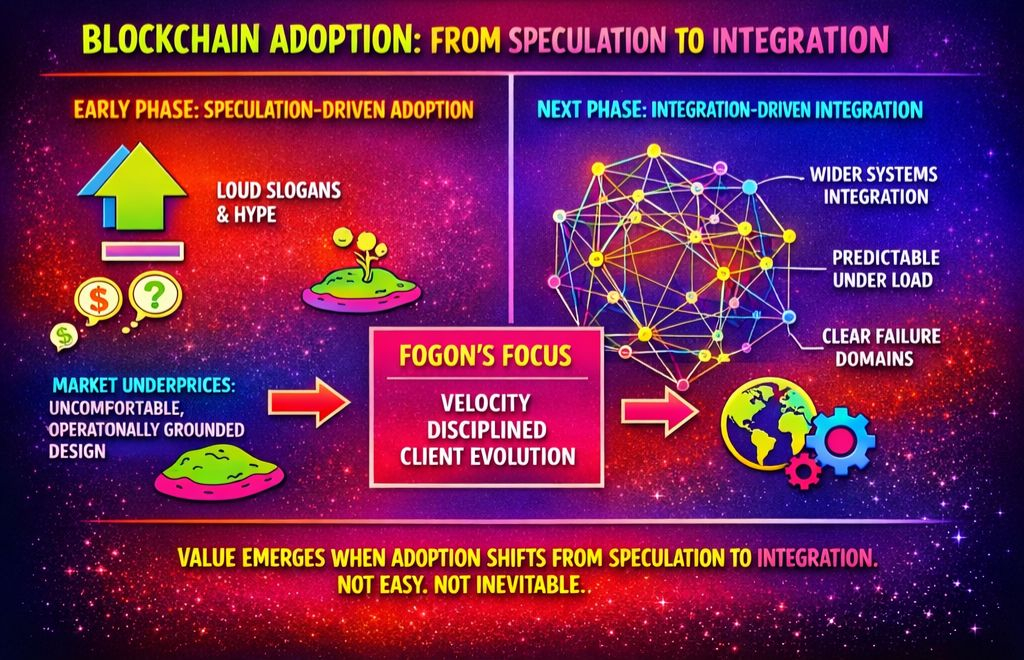
Fogo’s architecture seems aimed at that future — one where decentralization isn’t just a node count, but a balance of geography, resilience, and sustained performance. The question shifts from “Can it be fast on a good day?” to “Can it remain well-behaved on a bad one?”
None of this guarantees success. Hybrid migrations surface edge cases. Zone rotation adds governance complexity. Curated validator sets invite scrutiny. But infrastructure grounded in operational realism is often undervalued early, because its importance becomes clear only when adoption moves from speculation to integration.
That broader shift is the real context. As blockchains evolve into components of larger systems, the winners won’t be those with the loudest narratives — they’ll be the ones that behave predictably under load, define failure domains clearly, and acknowledge tradeoffs instead of hiding them. If that transition continues, Fogo’s focus on latency discipline, topology awareness, and measured evolution looks less like chasing benchmarks and more like preparing for the next phase of adoption — without pretending the path will be simple or inevitable.
#fogo #BinanceSquare $FOGO @Fogo Official
