
I've been thinking lately about why most blockchains still feel clunky for actual trading. You build a DEX on top of them, add some liquidity pools, and hope the execution stays smooth when volume picks up. Fogo takes a different path. It's a Layer 1 that runs on the Solana Virtual Machine, but the whole design centers on trading from the ground up.
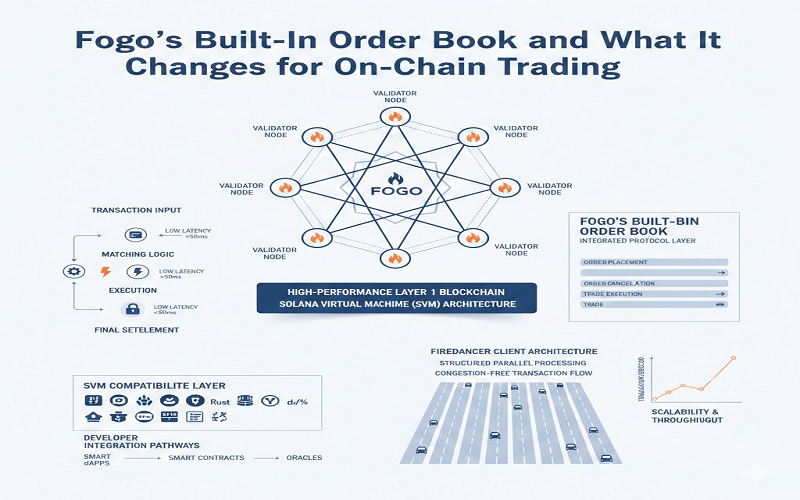
What sets it apart is the way market structure sits inside the protocol itself. Instead of leaving order books to separate smart contracts that compete for block space, Fogo bakes a limit order book directly into the chain. Liquidity lives in one place, matching happens at the base layer, and the usual fragmentation you see across dozens of pools just does not exist here. The result is execution that feels more predictable, with less of the slippage or failed fills that happen when everything has to route through general-purpose layers.
The team leaned into a Firedancer-style client to keep that performance steady. Blocks come in around forty milliseconds, finality lands in about one point three seconds, and the system handles parallel processing without letting one busy application stall everything else. For developers it is straightforward: full SVM compatibility means any Solana program deploys as-is, tools stay the same, and you can focus on building rather than rewriting for a new runtime. That compatibility lowers the barrier if you already have something running elsewhere in the SVM world.
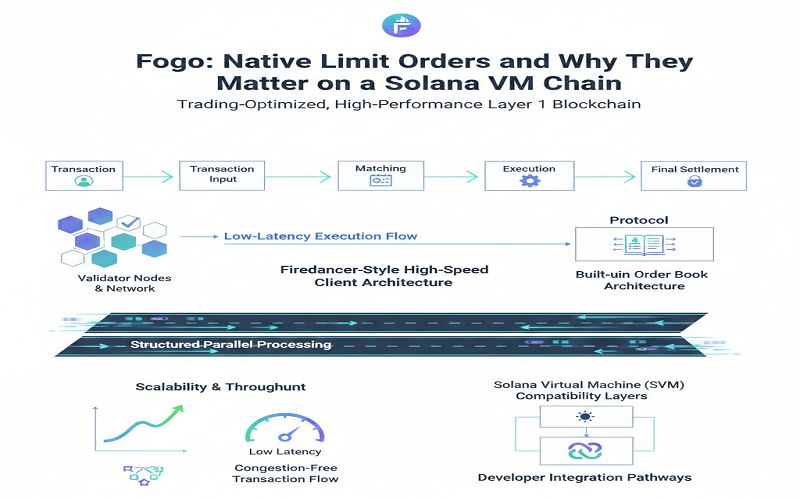
Of course the approach comes with real limits. Plenty of other SVM-based chains are chasing similar speed, so standing out depends on actual usage over time. The validator set is more curated than fully permissionless, which helps consistency but raises the usual questions about decentralization. And the broader ecosystem is still young, with most applications in early stages. None of this is hidden or glossed over in the docs.
I keep coming back to a simple analogy. Think of regular blockchains as shared highways where every type of traffic, from slow-moving cargo to high-speed commuters, squeezes into the same lanes. Fogo carves out lanes optimized for trading flows, so the applications that need tight timing and deep liquidity do not sit behind unrelated congestion.
You run across the project account @Fogo Official if you want to follow their updates, and the token associated with the network is $FOGO , often tagged in conversations under #Fogo and #fogo .