
Every technological movement begins with excitement, but only a few survive long enough to become part of everyday life. Blockchain has already passed through its early phase of hype, where speed, tokens, and speculation dominated the conversation. Yet somewhere along the way, the industry started asking a more serious question. If this technology is truly transformative, why has it not reached ordinary people in a meaningful way? Vanar Chain grows from that question. It represents a shift in mindset, one that places human experience at the center instead of technical competition.
Vanar did not emerge from a desire to build just another fast network or another financial playground. The project comes from a background rooted in gaming, entertainment, and brand partnerships, industries that understand something fundamental about adoption. People embrace what feels familiar long before they embrace what feels powerful. If blockchain is going to welcome the next three billion users, it must blend into experiences people already understand. This philosophy is not just a marketing angle. It shapes the structure of the chain itself, the products surrounding it, and the way the ecosystem measures success.
The idea behind Vanar begins with accessibility. Most blockchains were designed by developers for developers, which is why many still feel intimidating to the average person. Complex wallet setups, confusing transaction flows, and unfamiliar language create invisible barriers that discourage new users before they even begin. Vanar attempts to reverse this pattern by designing infrastructure that absorbs complexity rather than exposing it. The goal is to make blockchain interactions feel as natural as logging into a game, collecting a digital item, or joining a virtual event. When technology disappears into the background, adoption stops feeling like a learning curve and starts feeling like participation.
This thinking becomes clearer when looking at the ecosystem forming around the chain. Instead of launching infrastructure and hoping developers find uses for it, Vanar connects its network directly to real consumer verticals. Gaming plays a central role because it naturally introduces digital ownership. Through the VGN games network, players interact with assets that can carry value across experiences rather than remaining locked inside a single title. Virtual environments like the Virtua Metaverse extend this concept into social identity and digital spaces where users gather, explore, and express themselves. Brand integrations add another layer, showing how companies can create loyalty systems, collectibles, and immersive experiences that blend digital ownership with familiar consumer relationships.
These elements work together to create something more than a technical platform. They form a narrative that feels grounded in culture rather than code. If someone earns a digital collectible from a favorite brand, attends a concert inside a virtual environment, or trades an in game asset seamlessly, they are already participating in Web3 even if they never use the word. This is how adoption often happens in reality. It spreads through experiences rather than explanations.
Underneath these user facing layers, Vanar operates as a Layer one blockchain. Controlling its own foundation allows the network to tailor performance, security, and scalability toward consumer use instead of purely financial transactions. Many chains prioritize trading activity because that is where early demand existed. Vanar’s approach assumes that the next stage of blockchain growth will come from digital identity, entertainment ecosystems, and creator driven economies. This assumption influences how the infrastructure handles execution, data management, and asset ownership.
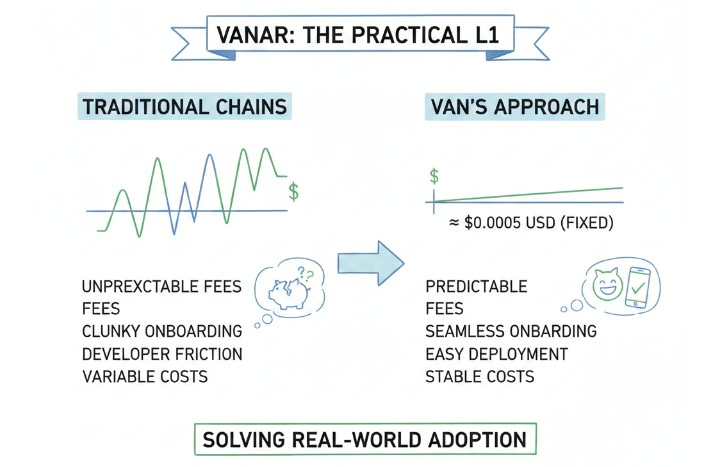
The network focuses heavily on scalability because consumer applications generate different patterns of activity than financial protocols. A game, a social environment, or a brand campaign may involve millions of small interactions rather than fewer high value transfers. Handling that kind of load requires efficient processing and consistent performance. Equally important is the concept of abstraction. Instead of forcing users to understand private keys, gas fees, or contract interactions, the system aims to simplify these steps behind the interface. If it becomes easier to interact with blockchain based systems than with traditional digital services, the technology crosses a crucial threshold. It stops being experimental and starts becoming infrastructure.
Measuring progress in such an ecosystem requires a different lens than the one typically used in crypto markets. Price movements and transaction spikes can be misleading because they often reflect speculation rather than real engagement. Vanar’s development makes more sense when evaluated through adoption quality. Are users returning to the ecosystem over time? Are they interacting with multiple applications instead of just one? Are brands building ongoing digital experiences rather than one time promotional drops? These signals indicate whether the network is becoming a living environment or simply hosting short bursts of attention.
Another meaningful metric lies in ecosystem connectivity. When gaming identities integrate with virtual spaces, when digital collectibles move across platforms, and when brand experiences feed into social interactions, the network begins to function as a cohesive system rather than a collection of isolated projects. This kind of integration suggests durability. It shows that the chain is not just supporting activity but enabling relationships between different layers of digital life.
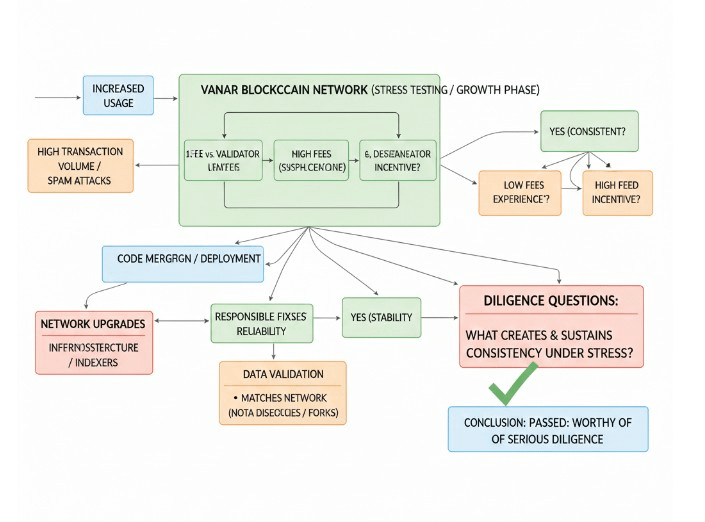
Despite these ambitions, the journey forward includes real risks. Technical challenges remain constant for any network aiming to scale consumer adoption. If demand rises suddenly, maintaining performance and security simultaneously becomes critical. Even small delays or inconsistencies can damage trust when mainstream users are involved. Infrastructure must hold steady under pressure, and achieving that reliability requires continuous optimization and testing.
User behavior presents another challenge. People do not change digital habits easily. Even when a system is objectively better, adoption can stall if onboarding feels unfamiliar or intimidating. Vanar’s emphasis on simplicity reflects an understanding that psychology often matters more than capability. A system that feels comfortable invites participation, while one that feels complicated pushes users away regardless of its power.
Regulation adds a further layer of uncertainty. As governments refine policies around digital ownership, tokens, and virtual economies, networks connected to gaming, entertainment, and brand ecosystems may face evolving compliance requirements. Navigating these rules while preserving decentralization and user autonomy will require careful strategic decisions. Success in this environment depends not only on technology but also on adaptability.
Market dynamics also play a role. The crypto landscape moves quickly, and narratives can shift in a matter of months. Projects that fail to maintain visibility risk losing momentum even when development continues steadily. Sustained storytelling and consistent product delivery must move together to ensure progress remains visible to users, developers, and partners alike.
Within this evolving environment, the VANRY token acts as the connective element across the ecosystem. It supports transaction validation, incentivizes network participation, and fuels interactions across applications. More importantly, it links multiple verticals into one shared value layer. When a single token functions across gaming environments, virtual spaces, and brand ecosystems, it becomes more than a medium of exchange. It turns into a unifying thread that ties experiences together.
This kind of integration has long term implications. Tokens rooted in real interactions tend to develop stronger foundations than those driven solely by speculation. When value flows through experiences people actually enjoy, it becomes more resilient to market fluctuations. The token’s role evolves alongside the ecosystem, reinforcing participation rather than merely reflecting sentiment.
Looking ahead, Vanar’s trajectory feels less like a race and more like a gradual construction process. The project does not rely on dramatic announcements or short term excitement. Instead, it builds through partnerships, product expansion, and steady ecosystem growth. This approach may seem slower compared to hype driven cycles, but it often produces stronger foundations. Technologies that last rarely explode into existence overnight. They grow through repeated use, quiet trust, and consistent improvement.
If the future of Web3 depends on making blockchain feel natural rather than revolutionary, Vanar’s direction becomes easier to understand. The project is not trying to convince people to care about decentralization in abstract terms. It is trying to show them why digital ownership, shared virtual spaces, and creator driven economies can enhance experiences they already value. When people begin to participate without needing persuasion, adoption stops being a goal and starts being a reality.
In the end, Vanar Chain represents more than infrastructure. It reflects a belief that technology succeeds when it aligns with human behavior rather than challenging it. By focusing on entertainment, culture, and accessible design, the ecosystem attempts to weave blockchain into the fabric of everyday digital life. The journey is far from complete, and the path ahead will test both resilience and vision. Yet if persistence continues to guide development and real experiences continue to anchor growth, Vanar’s quiet approach may prove powerful in the long run.
The most lasting platforms in history were not always the loudest at the beginning. They were the ones that solved real problems, earned trust slowly, and kept building when attention shifted elsewhere. If Vanar stays on that path, it may not just help expand Web3. It may help redefine what adoption truly means, turning blockchain from a concept people discuss into a world they simply live inside.