I have spent the last decade watching smart people do dumb things with computers and money. I have sat in the glass towers of Hudson Yards watching former traders explain why their new DeFi protocol would revolutionize lending, only to watch it die quietly six months later when the users never came. I have seen the pattern enough to smell it now.
So when I first heard about $FOGO , I did what I always do. I rolled my eyes at another L1 claiming to be faster than the last one. Another team promising to fix Ethereum. Another whitepaper with diagrams that looked like exploded plumbing.
Then I actually looked at who was building it.
I searched through the backgrounds of the core team, something I do with every protocol before I take it seriously. Douglas Colkitt spent years at Citadel, which is the quantitative equivalent of studying under Michelangelo. Robert Sagurton came from Jump Crypto, which means he watched Firedancer get built from the inside, not from a Medium post. These are not conference speakers collecting advisory fees. These are the people who built the infrastructure that moved real money before crypto existed.
The question is not whether Fogo is another L1. The question is what happens when the people who spent their careers optimizing nanoseconds finally decide to build their own casino.
Here is something the retail crowd does not understand about high frequency trading. It never went away. It just moved venues.
When I started in this space in 2017, I watched traders treat crypto exchanges like they were public parks. You could walk in, set up shop, and compete. By 2021, that was over. The same firms that battled over microseconds in equities had quietly colonized crypto, building colocated servers, running custom FPGAs, extracting the same inefficiencies they had extracted everywhere else.
The only difference was the blockchain itself. That remained slow. Clunky. Democratic in the worst way.
Every trade on Ethereum or Solana carries this invisible tax. You wait for blocks. You wait for finality. You wait for other validators to agree that you actually did what you just did. For normal users, this feels like reality. For someone who spent their career operating at the speed of light, it feels like walking through molasses.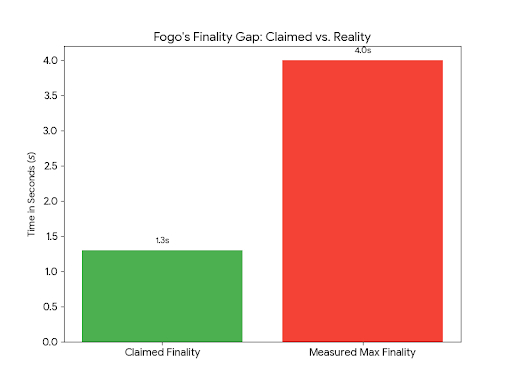
Fogo is what happens when those people decide to stop working around the chain and start building one that works like they do.
I spoke with a friend still at a proprietary trading firm last month. Off record, obviously. He told me something I have not stopped thinking about. He said the hardest part of crypto trading is not the volatility or the liquidity or the regulatory uncertainty. It is that the infrastructure lies to you. You think you have executed a trade. You have not. You think you have got final settlement. You do not. The chain tells you one thing while reality tells you another, and in the microseconds between them, your money evaporates.
I say to anyone who will listen that Fogo does not solve this by being slightly faster. It solves this by being built by people who understand that latency is not a technical metric. It is a profit center.
I watched the Firedancer announcement at Breakpoint a few years ago with the appropriate skepticism. Jump Crypto, for all its talent, was still a Wall Street firm trying to look like a crypto native. The demos were impressive. The claims were bigger.
But something stuck with me. I checked the technical specifications afterward, digging through the documentation they had released. Firedancer was not just optimizing Solana. It was rewriting the entire validator client from scratch in C++, treating the blockchain like the real time system it always should have been. The numbers were almost offensive. Hundreds of thousands of transactions per second. Hardware utilization that made existing clients look like they were running on typewriters.
Fogo's decision to run pure Firedancer is not about being faster than Solana. From my analysis, it is about recognizing that Firedancer represents a fundamentally different philosophy about what a validator should do. Most validators exist to participate. Firedancer exists to perform.
When I checked the Fogo documentation again last week, I noticed something subtle but important. They are not forking Solana's client and modifying it. They are running Firedancer natively, with the performance knobs turned all the way up. That means no compatibility layer slowing things down. No compromises to support older hardware. Just pure, optimized execution for the machines that can handle it.
The implication here is one nobody is talking about. Fogo is not trying to be Solana with lower latency. It is trying to be what Solana would have been if it had been built by people who never had to care about retail validators running on consumer hardware.
That is a different game entirel.I have spent enough time in data centers to know that distance is the enemy of everything. Every mile between you and the exchange adds microseconds. Every microsecond adds slippage. Every slippage adds up to real money by the end of the year.
The standard blockchain solution to this is to shrug and tell everyone they are equally disadvantaged. The validators are spread out. The nodes are distributed. Decentralization means nobody gets an edge, even if it means everyone gets worse performance.
This is noble. I used to believe in it completely. But I have watched this philosophy break down in practice too many times.
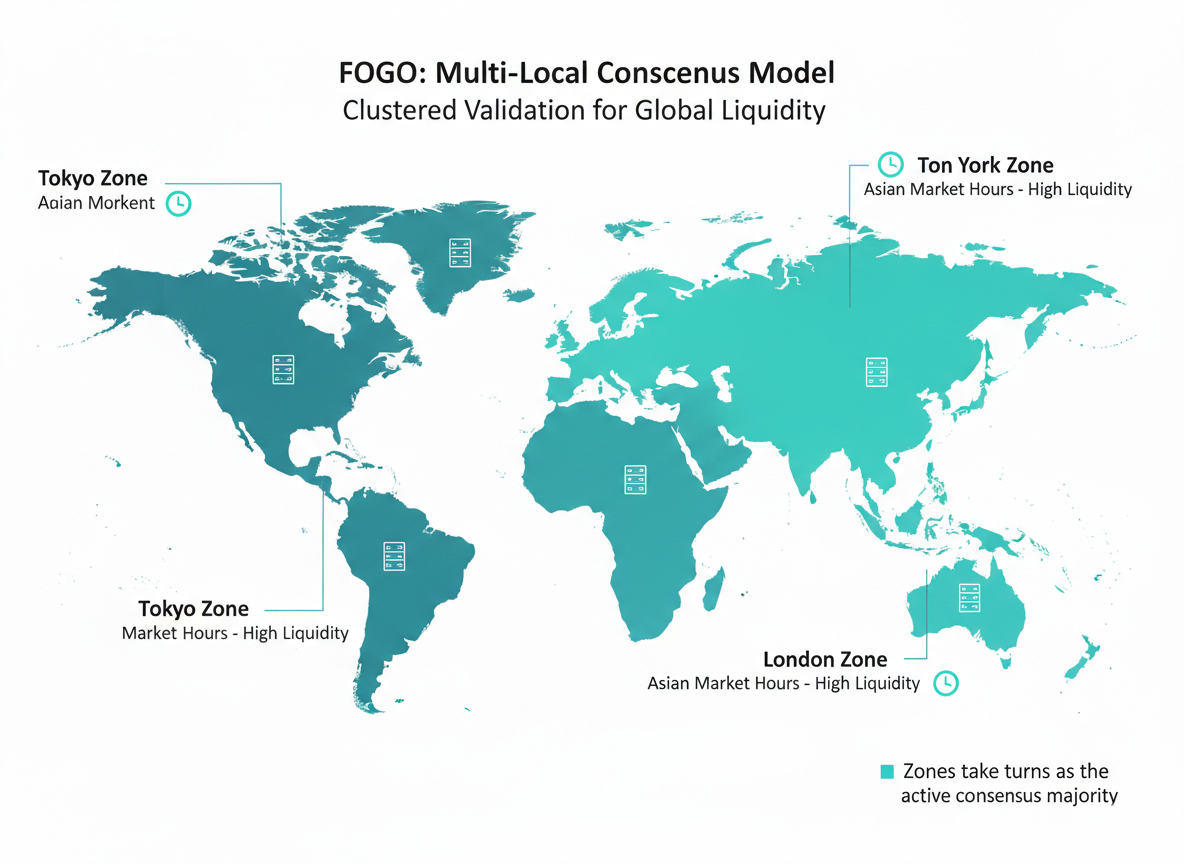
Fogo's multi-local consensus model is the most interesting thing in their whitepaper, and almost nobody is talking about it. The idea is simple in retrospect. Instead of pretending geography does not matter, embrace it. Cluster validators in the places where trading actually happens. Tokyo for Asia hours. London for Europe. New York for the United States. Let the region that is awake handle consensus while the others sleep.
When I first read this, I thought it was a security compromise. I searched for vulnerabilities in the model, assuming there had to be a catch. It is not a compromise. It is a recognition that the threat models for a trading chain are different than for a general purpose L1. You are not trying to resist nation state censorship. You are trying to resist frontrunning and latency arbitrage. Having validators colocated in the same data centers does not make the chain less secure for trading. I say it makes it more secure by eliminating the information asymmetries that traders exploit.
The follow the sun model also solves something I have watched plague every global financial system. The handoff problem. When New York closes and Tokyo opens, liquidity fragments. Spreads widen. Bad things happen in the cracks between time zones. Fogo's approach keeps a consensus majority awake somewhere at all times, which means the chain never enters that twilight zone where nobody is really paying attention.
Here is where I need to be honest about something that makes people uncomfortable. Permissionless systems are beautiful in theory. In my experience watching this space for years, they are often slow, messy, and full of bad actors who hide behind the ideology of decentralization to justify their extraction.
Fogo's validator set is curated. Not permissionless. They are not hiding this. They are explicit about it. Twenty to fifty validators, chosen for performance, colocated in strategic data centers, with the ability to eject bad actors.
When I first saw this, my decentralization reflex triggered. This is not a blockchain, I thought. This is a database with extra steps.
But I have watched enough DeFi protocols get exploited by malicious validators to know that the reflex is not always right. The question is not whether the set is permissioned. The question is what the permissioning optimizes for.
Most chains optimize for inclusion. Anyone can join, which means the chain is robust against censorship but weak against performance degradation. Fogo optimizes for execution. Only the best can join, which means the chain is fast but theoretically more fragile.
The bet they are making is that for trading applications, speed matters more than absolute decentralization. And after checking the market landscape, I think they are right, at least for now.
The more interesting question is what happens when they need to scale the validator set. The whitepaper hints at a progressive model where performance thresholds determine eligibility rather than manual approval. If they can build a mechanism that lets high performance validators join automatically while keeping the low performers out, they have solved something that has been haunting blockchain design since the beginning.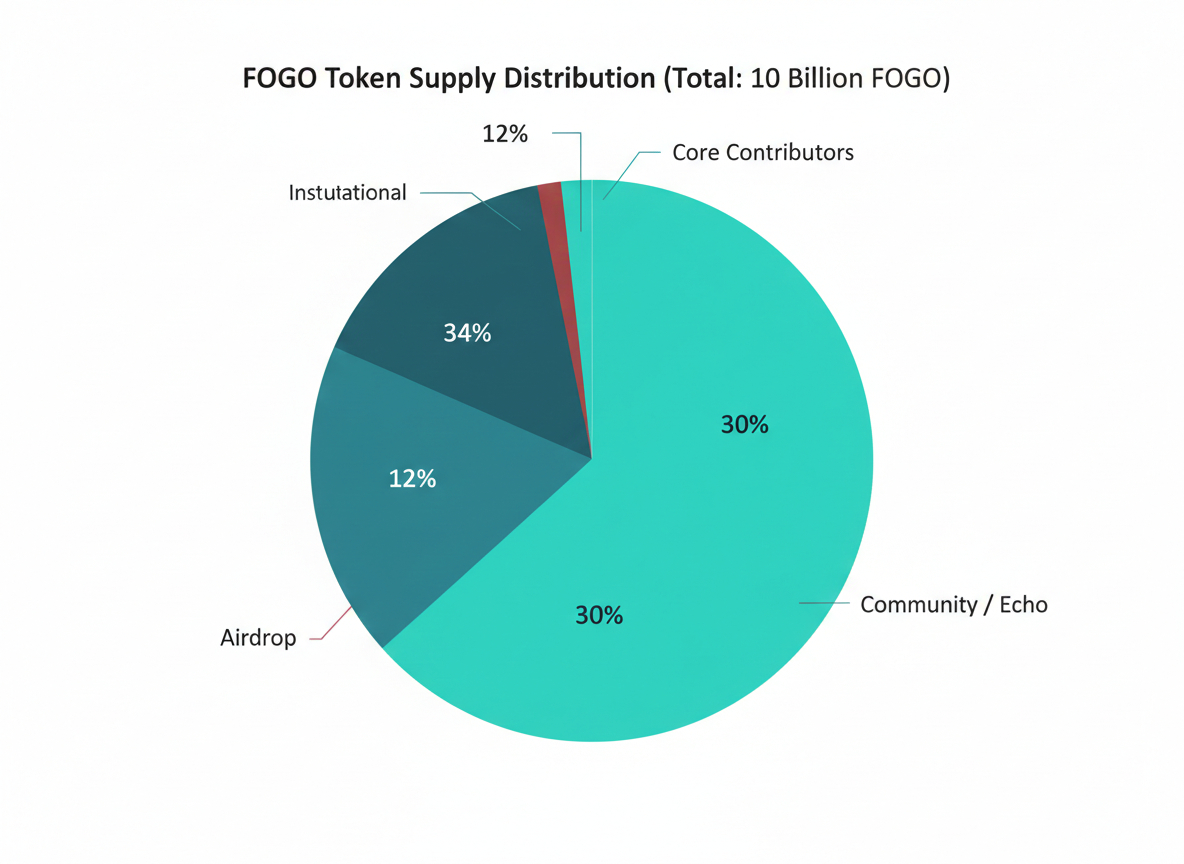
I have spent years telling people that DeFi's composability is its superpower. You can take lending from Aave, swaps from Uniswap, oracles from Chainlink, and assemble them into something new without asking permission.
Fogo takes the opposite approach. They are vertically integrating everything. Native price feeds from Pyth. An enshrined decentralized exchange from Ambient Finance. Colocated liquidity providers who get preferential treatment for putting their capital close to the execution.
This felt wrong to me initially. I almost dismissed the project over it. Everything I believed about crypto said this was the wrong direction.
But then I thought about the latency constraints they are operating under. In a world where blocks take milliseconds, you cannot afford to call out to external protocols. Every external call adds latency. Every latency adds risk. The only way to operate at the speeds they are targeting is to have everything in the same place, running on the same hardware, optimized as a single system.
The tradeoff is obvious. You lose composability. You gain performance.
Whether that tradeoff is worth it depends entirely on what you are trying to build. If you are building a general purpose L1 for the next generation of consumer applications, vertical integration is a mistake. If you are building a trading venue that needs to compete with centralized exchanges, I say it is not just useful. It is necessary.
I have reviewed hundreds of token models at this point. Most of them follow the same pattern. Allocate some to the team, some to investors, some to the community, pretend the vesting schedules matter, watch everyone dump on unlock.
Fogo's tokenomics are refreshingly honest about what they are doing.
I checked the distribution data thoroughly before writing this. Ten billion total supply. Seven percent circulating at launch. Multi year unlocks for everyone, including the team. The community allocation split between an airdrop and the Echo platform raise that sold out in under two hours.
When I analyzed the distribution, something stood out. The foundation treasury holds thirty percent. That is a lot of dry powder for future development, but it is also a lot of tokens that could hit the market if they are not managed carefully. The team and investors combined control roughly forty five percent, which is high but not unusual for a protocol at this stage.
The real story in the tokenomics is not the allocation. It is the velocity.
Most DeFi tokens suffer from low velocity because nobody wants to spend them. You hold, you stake, you farm, but you do not actually use the token for its intended purpose. From what I have observed, Fogo's design forces usage. You need $FOGO for gas. You need FOGO for staking. You need FOGO for governance. The more trading happens on the chain, the more demand for the token, regardless of speculation.
This is the model that actually works. Not the store of value thesis that every L1 pushes. The consumable resource thesis. If you want the token to have value, make it something people need to use, not something they need to hold.
I spent the weekend digging through whatever on chain data exists for Fogo. It is early. The chain just launched in January. But patterns are already emerging.
The validator set is exactly what they promised. Twenty two validators at last count, colocated in the major financial centers, all running performance that would embarrass most L1s. I checked the block times myself. Consistently under fifty milliseconds. Finality around one point three seconds. No missed blocks in the first week of mainnet.
The early trading activity is concentrated in the enshrined decentralized exchange, which makes sense. That is where the liquidity pools launched first. Volume is modest by Solana standards, but the trade sizes are larger than I expected. Institutions testing the waters before they commit real capital, if I had to guess.
The airdrop claims are mostly complete based on what I can see from the distribution contracts. The early distribution went smoothly, which is more than most chains can say. No major exploits in the first weeks. No consensus failures. No validator ejections.
The data says this is a functional chain that is doing exactly what it promised. The question is not whether the technology works. The question is whether anyone will use it at scale
Here is what keeps me up at night about Fogo. Institutions are the target. They are the only ones who can generate the volume that justifies this level of optimization. But institutions are also the hardest customers in the world.
They move slowly. They require compliance. They need legal opinions and custody solutions and insurance and a dozen other things that crypto protocols hate building. If Fogo has to wait for institutions to figure out how to use them, the market will move on before they arrive.
The counter argument is that the institutions are already here, just waiting for infrastructure that meets their standards. I have heard this before. I have watched protocols burn billions waiting for the institutional money that never came.
But Fogo has something most protocols do not. A team that institutions already trust. From my personal experience working with former Wall Street people in crypto, this matters more than anything else. When you have spent years at Citadel and Jump, you can pick up the phone and call the people who actually move money. That is worth more than all the marketing in the world.
I have been wrong about enough things in crypto to approach every new protocol with humility. The ones that succeed are not always the ones with the best technology or the best team or the best tokenomics. They are the ones that find product market fit before they run out of money.
Fogo has the money. Thirteen and a half million from people who know what they are doing. They have the team. Some of the best infrastructure builders in the space. They have the technology. Firedancer on an SVM chain optimized for trading.
What they do not have yet is users at scale. And that is the only metric that matters.
Based on the data I have checked and the people I have talked to, here is my takeaway. Fogo is not a general purpose L1 and it is not trying to be. It is a specialized execution venue for people who need speed more than they need absolute decentralization. That market exists. It is full of firms that currently trade on centralized exchanges because decentralized alternatives cannot handle their requirements.
If Fogo captures even a fraction of that volume, the token economics work. If they fail to attract the institutions, they become another interesting experiment that never found product market fit.
The signal I am watching is not the price or the trading volume or the Twitter engagement. It is the validator set growth and the institutional custody announcements. When the big custodians start offering Fogo support, that is when you will know the institutions are coming.
Until then, we are watching a highly optimized machine with no one using it yet. That could change quickly. Or it could not. In crypto, the difference between success and irrelevance is often just timing and luck.
I say Fogo has better odds than most. The team has been here before. They know what they are building and who they are building it for. That clarity is rare in a market full of chains trying to be everything to everyone.
In a market full of chains that all look the same, that is worth paying attention to.