Most people hear “SVM chain” and immediately think about Solana.
Speed. TPS. Low latency.
But Fogo isn’t trying to win a TPS leaderboard.
It’s targeting something far less flashy — and far more structural.
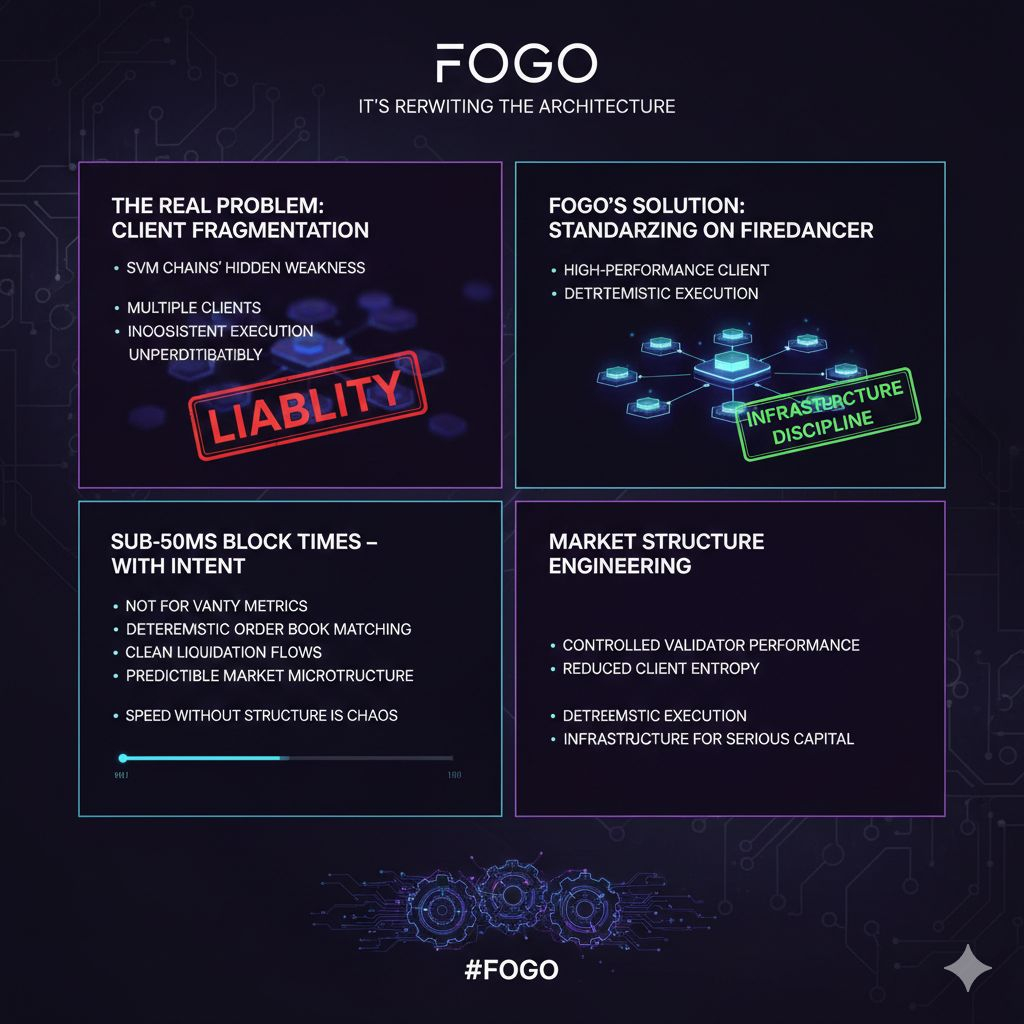
The Real Problem: Client Fragmentation
SVM chains have a hidden weakness:
client fragmentation.
Multiple validator clients.
Different performance behaviors.
Inconsistent execution characteristics.
In theory, that sounds decentralized.
In practice, it creates unpredictability.
For retail DeFi, maybe that’s tolerable.
For institutional-grade markets? It’s a liability.
Fogo sees that clearly.
Standardizing on Firedancer
Firedancer isn’t just another validator client.
It’s engineered for high-performance, deterministic execution.
Fogo’s decision to adopt Firedancer as the standard client is deliberate.
It sacrifices some theoretical decentralization in exchange for:
Predictable validator behavior
Consistent execution environments
Lower variance in performance
Reliability under stress
That’s not a marketing move.
That’s infrastructure discipline.
Sub-50ms Block Times — But With Intent
Yes, Fogo is targeting <50ms block times.
But not for vanity metrics.
The real goal:
Deterministic order book matching
Clean liquidation flows
Institutional-style DeFi execution
Predictable market microstructure
Because speed without structure is chaos.
And DeFi has already seen enough of that.
This Is Market Structure Engineering
Fogo isn’t building “a faster Solana.”
It’s engineering:
Controlled validator performance
Reduced client entropy
Deterministic execution for high-frequency activity
Infrastructure that can support serious capital
That’s not scaling throughput.
That’s redesigning the rails.
People will keep comparing it to Solana because that’s easy.
But the real story isn’t about TPS.
It’s about predictability.
And in financial markets, predictability beats raw speed every time.
That’s market structure engineering at another level 🔥