
If you really want to understand what Fogo (FOGO) is trying to do, stop comparing it to other chains on a simple TPS leaderboard. Throughput numbers are easy to market. Execution quality is harder to design. Fogo’s core idea isn’t “be faster than everyone else.” It’s to reduce inconsistency in speed — the tiny variations in timing that quietly distort trading outcomes.
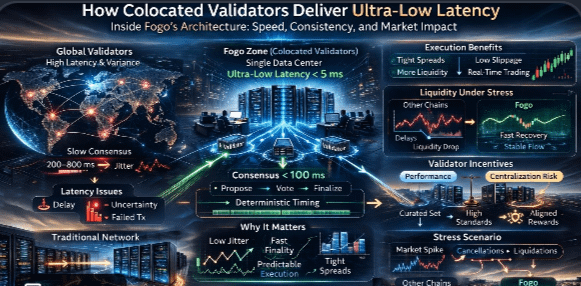
In markets, jitter is more dangerous than raw latency. A system that is predictably 20 milliseconds is often safer than one that swings between 5 and 80. When timing varies, traders widen spreads, hold excess collateral, and hesitate on tighter opportunities. Not because they are inefficient, but because uncertainty forces defensive behavior. That defensive posture is what drains liquidity during volatile periods.
By placing validators physically closer together, the network reduces geographic delay and timing variance before consensus even begins. Instead of letting global internet conditions dictate performance, it narrows the communication path. Consensus becomes bounded more by hardware limits than by oceans and routing hops. That doesn’t just improve speed — it improves determinism.
Determinism is what traders feel.
When execution timing is stable, market makers can quote tighter spreads because the window for adverse selection shrinks. Arbitrage strategies can operate on thinner edges because execution risk declines. Capital buffers can be reduced because rebalancing becomes more reliable. Over time, this can make a venue “feel” deeper than its raw capital suggests. Liquidity isn’t magically created — it simply stops being destroyed by noise.
But this design choice introduces tradeoffs.
Colocation concentrates infrastructure. When validators share geography, they also share risk exposure. Regional outages, data center issues, or routing disruptions become correlated events. Instead of isolated validator problems, you risk systemic pauses. Backup systems help, but failover under heavy market load is where infrastructure reveals its real resilience. A chain built for trading cannot just be fast in normal conditions — it must remain predictable under stress.
There is also an operational dimension. Performance-oriented validator environments tend to attract specialized operators with elite infrastructure. That can be beneficial for execution quality, but it subtly reshapes participation. When the bar to operate is high and location-specific, validator diversity can narrow. The conversation then shifts from ideology to incentives: how do you preserve performance while avoiding governance or operator concentration?
In high-speed markets, governance stability matters as much as hardware speed. A venue that executes predictably but upgrades unpredictably introduces a different form of risk. For a trading-focused chain, execution determinism must be paired with policy clarity.
Stress scenarios are the real proving ground. During volatility, feedback loops tighten. Liquidations cascade faster. Quotes update more aggressively. Capital moves rapidly. A well-designed low-latency chain can enable clean price discovery in these moments. A poorly prepared one can see liquidity evaporate in seconds. Traditional exchanges implement circuit breakers and volatility controls for a reason. An execution-first blockchain needs similarly transparent overload behavior.
There is also a second-order economic effect. Faster and more reliable settlement reduces idle capital requirements. Traders don’t need excessive buffers. Funds rotate more efficiently. That increases capital efficiency but also raises reflexivity — capital can flow in quickly, and exit just as fast. Speed amplifies both expansion and contraction cycles.
So when Fogo emphasizes ultra-low latency from day one, it’s making a clear strategic choice: pay for determinism with geography. Colocated validators are the mechanism. The ongoing challenge is managing correlated infrastructure risk and operator incentives without degrading execution quality.
If Fogo succeeds, it won’t just be another fast chain. It will operate more like an execution venue — a place where trades can be planned, sized, and risk-managed with confidence. If it fails to balance performance with resilience, the market will treat it accordingly: useful in calm weather, questionable in a storm.
That distinction — not TPS — is what will ultimately define its edge.