
Most platforms are optimized for launch day.
You can see it in how they talk about themselves: features, throughput, roadmaps, integrations. The story is always about what’s coming next, rarely about what it will feel like to run this thing every day for three years.
That’s where a lot of infrastructure quietly breaks down.
Not because it can’t handle load.
But because it can’t handle routine.
What stands out about Vanar Chain’s direction is how much it seems to care about the operational life of a system, not just its technical potential. There’s a difference between something that demos well and something that teams are willing to put into their core workflows and forget about.
In real environments, most pain doesn’t come from edge-case failures. It comes from daily friction. Small inconsistencies. Slightly confusing behaviors. Processes that work, but only if the same two people are around to remember why.
Over time, that friction becomes institutional. New engineers learn the system through tribal knowledge. Old engineers become gatekeepers. Changes slow down, not because the system is fragile, but because nobody trusts their understanding of it anymore.
Vanar’s design posture feels like it’s trying to avoid that trap.
Instead of pushing complexity upward and asking teams to absorb it, the platform seems more focused on making the base predictable enough that higher layers don’t need to compensate. That’s not glamorous. But it’s exactly what makes systems survivable.
There’s a quiet discipline in building for operations.
It means caring about how things fail, not just how they perform. It means preferring clear behavior over clever shortcuts. It means designing so that when something goes wrong at 3 a.m., the path from symptom to cause doesn’t look like a maze.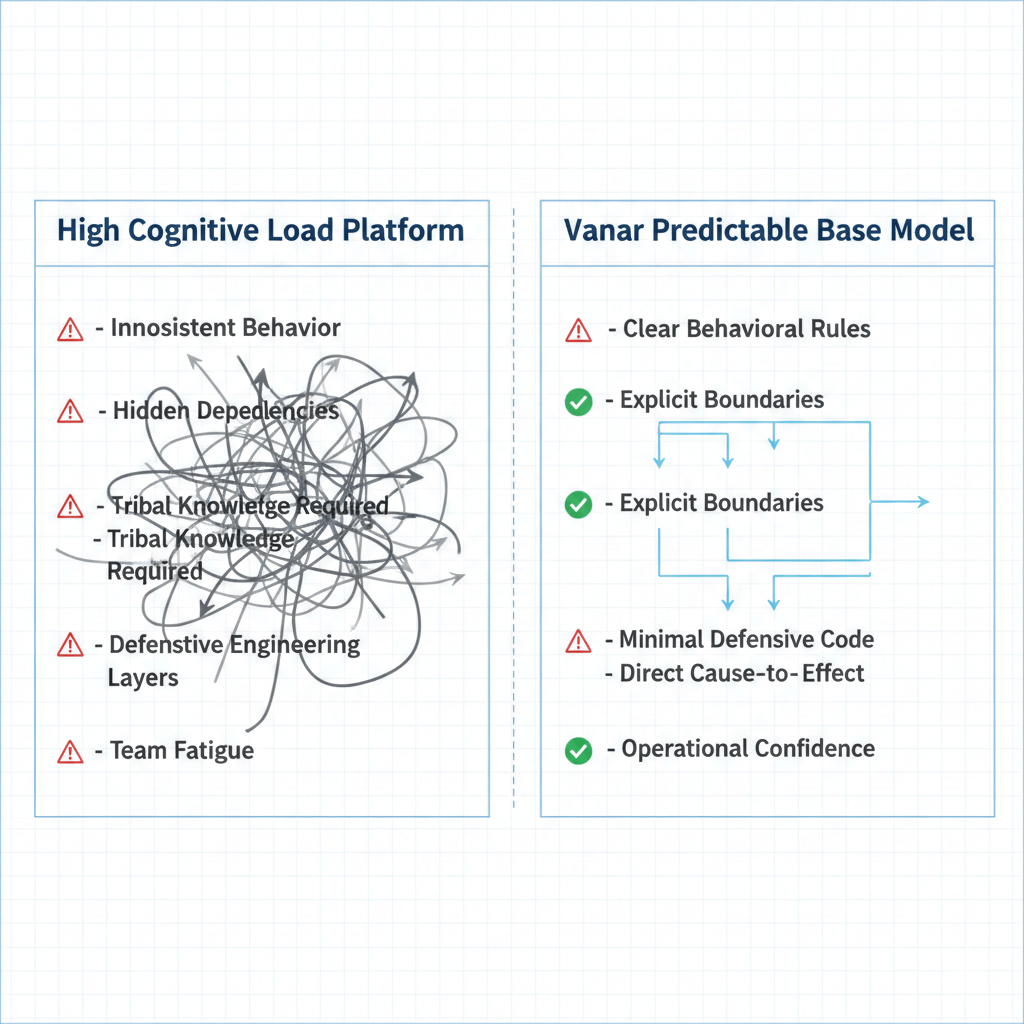
Most teams don’t burn out because systems are slow.
They burn out because systems are mentally expensive.
Every time you have to second-guess what a component is supposed to do, you pay a cognitive tax. Every time behavior depends on history instead of rules, you pay it again. Over months and years, that tax adds up more than any performance issue ever could.
Vanar’s approach feels more like it’s trying to minimize that long-term cost.
Not by freezing the system or avoiding change, but by forcing change to stay legible. When evolution has to fit within a clear structure, you don’t just get safer upgrades—you get a platform that remains explainable to people who weren’t there at the beginning.
That matters a lot more than it sounds.
Most platforms lose their original clarity long before they lose users. The code still runs. The docs still exist. But nobody can quite tell you, end to end, how things are supposed to behave anymore. At that point, the system is alive, but it’s no longer healthy.
Vanar seems to be betting on a different outcome: a system that can grow without becoming narratively fragmented.
This also changes how teams plan.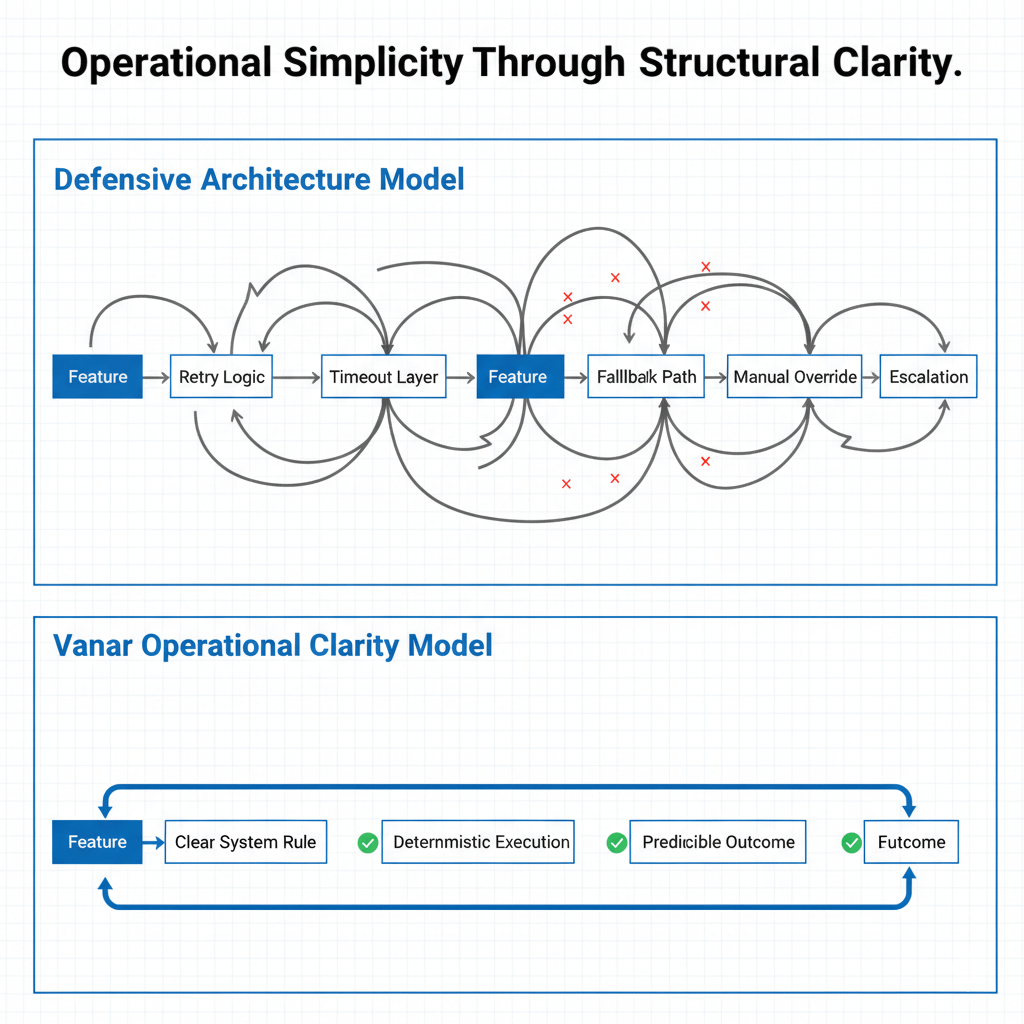
When the base layer is predictable, you don’t need to overdesign every feature with escape hatches and fallback logic. You can build closer to your actual intent instead of building defensively. Products get simpler. Architectures get flatter. Decisions get easier to reverse because they’re easier to understand in the first place.
There’s also a strategic side to this.
Platforms that optimize for shipping speed often win early. Platforms that optimize for operational clarity often win later. They become the places where serious workloads settle, not because they’re the most exciting, but because they’re the least exhausting.
That’s how real infrastructure usually becomes central. Not through hype cycles, but through quiet accumulation of trust.
Vanar doesn’t feel like it’s trying to be the most talked-about system in the room. It feels like it’s trying to be the one people stop arguing about and start depending on.
And in practice, that’s a much harder thing to build.
Because it requires saying no to certain kinds of complexity.
It requires choosing coherence over cleverness.
And it requires designing not just for users, but for the people who will have to live inside the system for years.
If Vanar keeps leaning into that philosophy, its real advantage won’t be measured in headlines or benchmarks. It will show up in something quieter: teams that stop budgeting mental energy for the platform itself and start spending it on what they’re actually trying to build.
That’s usually the point where infrastructure stops being a tool and starts being a foundation.