The question of when the Clarity Act will pass reflects more than curiosity — it reflects an industry that has operated for years in regulatory gray zones. The bill in focus, formally known as the Digital Asset Market Structure Clarity Act, represents the most comprehensive federal attempt to define digital asset market structure in the United States.
The legislation has already cleared a major hurdle. It passed the House of Representatives in mid-2025 with bipartisan backing, signaling that crypto market structure is no longer treated as experimental policy. It then moved to the United States Senate Committee on Banking, Housing, and Urban Affairs, where it now awaits committee action.
This Senate phase is decisive. Committees do more than review bills — they reshape them. Language can be amended, regulatory authority boundaries can be adjusted, and compromises are negotiated. Even though the House approved a version, the Senate is not required to pass it unchanged. If revisions are adopted, both chambers must reconcile differences before the bill can go to the President.
At the heart of the debate is regulatory jurisdiction. The Clarity Act aims to define clearer boundaries between the U.S. Securities and Exchange Commission and the Commodity Futures Trading Commission. This distinction determines which rulebook governs digital asset exchanges, issuers, and intermediaries — and how enforcement will look for years to come.
There are also negotiations surrounding stablecoin oversight, disclosure standards, and how decentralized protocols fit within regulatory frameworks. These are not minor technical details. They shape compliance costs, innovation incentives, and institutional participation.
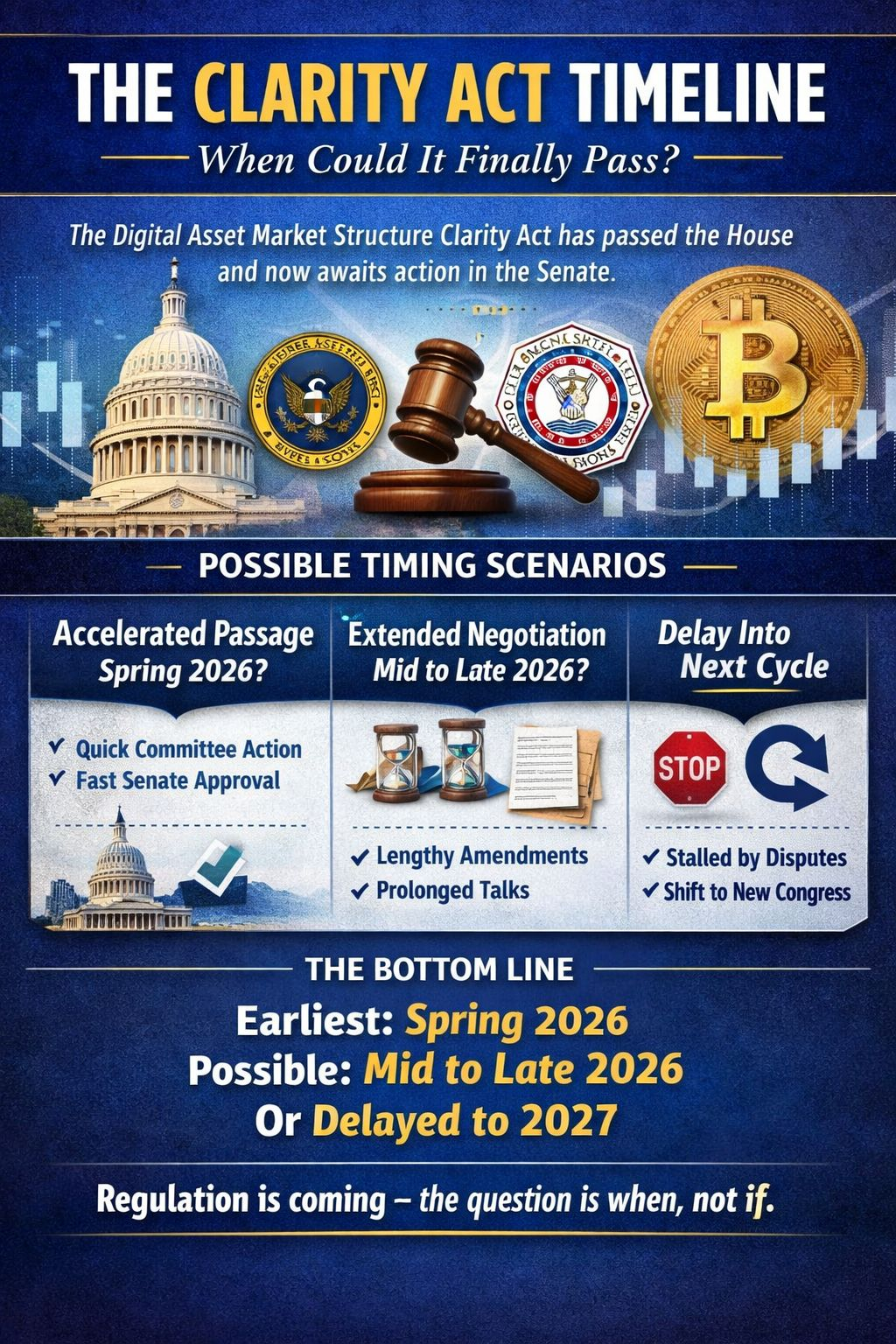
Possible Timing Scenarios
1. Accelerated Passage (Spring 2026):
If the Senate committee finalizes language quickly and leadership prioritizes floor time, the bill could pass within months. This would require strong bipartisan coordination and minimal procedural friction.
2. Extended Negotiation (Mid to Late 2026):
More realistically, complex financial legislation often moves deliberately. Amendments, negotiations, and reconciliation could push final passage into mid or late 2026.
3. Delay Into the Next Cycle:
If disagreements over jurisdiction or stablecoin frameworks deepen, the bill could stall and carry into the next congressional session. This would not kill the effort but would reset momentum.
The Bottom Line
The earliest plausible window for passage is spring 2026. The more probable timeline stretches into mid or late 2026. While the bill has momentum following House approval, Senate procedure and negotiation complexity mean that speed is not guaranteed.
What makes this moment different from past crypto debates is that digital asset regulation is now treated as infrastructure policy, not speculation. The Clarity Act seeks to replace interpretive ambiguity with statutory clarity. The question is no longer whether regulation will come — it is how precisely it will be defined, and how soon lawmakers align on that definition.