
I didn’t come across Vanar through ads, trending posts, or loud promotions.
It started appearing in conversations with developers.
Not the kind of conversations where people are trying to hype a token.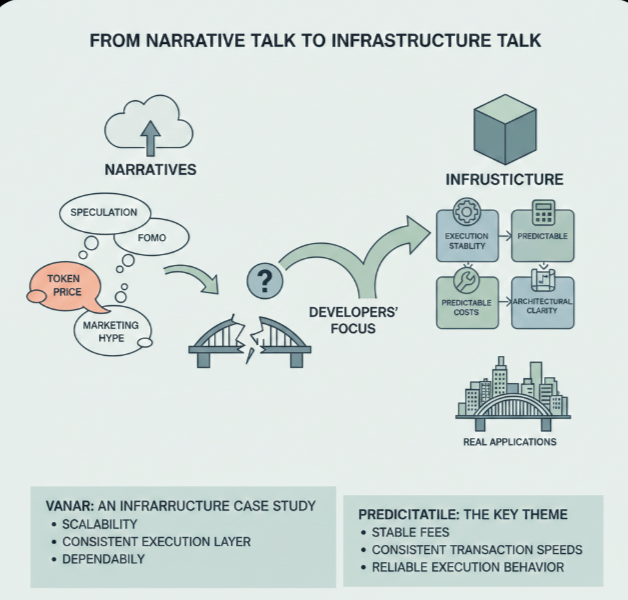
These were real discussions. Builders troubleshooting problems. Comparing execution environments. Talking about transaction reliability, fee stability, and architecture decisions.
When a blockchain begins showing up naturally in builder conversations, that’s usually a meaningful signal. Not a hype signal — a foundation signal.
That’s when Vanar first caught my attention.
From Narrative Talk to Infrastructure Talk
In this market, most projects become visible because of narratives.
But developers don’t focus on narratives. They focus on what actually works.
They look at things like execution stability, predictable costs, ease of deployment, and long-term architectural clarity.
What stood out to me was that Vanar wasn’t being mentioned as a speculative opportunity. It was being discussed as infrastructure.
Builders were talking about how it handles scalability, how consistent the execution layer feels, and whether it’s dependable enough for real applications. That’s a very different kind of discussion compared to token price speculation.
When developers start evaluating a network based on reliability instead of marketing, it usually means the fundamentals are strong.
Predictability Became the Key Theme
One thing kept coming up again and again: predictability.
On many chains, fees move unpredictably. Transactions slow down during congestion. Execution behavior changes under load. Developers often need to build extra safeguards just to handle network uncertainty.
But when Vanar came up in conversations, the tone was different.
People were talking about smoother execution and fewer unexpected issues.
Predictability isn’t flashy, but it’s extremely valuable.
For builders creating real products — especially for real users — consistency matters more than headline speed claims.
That’s when I realized this wasn’t just another Layer 1 entering the space.
It was being discussed as reliable infrastructure.
Builders Move Toward Stability, Not Noise
Retail tends to follow momentum.
Builders tend to follow stability.
So when I noticed Vanar being mentioned in quieter technical discussions rather than loud social feeds, that stood out to me.
Strong ecosystems aren’t created through marketing waves alone.
They grow when developers feel confident launching real products.
A blockchain doesn’t need to trend every day.
It needs to work every day.
Vanar didn’t enter my radar because it was everywhere.
It entered because it was quietly earning trust.
Why This Matters Looking Ahead
The next stage of blockchain growth won’t be driven by hype cycles alone.
It will be driven by usable, dependable infrastructure.
If a network is being discussed for its architectural clarity, scalable design, execution reliability, and long-term ecosystem direction, it deserves attention.
For me, Vanar didn’t arrive loudly.
It came through builders.
And in this industry, that’s usually where the real signals start.