
If you strip away the branding, the competitive comparisons, and the obsession with benchmark numbers, what Fogo is really confronting is something deeply human: the quiet anxiety of being just slightly behind. Not behind in an obvious, dramatic way, but behind by a fraction so small it is almost invisible—yet large enough to cost you something real. In modern digital markets, that fraction of time can mean the difference between execution and slippage, between fairness and suspicion, between confidence and doubt. What Fogo appears to understand is that the emotional architecture of a market is built on timing, and timing that fluctuates unpredictably slowly erodes trust in ways that no throughput chart can repair.
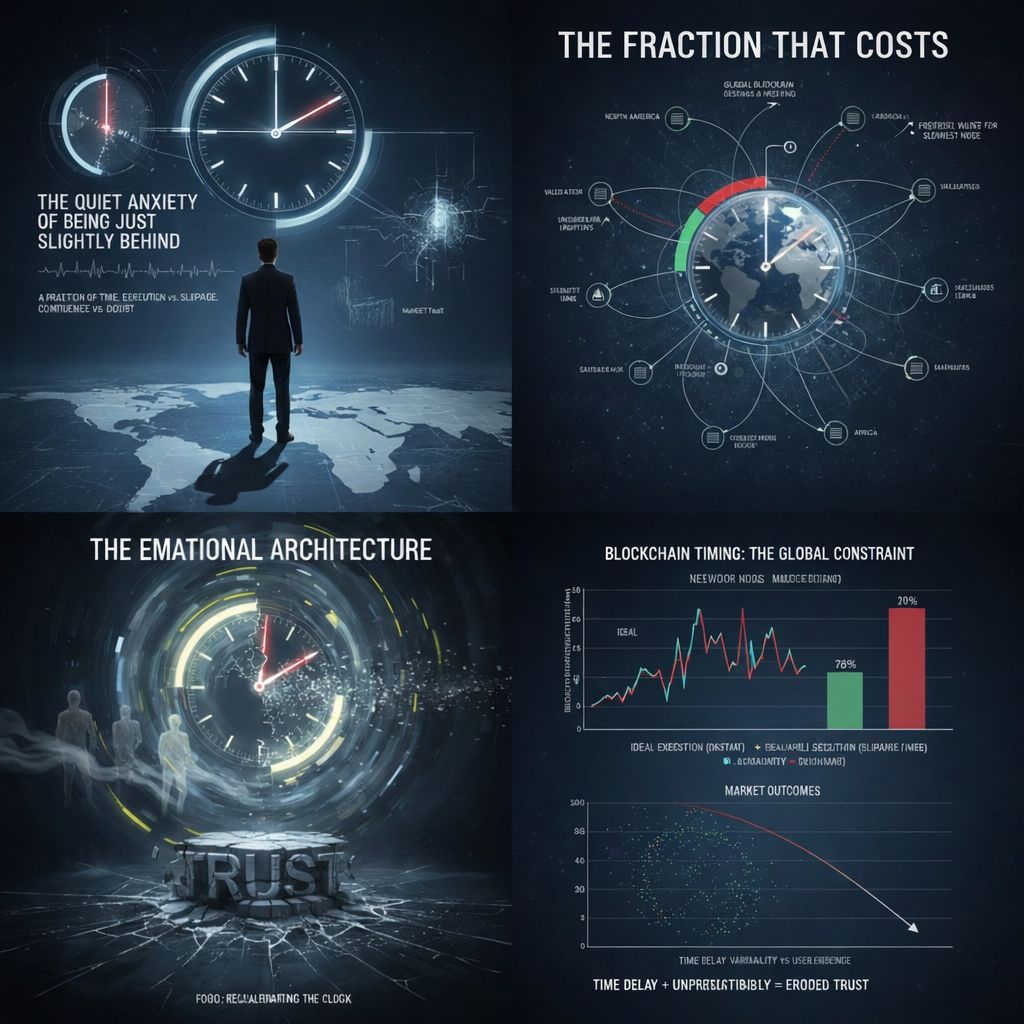
Most blockchain networks inherit the geography of the open internet as an unquestioned constraint. Validators are scattered across continents in pursuit of decentralization, resilience, and political neutrality. Messages travel through undersea cables, pass through layers of routing infrastructure, and arrive according to conditions that are never perfectly stable. Congestion, distance, hardware differences, and routing variability all shape how quickly information spreads. To remain secure, the protocol must budget for the slowest honest participant. It must wait long enough for the farthest node to see and respond. That waiting becomes embedded into the rhythm of the chain, forming block times, confirmation windows, and finality rules that quietly assume the world itself is the limiting factor.
The true cost of this arrangement is not merely delay; it is inconsistency. Human beings can adapt to systems that are predictably slow, but unpredictability creates tension. When timing varies from moment to moment, participants begin to question whether someone else is seeing information earlier, reacting faster, or benefiting from structural advantages hidden within the network’s physical layout. In financial markets, such variability has long been recognized as a source of distortion. Microsecond differences in order arrival times can reshape execution quality and alter incentives. The same psychological undercurrent flows into blockchain environments where transaction ordering, propagation delays, and validator coordination determine who gets included first and who does not.

Fogo’s embrace of colocated validators signals a deliberate attempt to compress that uncertainty at its source. Instead of treating global dispersion as sacred or unavoidable, it narrows the physical space in which consensus occurs. By positioning validators within close proximity, the network reduces the distance messages must travel and, more importantly, reduces the variance in how long those messages take to arrive. When propagation time becomes tightly bounded and predictable, consensus stops negotiating with oceans and begins operating within a controlled envelope shaped by hardware and engineering rather than geography.
This design choice is not primarily about chasing raw speed, even though lower latency naturally follows. The deeper objective appears to be coherence. When validators receive information within nearly identical windows of time, the network’s internal clock steadies. Agreement becomes less about racing across continents and more about synchronizing within a shared physical environment. The latency budget—the slice of time allocated for communication, validation, and finalization—can be tightened because it no longer has to accommodate the most distant path on the planet. That tightening reduces jitter, and reduced jitter diminishes the space in which adversarial timing strategies thrive.
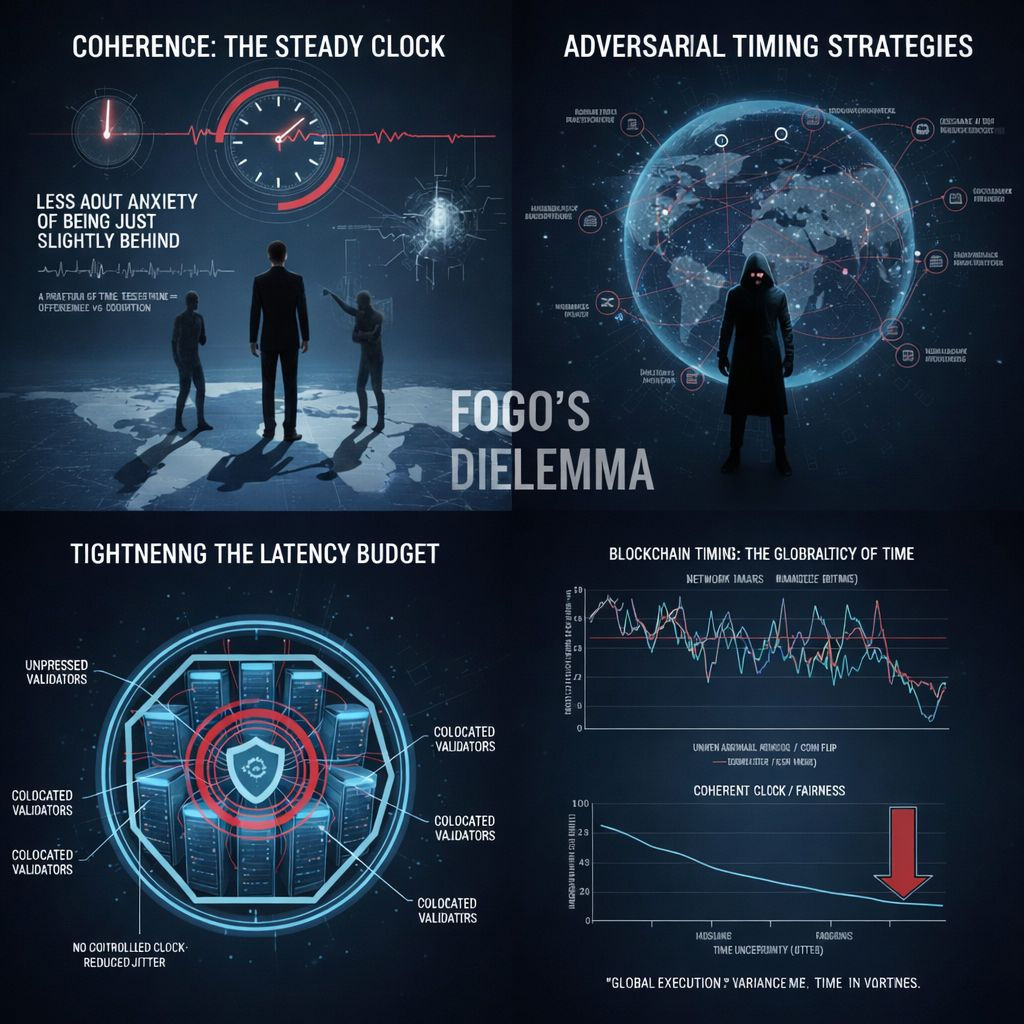
In systems where information arrives unevenly, incentives shift toward exploiting those uneven arrivals. Participants begin optimizing for propagation advantages, anticipating delays, and designing strategies around gaps in visibility. Over time, this subtly transforms the culture of the network. It becomes less about participation under shared conditions and more about mastering the quirks of the clock. When timing feels like a coin flip influenced by invisible factors, confidence erodes even if the system remains technically secure. Fairness, in practice, depends not only on rules but on the perceived neutrality of time itself.
By compressing physical distance, Fogo attempts to stabilize that perception. The system’s heartbeat becomes more regular, less stretched by unpredictable routing paths, and less vulnerable to variance introduced by long-haul communication. In such an environment, ordering grows more deterministic, confirmation windows become more consistent, and participants can act with greater assurance that what they see is nearly what others see as well. The emotional shift this creates is subtle yet powerful. When timing steadies, suspicion recedes. When propagation becomes predictable, strategy focuses more on fundamentals than on exploiting microsecond asymmetries.
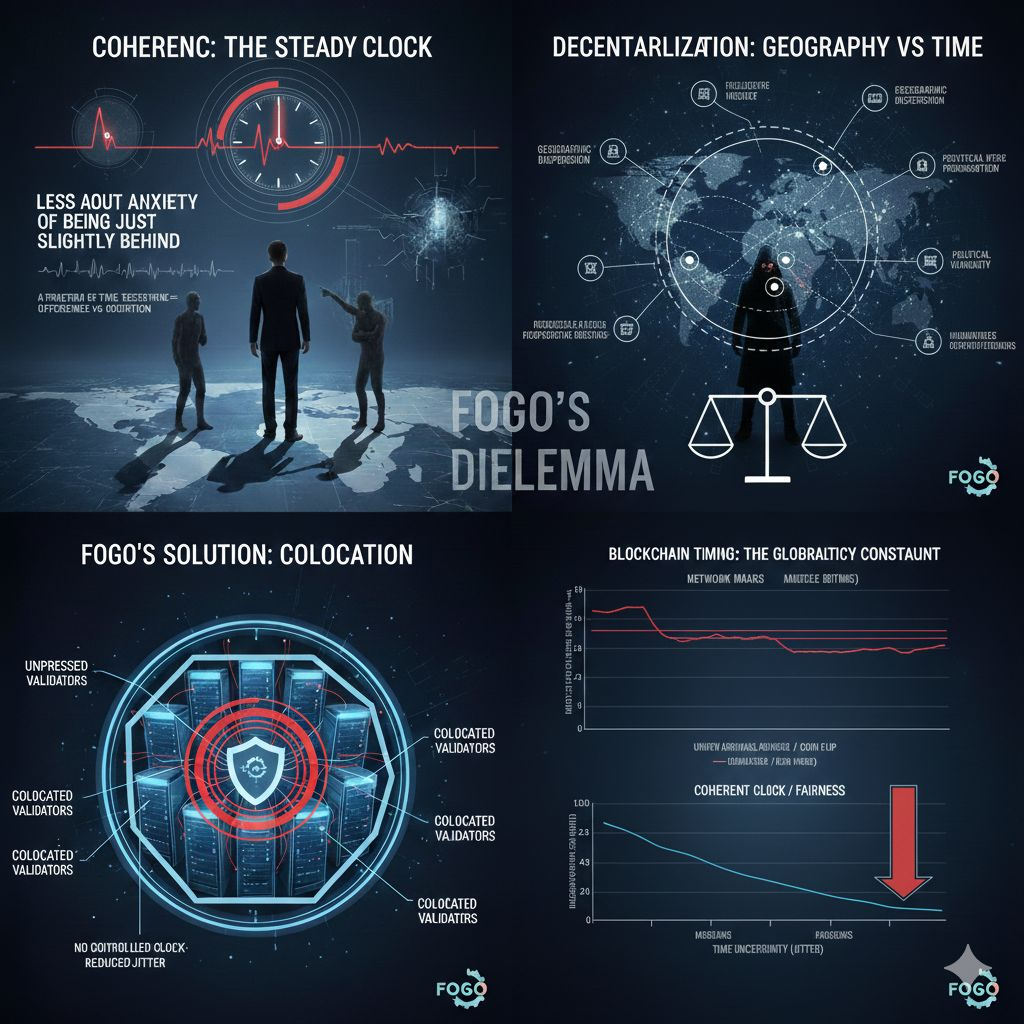
Of course, this approach introduces philosophical tension. Geographic dispersion has long been intertwined with the concept of decentralization, offering resilience against regional outages, political interference, and localized disruptions. Bringing validators closer together prioritizes timing determinism over geographic spread, and that tradeoff cannot be dismissed lightly. Yet it also invites a deeper question about what decentralization ultimately aims to protect. If the objective is to ensure credible, neutral coordination, then minimizing structural timing advantages may serve that goal as much as maximizing spatial distance.
Fogo’s architecture suggests that decentralization is not purely a matter of miles between machines but also a matter of incentive design, governance, and open participation. Physical proximity does not inherently negate openness; rather, it reshapes the environment in which agreement is forged. By mastering the physics of consensus—by reducing the planet’s influence on timing—the network attempts to remove one of the quietest sources of distortion. The ambition is not theatrical speed but disciplined predictability, not explosive scale but controlled coherence.
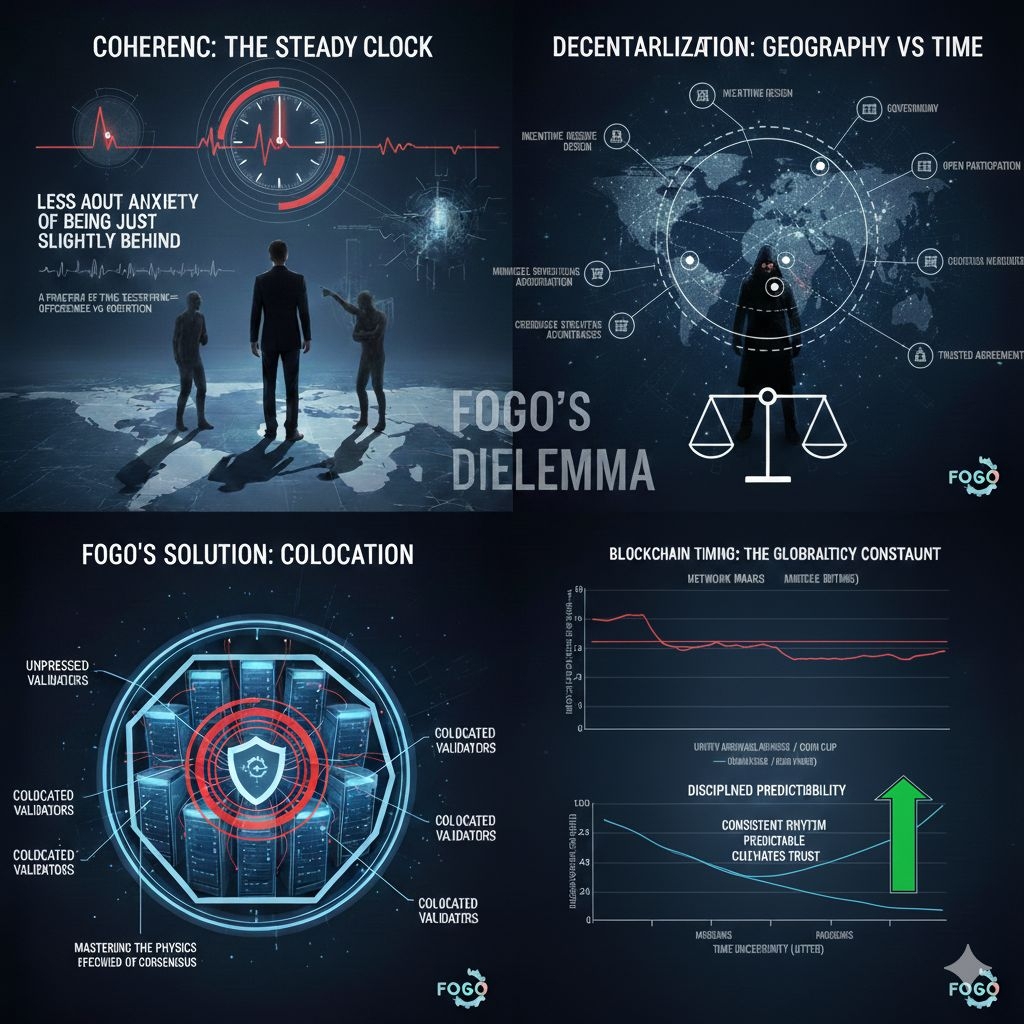
In a landscape where projects compete to advertise ever larger performance metrics, choosing to focus on latency variance rather than headline throughput reflects a different kind of maturity. It acknowledges that markets do not collapse because they are insufficiently fast; they falter when participants lose faith in the neutrality of execution. A steady clock fosters steadier behavior. Predictable ordering cultivates trust. When the infrastructure beneath a market hums with consistent rhythm rather than fluctuating unpredictability, the participants above it begin to breathe more easily.
Ultimately, colocated validators represent an attempt to design not only for performance but for psychological stability. By tightening the latency budget and compressing the physical space of consensus, Fogo seeks to build an environment where timing ceases to be an adversary. In doing so, it reframes the conversation from how quickly a chain can move to how reliably it can agree. And in markets, reliability—more than raw speed—is what allows trust to take root and endure.
