
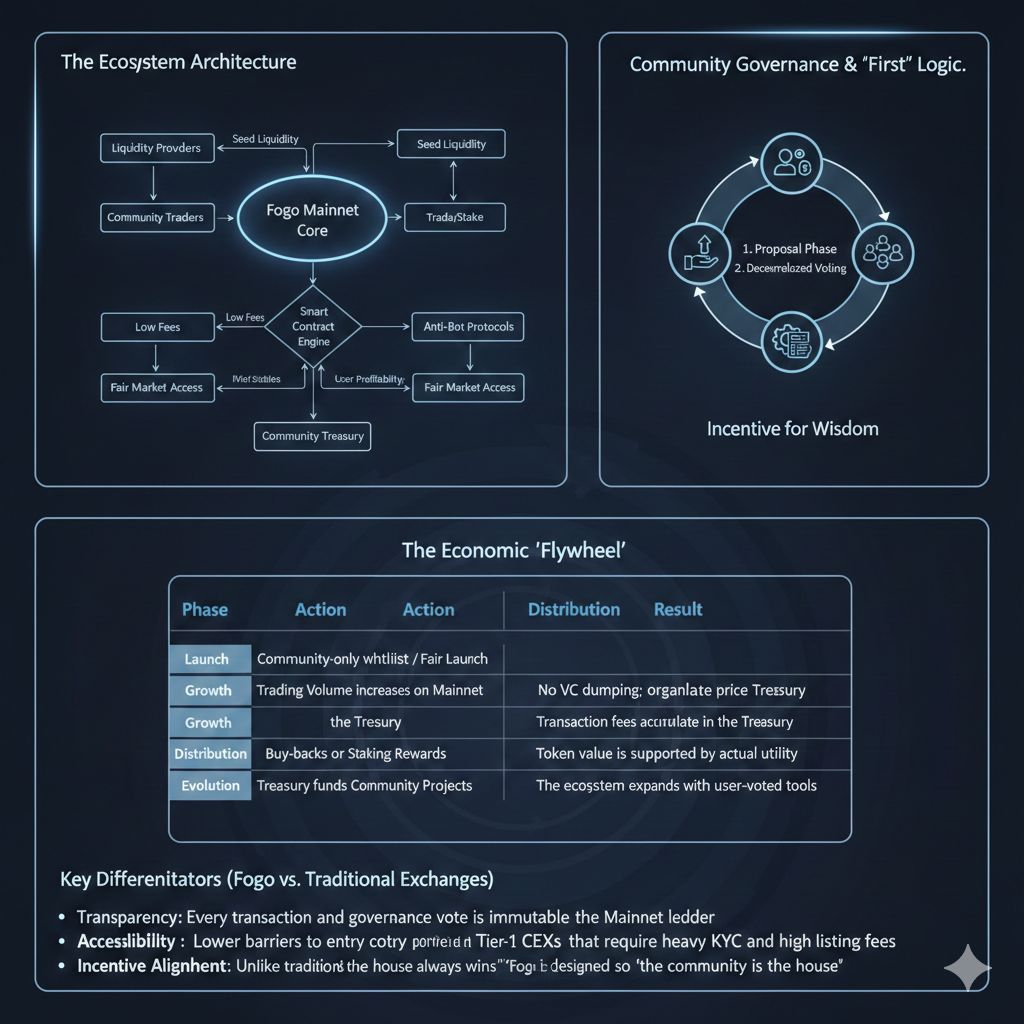
Fogo is one of those rare projects that arrives quietly, grows suddenly, and then forces the entire market to pay attention. Over the last few months, the project account @fogo and the token $FOGO have quickly moved from being an underground conversation to becoming one of the most discussed emerging Layer-1 ecosystems of 2026. What makes this movement different is not just speed or hype. It is the combination of high performance engineering, community driven token decisions, unexpected announcements, real world trading use cases, and the way Fogo is positioning itself as a blockchain designed for the new era of decentralized finance.
At its foundation, Fogo is a high performance Layer-1 blockchain that builds directly on top of the Solana Virtual Machine. By using SVM as its execution layer, it inherits the speed, parallel processing, and throughput advantages that made Solana unique. But Fogo does not stop there. The team redesigned consensus configuration, optimized validator architecture, and implemented an environment tuned specifically for real time trading. The result is a network that is not a general purpose chain trying to do everything. Instead, it focuses intensely on performance, latency, and execution reliability for the types of users who need speed the most. Traders, market makers, arbitrage engines, automated strategies, high frequency systems, liquidity providers, and all kinds of real-time DeFi applications are the profile of users Fogo was engineered for.
Fogo’s mainnet launch in early 2026 changed the tone of the entire conversation. Many Layer-1s remain testnets for years, gathering hype but delivering little. Fogo chose a completely different approach. It delivered a functioning mainnet, with near-instant block times, fast finality, and real transaction processing. The mainnet is not a demo. It is a fully operational chain capable of handling thousands of transactions per second with execution speeds close to centralized trading environments. Block times of around forty milliseconds turn on-chain execution into an experience that finally feels ready for trading, derivatives, auctions, AMMs, prediction markets, and perpetual engines. People often talk about bridging TradFi speed into DeFi, but Fogo is one of the few chains where this ambition is actually visible in the architecture.
Alongside technical achievements, one of the most unexpected moments in Fogo’s journey was the cancellation of its presale. Originally, the team had prepared a twenty million dollar token sale, where a portion of the supply would be allocated to institutional investors. In most ecosystems, this is the standard path. A presale brings capital, creates a treasury, and gives early investors a supply advantage. But the Fogo team made a decision that surprised even long time analysts. They canceled the presale entirely and redirected the tokens to the community. It was not just a change in fundraising. It was a complete philosophical shift, showing that the network wanted real users, not capital-dominant early holders. Airdrops replaced allocations. Community participation replaced institutional placements. And this immediately attracted trust from users who had grown tired of seed rounds, private rounds, and unlock charts that put heavy pressure on early stage tokens.
The cancellation was followed by a token burn, removing a portion of supply permanently and reinforcing the idea that supply belongs with the community rather than insiders. This set the tone for how @fogo wanted to operate: fast execution, real adoption, and fair distribution where early contributors and ecosystem participants benefit the most. The moment this announcement went live, the sentiment across crypto changed. The market realized that Fogo was not just building a blockchain. It was building a culture.
Then came the listings. Binance announced support for FOGO with a Seed Tag, which is reserved for new high potential ecosystems. This listing alone accelerated global awareness, but other major exchanges followed quickly. OKX listed the token as well, expanding access, liquidity, and global participation. When multiple top ten exchanges support a new Layer 1 this early, you can feel the momentum forming. It signals confidence not just in the token, but in the network’s future and the design choices behind it. The listing also improved trading depth, broadened liquidity pools, and allowed the Fogo community to expand far beyond early holders.
Behind the listings and distribution strategy, there is something deeper happening. Fogo represents a transition in how Layer 1 blockchains are positioning themselves in this new market cycle. Instead of pretending to be everything for everyone, Fogo is intentionally narrow. It is built for speed. It is built for trading. It is built for performance. It is built for real-time execution. It is built for protocols that need consistent finality and predictable block times. It is built for users who want to interact with decentralized markets without feeling the slowdown that usually comes with on-chain actions. Many Layer 1s aim to be full ecosystems with gaming, NFTs, identity, social layers, and entertainment. Fogo does not attempt to compete in those categories. It focuses on one domain and wants to dominate it. This narrowness makes its architecture meaningful.
The validator environment is another unique characteristic. Instead of distributing validators globally with massive geographic randomness, Fogo optimizes for colocation, consistent routing, and lower network variance. This reduces randomness in execution, allowing block production and settlement to follow predictable patterns. The design eliminates unnecessary noise, enabling its custom Firedancer-based client to shine. Firedancer was originally engineered for Solana by Jump to deliver ultra-efficient validation. Fogo takes those principles and builds a custom configuration specifically for high-performance execution. The result is a chain where performance is not theoretical, but structural. Performance is not a statistic you hope for. It is an outcome you can rely on.
As all these developments unfolded, the price of FOGO moved through the typical volatile range of a new ecosystem token. But what stood out was not the price. It was the activity. People cared about the token because they cared about the network. They saw the mainnet running. They saw transactions flowing. They saw the cultural shift in token distribution. They saw the listings. They saw the builder energy forming around the ecosystem. And they saw the identity of a chain that is not confused about what it wants to be.
Fogo wants to be the execution engine for on-chain trading. And it is building exactly that.
As the market continues to evolve, Fogo’s positioning becomes even more relevant. Decentralized finance is shifting from simple swaps to advanced strategies. Trading algorithms that used to rely on centralized exchanges are looking for decentralized venues that can match their execution needs. Liquidity providers want predictability. Arbitrage systems want speed. Market makers want reliable block timing. Derivatives protocols want latency that does not make them obsolete. The entire on-chain trading industry wants performance that does not break under load. Fogo steps into this gap at exactly the right moment.
The community behind @fogo is another core strength. Instead of organic hype fading after launch, the momentum increased. Holders, contributors, traders, and analysts all discuss the project actively. With over three thousand “Echo” participants and thousands more joining after listings, Fogo has built a community that does not wait for hype to come from outside. They generate it internally by engaging, analyzing, building, and testing. This internal strength is what keeps ecosystems alive long after their first rally.
Looking forward, the roadmap for Fogo is filled with expansion opportunities. More ecosystem projects are expected to launch. DeFi protocols will choose Fogo because it matches the demands of real-time finance. Builders who want to explore ultra low latency on chain trading will find a home here. Global users who want fairness in distribution and transparency in development will continue to support it. When a chain delivers both performance and community alignment, adoption becomes a natural outcome.
Fogo represents a new kind of blockchain philosophy. One where speed matters. One where community ownership matters. One where the token is more than a financial instrument. One where the architecture and the culture are built with the same intention. One where a chain is defined not by hype, but by clarity of purpose. That is why the FOGO narrative continues to grow. That is why the community keeps expanding. That is why the ecosystem gains momentum every week. And that is why Fogo is being recognized as one of the most promising real time trading blockchains of this cycle.
If the next wave of DeFi is going to be fast, efficient, transparent, community-aligned, and capable of handling real institutional grade execution, then Fogo is one of the chains to watch closely. Because this is not just another Layer-1. This is a deliberate answer to everything on chain trading has been missing. And watching @fogo grow from here will be one of the most interesting narratives of 2026.