

@Vanarchain Blockchains have evolved significantly over the past decade, yet many existing platforms still struggle to serve mainstream users and real world applications at scale. Vanar is a Layer 1 blockchain project designed to address limitations in adoption, performance, and utility that have persisted in earlier networks. Its development team brings experience from gaming, entertainment, and brand ecosystems, and the project aims to support a wide range of use cases beyond traditional decentralized finance or speculative activity. At the heart of Vanar’s approach is a focus on infrastructure that can support consumer oriented experiences and practical applications, with the VANRY token acting as its native protocol asset. This article provides an educational overview of Vanar’s goals, architecture, features, and potential role in the broader blockchain ecosystem.
A core problem Vanar seeks to address is the disconnect between blockchain technology and mainstream adoption. Many existing blockchains offer high levels of decentralization or security but struggle with performance, cost, and ease of use. These limitations make it difficult for consumer facing products, such as games or interactive metaverse environments, to deliver smooth, affordable user experiences. Vanar positions itself as a solution by designing a blockchain that prioritizes throughput, predictable costs, and compatibility with real-world applications. The team’s emphasis on usability reflects a belief that bringing large numbers of everyday users into Web3 requires infrastructure that behaves more like conventional systems in terms of responsiveness and predictability.
At a high level, Vanar functions as a Layer 1 blockchain with its own consensus mechanism, runtime environment, and token economics. It is built to support smart contracts and decentralized applications in a way that integrates performance considerations with modular system design. While the project does not publish overly technical specifications as a marketing point, its architecture suggests that it uses optimized node architectures and execution environments to improve transaction finality and throughput compared to traditional proof of work or basic proof of stake networks. The VANRY token is used for transaction fees, staking, and governance participation within the protocol. In this way, Vanar aims to balance the technical requirements of a secure distributed ledger with the practical demands of high-frequency consumer interactions.
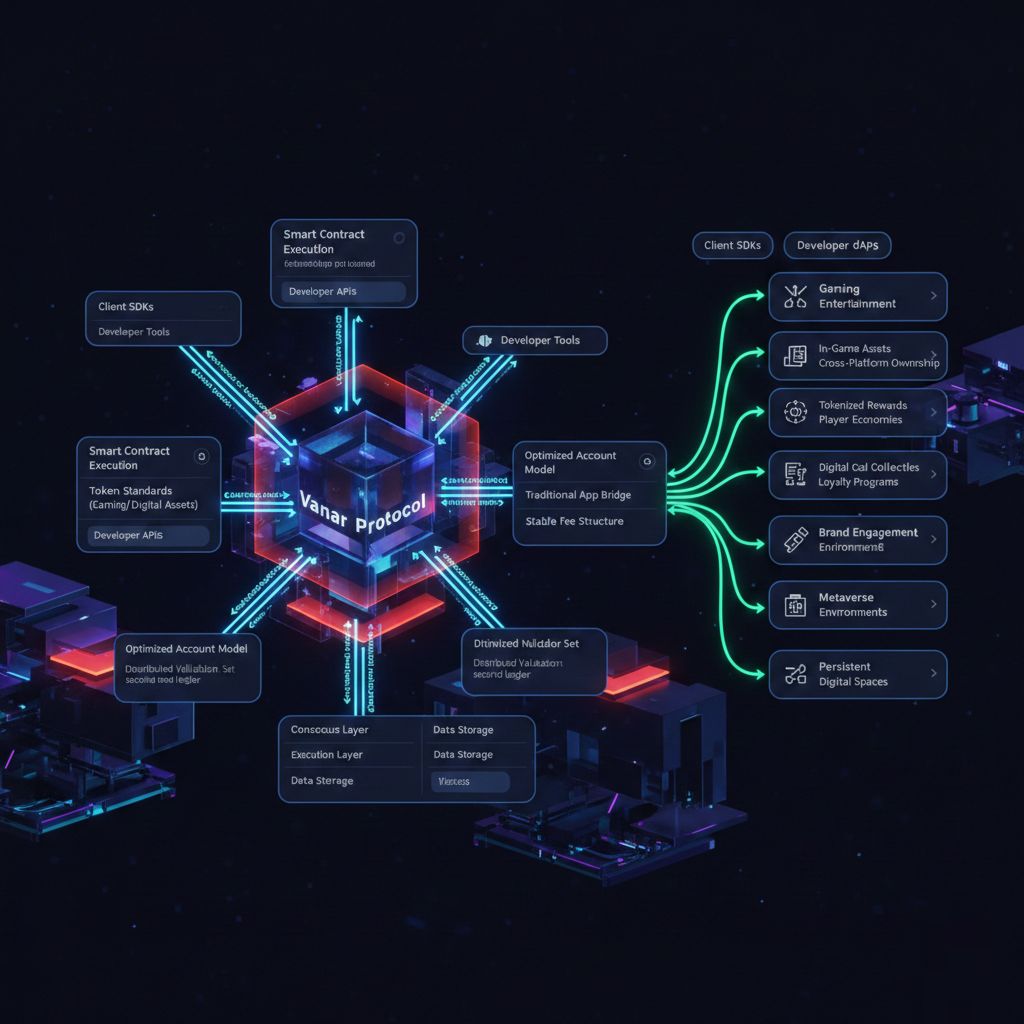
Vanar’s feature set emphasizes mechanisms that support cross industry applications. The protocol includes support for smart contract execution, token standards suitable for gaming and digital assets, and tools to bridge traditional applications with blockchain based services. Technical features include an account model optimized for fast state transitions, a fee structure designed to remain stable under varying load conditions, and developer APIs that abstract blockchain complexity where possible. These components work together to lower the barrier for developers who want to build interactive experiences without needing deep expertise in consensus algorithms or cryptoeconomics.
The system design reflects an emphasis on modular layers and integration points. Rather than treating every function as hardwired into the core protocol, Vanar’s architecture allows components like consensus, execution, and data storage to operate with clear boundaries. This modularity can make maintenance and upgrades more manageable over time and allows specific subsystems to evolve independently. The network relies on a distributed validator set to secure the ledger and reach consensus on transactions, while client SDKs and developer tools provide the interfaces through which applications interact with the blockchain. By keeping these layers distinct but interoperable, Vanar seeks to maintain clarity of operation while supporting a diverse range of workloads.
Vanar’s intended use cases span industries such as gaming, entertainment, brand engagement, metaverse environments, and decentralized applications that require real time interaction. In gaming, for example, blockchain integration can be used to represent in game assets, enable cross platform item ownership, or facilitate player driven economies. In entertainment and brand applications, tokenized rewards or digital collectibles can form part of loyalty programs or interactive campaigns. The metaverse products associated with Vanar aim to create persistent digital spaces where users can interact, trade, and build. Across these sectors, the blockchain’s role is to provide a shared, verifiable source of truth for assets, actions, and states that multiple participants can trust without a central intermediary.
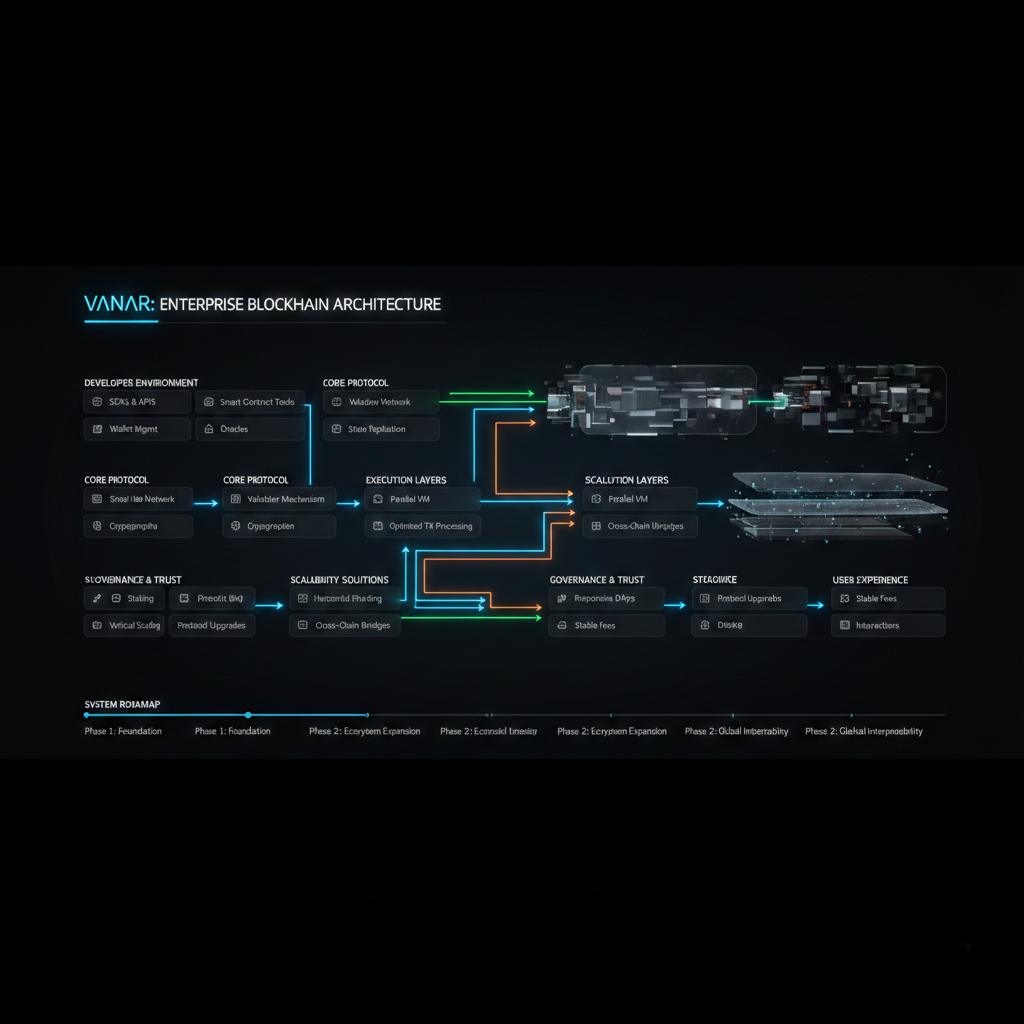
From a developer’s perspective, Vanar can be useful because it offers an environment where application logic can be deployed with predictable performance characteristics. Developer tools and documentation aim to reduce the friction that often accompanies blockchain development, such as managing wallets, handling asynchronous transactions, or optimizing execution costs. Users, on the other hand, benefit from experiences where interactions feel responsive and fees remain stable. Even when blockchain processes are behind the scenes, their reliability and consistency matter to both developers building on the platform and end users interacting with applications powered by it.
Security and reliability are important considerations for any blockchain. Vanar’s consensus mechanism and validator architecture aim to protect against common attack vectors while maintaining decentralization appropriate for its scale. The project incorporates standard cryptographic primitives for transaction validation and state integrity. Network reliability is supported by distributed nodes that maintain consensus even in the presence of failures or network disturbances. Trust related mechanisms, such as transparent governance and staking, give stakeholders a voice in protocol upgrades and economic parameters. These aspects contribute to a secure foundation that applications can build upon.
Scalability has been a persistent challenge for blockchain networks, especially those that aspire to support consumer level usage patterns. Vanar’s approach includes design choices to improve throughput and reduce latency, such as efficient state replication and optimized transaction processing pipelines. Network support for compatibility with existing developer frameworks and tooling also helps bridge the gap between traditional systems and blockchain native applications. By focusing on both horizontal and vertical scaling strategies, Vanar aims to sustain performance as demand grows without degrading the user experience.
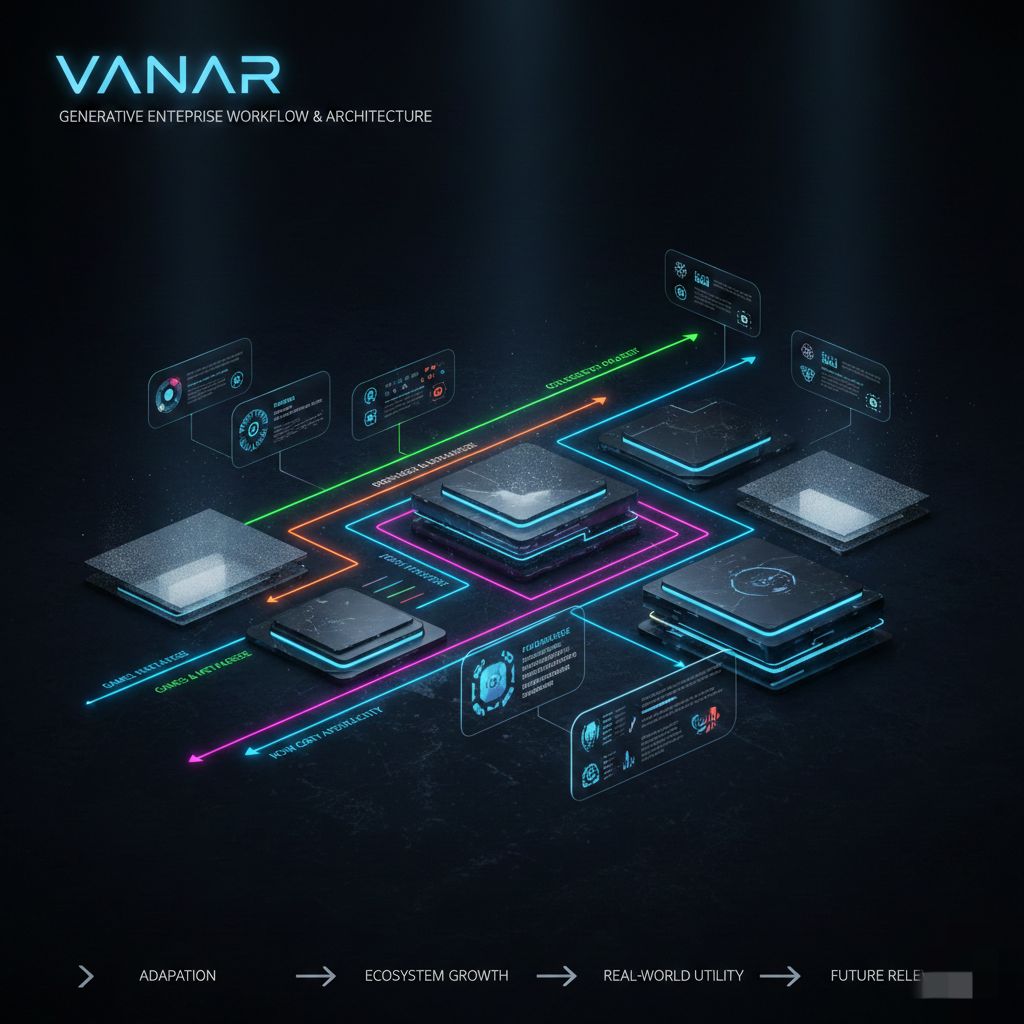
Cost efficiency and performance benefits are realized through predictable fee structures and optimized protocol execution. For applications with frequent interactions, such as games or interactive metaverse environments, minimizing transaction costs is critical. Vanar’s economic model seeks to avoid the volatile fee spikes seen on some public networks by anchoring costs to internal parameters rather than purely market driven congestion pricing. Performance optimizations in node software and execution environments also contribute to lower overhead for running applications and processing transactions.
Long term relevance for any blockchain project depends on its ability to adapt to changing technological landscapes and competitive pressures. Vanar’s focus on real world utility, modular design, and cross industry applicability provides a foundation for sustained development. Challenges remain, including attracting a vibrant developer ecosystem, demonstrating real world deployments at scale, and differentiating itself from other Layer 1 and Layer 2 solutions that also target performance and usability. Competition in the blockchain space is strong, and success will likely require not just technical robustness but also ecosystem growth and adoption by third party builders.
In summary, Vanar is a Layer 1 blockchain that attempts to bridge the gap between decentralized ledger technology and mainstream application requirements. By emphasizing architecture that supports performance, predictable costs, developer accessibility, and cross industry use cases, it aims to offer a platform capable of supporting diverse consumer oriented experiences. While technical and market challenges remain, the project’s focus on infrastructure and real world utility positions it as one of many evolving efforts to bring blockchain technology into broader practical use.
