
Security is not a mantra; it is not a drawing in a white paper or a line in a pitch deck. On a high-performance Layer 1 like Fogo, security is a humming rack of servers in a cold aisle at 2:17, drawing power from redundant feeds, synchronized to atomic clocks, waiting for the next block window not in seconds, but in heartbeats of silicon.
To understand the long-run credibility of Fogo, we must go beyond the tokens, governance discussions, and the white papers, and go into the machine room. In a millisecond-optimized network, security is not an abstract theory of decentralization. It is a matter of real, operational capital, and geographic discipline.
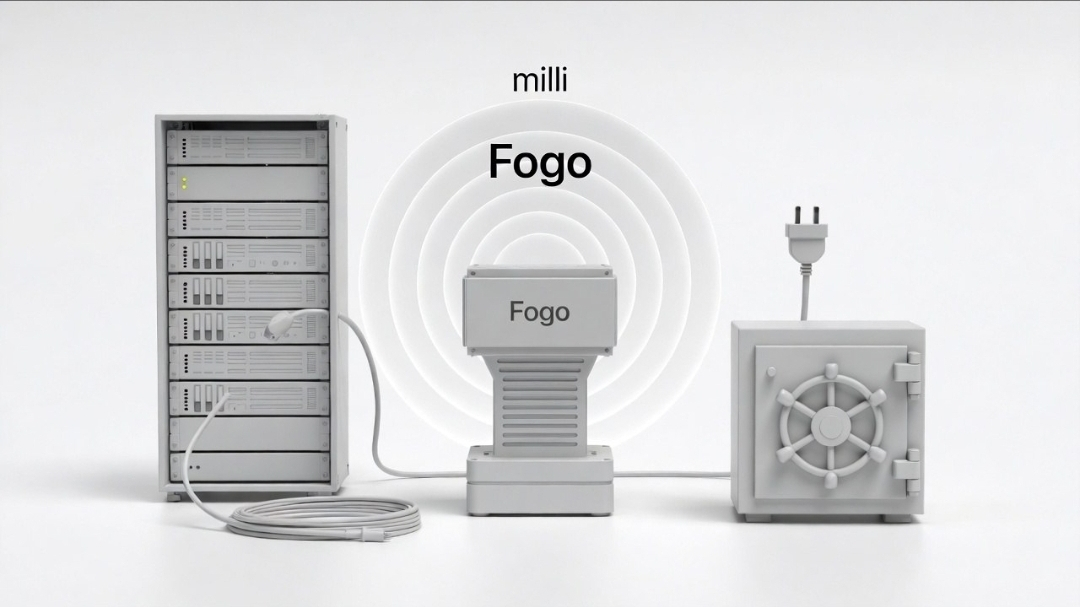
The Entry Ticket: Hardware That Keeps Up with Time
A Fogo validator is not a hobbyist node idling under a desk.
When execution finality compresses to milliseconds, hardware is more than just a component – it is strategy. In these scenarios, the performance of a single core becomes a matter of necessity. The hierarchy of slow cores will be punished for a serialization bottleneck, high-frequency RAM is critical to minimize latency during state access, enterprise NVMe drives eliminate I/O contention during bursts, and network interface cards must be tuned for low jitter and prioritized packet forwarding.
A competitive validator stack looks more like trading infrastructure than consumer electronics.
· High clock, server-grade CPUs
· 128-256GB ECC memory
· High-end NVMe storage (Redundant)
· Dual Low-latency network uplinks
· Failover nodes in separate locations
The initial hardware investment will likely exceed tens of thousands of dollars with redundancy included. And redundancy is not optional. In situations where missing out on a proposer slot could result in a financial loss, being offline is a loss every time.
In Fogo’s environment, a few milliseconds of latency could mean being completely irrelevant. Hardware removes the irrelevant.
Geography: Where the Rules are Set by Physics
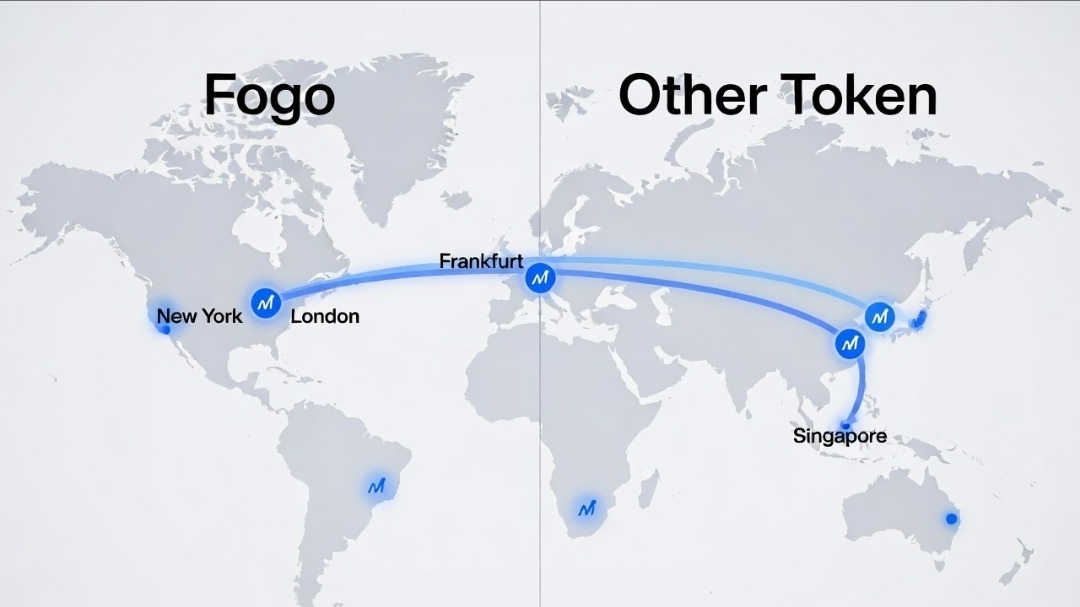
It’s not a matter of software. Latency is a function of the underlying geography.
In fiber, light travels about 200 kilometers every millisecond, and this is the limit for the speed of light. This natural limit helps define the economics of validators. A validator a few kilometers away from the others is sitting on a latency ‘tax.’ It will always be a few milliseconds behind in its ability to broadcast, validate, and respond.
In a network designed for speed, being “second” is a costly.
Economic gravity centers on data corridors such as New York, London, Frankfurt, and Singapore, where there is cross-connect low latency. However, rack space in Tier 1 facilities is highly priced. Monthly colocating fees, cross-connect fees, and other costs like minimum bandwidth, and remote hands services add to OPEX.
Thus, the reasoning becomes paradoxical. In order to compete in the decentralized network, the validators become centralized.
Fogo’s Performance Promise
Bandwidth: the invisible burn rate.
Marketing throughput focuses on the number of transactions per second. For validators, it is bandwidth per second.
High transactional speed means the data must be ingested, validated, and rebroadcast quickly and constantly. This means data is cheap, but the premium contracts on bandwidth (with low packet loss, consistent latency, and multiple upstream providers) aren’t. In unstable markets, high transactional velocities lead to network volatility and sink.
With customer burn rate, this will forever be invisible. The paywall used to access customer data.
For over 400 validators, burstable networks promise will secured in.
In a millisecond network, “good enough” is not enough.
The Biggest Expense: Capital at Risk
Aside from hardware and bandwidth, the largest expense remains a mystery—capital at risk.
In order to validate on Fogo, operators are required to risk a considerable amount of their tokens. This means capital that would normally earn returns from yield farming or providing liquidity elsewhere, is left to generate no returns as a bonded stake.
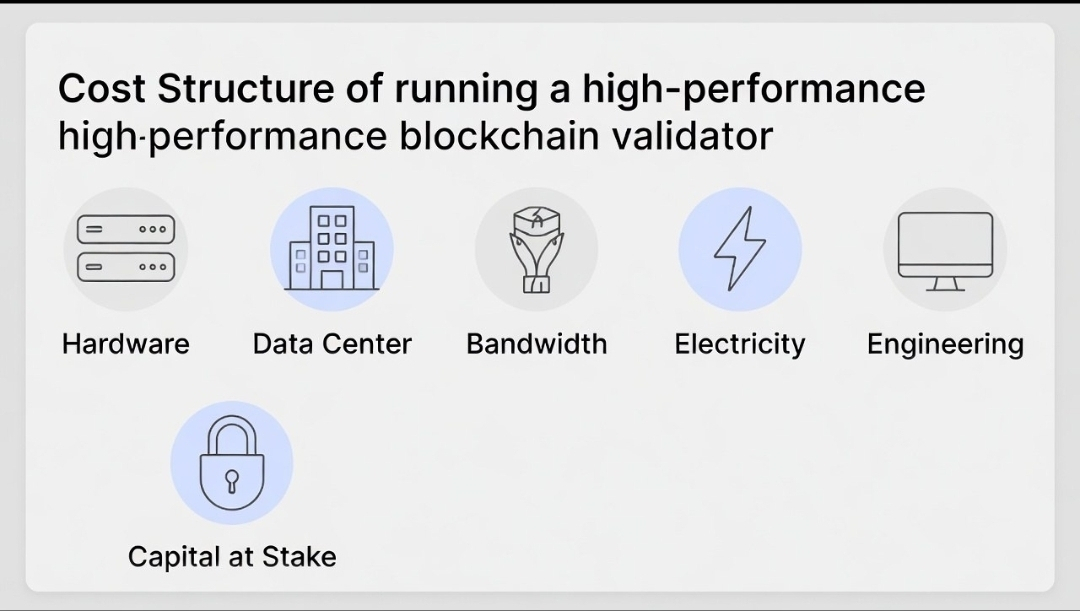
The validator’s balance sheet therefore captures the following expenses:
Wear and tear on hardware
OPEX of the data center
Bandwith contracts
Value of the engineering work
Risk of the price of the tokens
The opportunity cost of the capital that is staked
In all bear markets, block rewards and transaction fees must cover all of the above costs. Paid transaction fees will compress until only the most committed remain.
When the market turns and transaction block fees contracts to nothing, validators face the greatest challenges to remain sustainable. Only those with disciplined cost structures and long-term conviction remain.
Performance that is Curated vs. Open
High-performance networks often tend toward closed validator sets to maintain guarantees around latency. A small and chosen group means less coordination and a better chance that the required hardware is all to the same standard.
Closed sets strike a balance.
They keep a workable performance balance and increase the cost of entry. The criteria for selection, which is operational history, geographical position, and hardware all tend to strengthen a network.
The validator rewards could be made to outcompete other crypto projects. The higher the barriers to entry to become a validator, the more the network shifts from being a community project to a more professional structure.
The more negative shift is that, in a professionally run system, participants are unlikely to act in a way that favors the network as a whole, rather than their personal profit. The system will be designed to optimize profit at the expense of overall network health.
The greater the number of independent operating companies in the system, the greater the financial resilience.
Unromantic electricity.
The only place that electricity trends is on the invoices from the electricity provider.
High performance servers + cooling systems of tier 1 data center = high power consumption. Over the course of a year, the power consumption of a data center cooling system can be greater than the depreciation of the system.
In this regard, the data center operated by validators hand is secure. Correspondingly, the technical systems also generate a lot of heat.
The human layer.
Behind each validator is a team. Or at least a highly capable individual.
Continuous monitoring systems exist that will track the health of the node, the time taken to propagate a block, the number of peers connected, and the number of peers connected to facilitate a block and the time taken. Multiple security audits are required to optimize the risk of a key being compromised. Software updates are required to optimize the determinants of key compromise.
Forks and slashing events are a certainty unless software upgrades are coordinated with care.
This is not passive staking. It is management of operational infrastructure.
The best validators are like mini data center businesses - disciplined, audited, and optimally located.
The Real Measure of Network Strength
So what does it actually cost to run a Fogo validator?
It costs capital. It costs proximity. It costs power. It costs expertise. It costs sleepless nights during turbulent markets.
And that cost is the point.
A network optimized for milliseconds cannot be secured by casual participation alone. Its validator economics are designed to filter for serious operators. The barrier to entry is not a bug - it is a performance gate.
However, sustainability demands equilibrium. The costs must be justified by the rewards. Geographic diversity must balance clustering incentives. Governance must prevent validator oligopolies while respecting the performance realities.
If Fogo can continue to juggle being a validator operator, it's rare to have security based on real-world infrastructure rather than theoretical constructs.
Ultimately, the security of the blockchain should not be confusing. It is simply, steel in racks. Fiber in trenches. Electron in circuits. It is money.
That is the real cost of a millisecond in a network that is built around time. It is the only thing that really counts.