
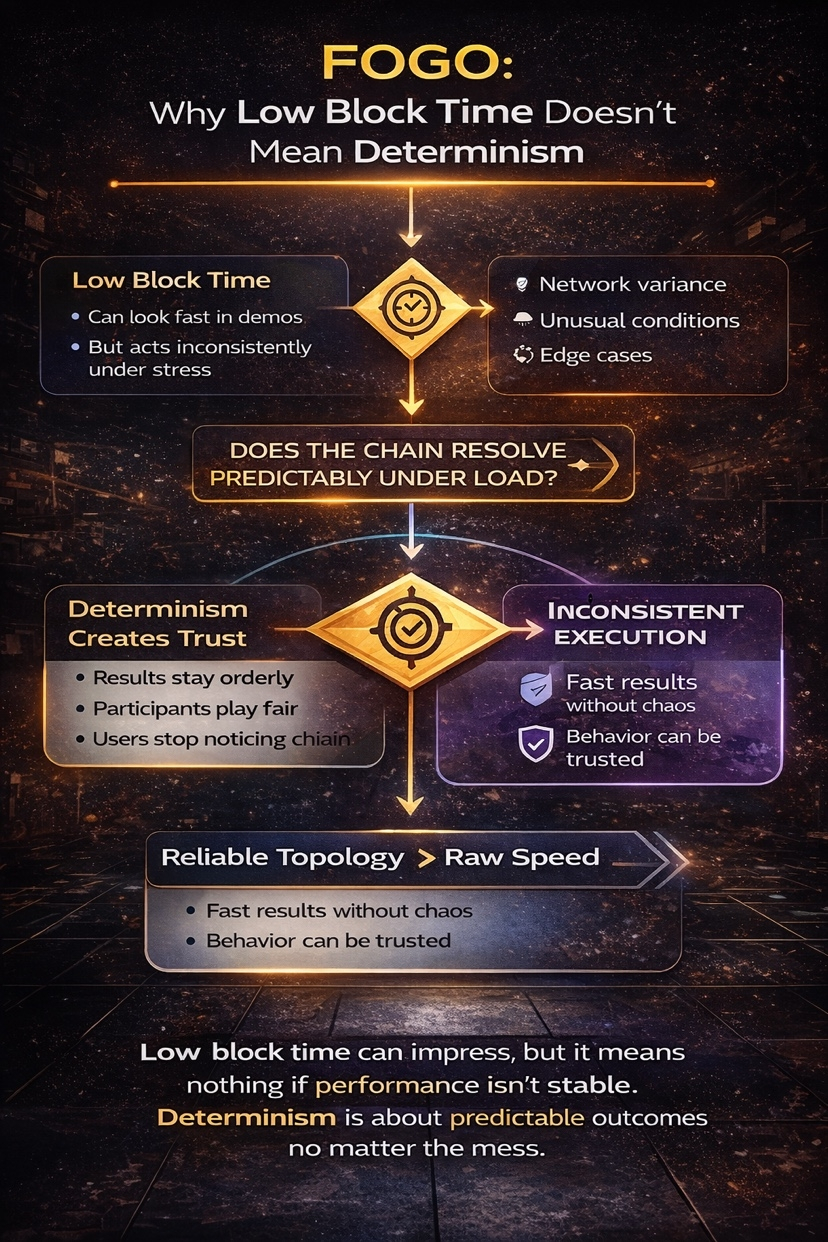

One of the easiest mistakes to make in crypto infrastructure is assuming that faster blocks automatically create a better system. It’s an attractive idea because it turns performance into a simple race. Smaller numbers look cleaner on charts. Lower latency sounds like progress. And for a while, the conversation often stays there who can produce blocks quicker, who can confirm faster, who can advertise the smallest delay.
Builders don’t look at it that way.
Builders care about determinism more than speed. They don’t just ask how fast something usually happens. They ask whether it happens the same way every time, especially when things get messy. That’s the difference between a chain that feels smooth in demos and a chain that survives real workloads. Low block time can improve responsiveness, but it doesn’t guarantee that outcomes remain predictable. And when predictability disappears, speed stops mattering very quickly.
That’s the lens where @Fogo Official becomes interesting, because the project’s direction suggests an understanding that performance isn’t only about shrinking intervals. It’s about controlling what happens inside those intervals.
Most people intuitively think of block time as a direct proxy for user experience. If blocks arrive faster, everything feels more immediate. That part is true. But what gets overlooked is that faster cadence also compresses tolerance. When blocks arrive every few hundred milliseconds or less, the system has less room to absorb variance from the real world.
The internet doesn’t behave consistently. Messages travel different paths. Packet loss happens. Routing changes dynamically. Hardware scheduling introduces tiny delays that accumulate unpredictably. In slower systems, those differences average out. In extremely fast systems, they start to shape outcomes.
That’s where determinism begins to diverge from raw speed.
You can have a chain producing rapid blocks and still end up with inconsistent ordering, timing disputes, or subtle edge cases that force builders to design defensively. From a user perspective, the app may look fast most of the time. From a builder perspective, it feels fragile because rare moments of uncertainty keep appearing.
And those moments define trust more than the average experience.
FOGO’s approach feels like an attempt to confront this reality rather than hide it. Instead of treating latency as a single number to minimise, the architecture leans toward controlling variance reducing the chaos that comes from global distribution and inconsistent operational environments. The idea isn’t simply to run faster; it’s to make fast behavior reproducible.
That distinction matters more than it sounds.
Determinism is what allows developers to simplify products. If outcomes are predictable, they can remove layers of defensive logic. They can trust that user actions resolve cleanly without waiting extra buffers or adding unnecessary confirmation steps. The product starts to feel natural, not because it’s fast on paper, but because nothing surprising happens when people use it.
When determinism fails, every design decision becomes cautious. Builders add delays, warnings, retries, fallback flows all invisible signs that the underlying system can’t be fully trusted.
Low block time alone doesn’t solve that. Sometimes it makes it worse.
This is where many performance conversations go off track. They assume that reducing block intervals automatically improves everything. But faster cadence increases pressure on validators, networking and consensus coordination. Small operational differences become amplified. The system begins depending on tight synchronization between participants that may not realistically exist across global infrastructure.
FOGO’s focus on topology and disciplined validator environments starts to make sense through this lens. If you’re trying to create deterministic behavior at low latency, you can’t ignore how physical distance and operational quality shape consensus outcomes. Weak links don’t just slow things down; they introduce uncertainty.
And uncertainty is what kills determinism.
Builders notice this faster than traders do. Traders can tolerate occasional irregularities as long as numbers look good. Builders cannot. A consumer application that behaves unpredictably loses users quietly. People don’t write essays about it. They just stop using the product.
That’s why determinism is ultimately a product question, not just an infrastructure one.
There’s also a subtle psychological factor at play. Users don’t consciously measure speed. They measure confidence. When an action resolves consistently, they relax. When results occasionally hesitate or behave unexpectedly, even if only for a moment, doubt appears.
Doubt creates friction.
A fast chain that occasionally stutters feels slower than a slightly slower chain that always behaves as expected. This is one of those truths that performance charts rarely capture but product teams experience immediately.
FOGO’s direction suggests an attempt to prioritise that confidence layer building an environment where timing behaviour stays stable enough that users stop thinking about the chain entirely.
And that’s the point where infrastructure starts doing its job properly.
Another reason low block time alone is insufficient comes from economic behavior. In markets or automated systems, participants adapt quickly to timing patterns. If variability exists, sophisticated actors exploit it. The result is that tiny inconsistencies become strategic surfaces rather than harmless noise.
Deterministic behavior reduces those opportunities because everyone operates under the same expectations. Fast but inconsistent systems create subtle asymmetries that only advanced participants can navigate effectively.
For a chain aiming to support serious applications, that gap becomes dangerous.
This is why FOGO’s emphasis on disciplined engineering choices feels less like optimization and more like risk control. The goal isn’t to chase a performance headline. It’s to shape the environment so that timing itself becomes less of an unknown.
None of this means low block times are unimportant. They absolutely matter for responsiveness and user perception. But they’re only valuable when paired with consistent execution and stable coordination. Without that foundation, speed becomes superficial impressive from the outside but stressful for those building on top.
And that’s where the real test begins.
Determinism doesn’t come from one innovation or one parameter. It comes from a chain of disciplined choices: topology, validator standards, client design, networking paths, and operational culture. Every weak link reintroduces variance. Every shortcut makes unpredictability more likely.
FOGO’s challenge isn’t proving it can be fast. Many systems can demonstrate speed briefly. The harder challenge is proving that speed remains calm and predictable when the environment becomes chaotic.
Builders will judge it by that standard.
The broader lesson is simple but often overlooked.
Low block time tells you how often decisions happen. Determinism tells you whether those decisions feel trustworthy. One is a metric. The other is an experience.
If the next phase of blockchain adoption is about integrating into systems where reliability matters finance, automation, coordinated workflows then determinism becomes more valuable than pure speed. Chains that understand this early may look less flashy at first, but they tend to age better as workloads become real.
FOGO’s direction suggests it’s trying to operate in that space. Not just faster blocks, but systems that behave predictably enough that builders can stop worrying about the chain and start focusing on the product.
And ultimately, that’s what infrastructure is supposed to do.
Disappear, without surprises.