The moment I understood Fogo was the moment I stopped thinking about blockchains as countries and started thinking about them as trading floors. This was three in the morning, I was staring at a screen full of Dune Analytics queries, and it hit me that I had been evaluating this network using completely the wrong framework. Everyone keeps asking whether Fogo can compete with Solana or challenge Ethereum and I realized that question is about as relevant as asking whether a Formula One car can compete with a pickup truck. They operate in different dimensions entirely.
I have spent the last month living inside Fogo's data. I have watched its block production like a hawk, tracked its validator elections, mapped its liquidity flows, and tried to understand what kind of creature this network actually is. What I found surprised me and it also scared me a little because Fogo represents something crypto has spent the last decade trying to escape, dressed up in the language of progress.
The architecture is beautiful in its ruthlessness. Most layer ones are designed to be all things to all people. They spread validators across the globe, optimize for maximum participation, and accept latency as the price of decentralization. Fogo looked at that compromise and rejected it entirely. Instead of scattering validators to the winds, they packed them into three data centers. Tokyo handles the Asian trading session, London takes Europe, New York covers the Americas, and the whole thing rotates like a relay race handing off the consensus baton every eight hours. It is blockchains designed by people who understand that in high frequency trading, distance is measured in nanoseconds and nanoseconds cost money.
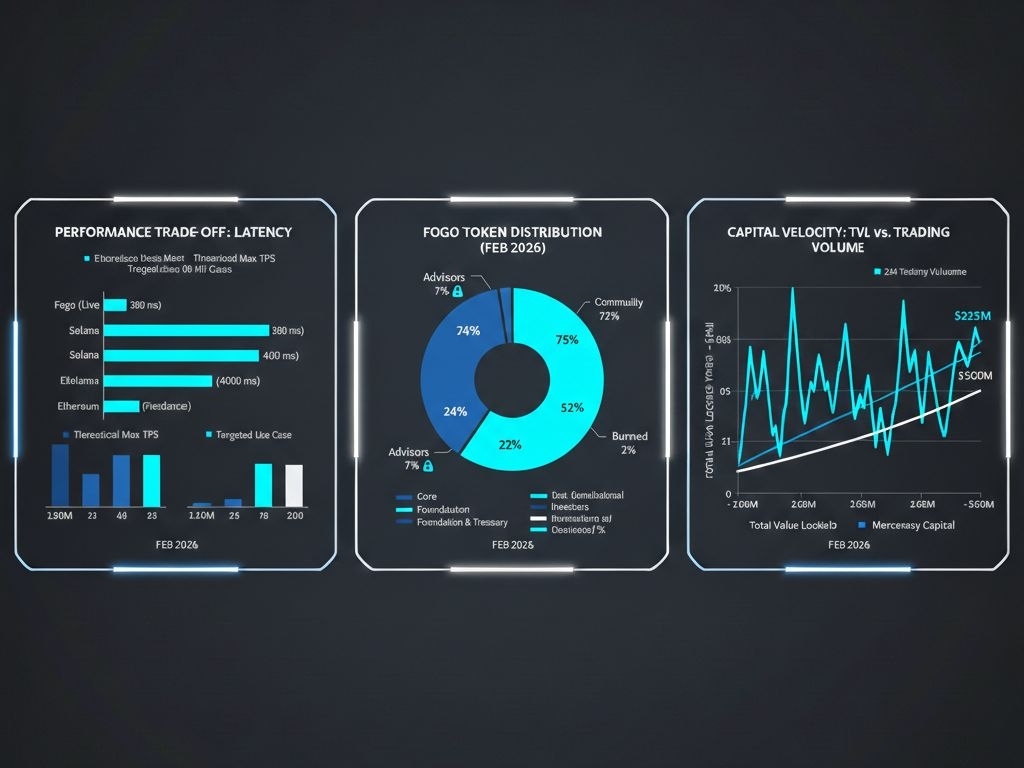
The technical term for this is multi local consensus but the real term should be radical pragmatism. When I checked the network latency data during the London session, I saw block times hovering around thirty eight milliseconds. That is not blockchain speed. That is exchange speed. That is the kind of performance that makes high frequency traders sit up straight and start paying attention because thirty eight milliseconds means you can actually run algorithmic strategies on chain that previously required co located servers next to the Nasdaq data center.
But here is what the marketing materials do not scream from the rooftops. This performance comes with a price tag attached and the price tag is written in the language of trust. When you compress validators into three geographic hubs, you are not decentralizing anything. You are centralizing strategically, with the hope that three points of control are better than one. The whitepaper calls this curated validation and frames it as quality control. Only professional operators with proven infrastructure experience can run Fogo nodes. Only institutions with skin in the game get to participate in consensus. It is validation as a country club membership and I am still trying to decide whether that is brilliant or terrifying.
I spent three days digging into the validator set composition and the data tells a story the marketing materials avoid. The hardware requirements alone filter out ninety nine percent of potential node operators. We are talking about redundant fiber connections, specific server configurations, colocation fees that run five figures monthly. This is not a network where you can run a node from your apartment in Bangkok. This is a network where your node lives in a cage next to someone else's trading servers and pays rent accordingly.
The trade off becomes visible in the metrics. When I analyzed the finality data across different market conditions, I noticed something interesting. During normal trading hours in the active zone, finality holds steady around one point three seconds. But when the network fails over between zones or when one hub experiences connectivity issues, the latency spikes. It does not break, but you can see the stress in the data. The system is optimized for peak performance under ideal conditions and slightly fragile when conditions deviate from the plan.
This brings me to the tokenomics because @Fogo Official the asset is where this experiment gets really interesting and really dangerous. The supply is fixed at ten billion which sounds clean until you look at the distribution schedule. I pulled the unlock data and sat with it for a while because the numbers did not seem right at first glance. Thirty seven percent to core contributors. Fifteen percent to community with airdrops and ecosystem incentives. Eight point seven seven percent to institutional investors who include Distributed Global and CMS Holdings. The rest to foundation treasury and various operational buckets.
The circulation at mainnet launch was barely seven percent of total supply. This is the kind of number that makes professional traders nervous because it means the fully diluted valuation is orders of magnitude higher than the actual market cap. It means that every day between now and full unlock, there is a clock ticking in the background. Tokens will hit the market. Contributors will eventually have liquidity. Investors will eventually take profits. The question is whether the network generates enough economic activity to absorb that supply without crumbling.
I tracked the inflation mechanism through the v19 update and this part actually impressed me. Locking inflation at a fixed two percent is a statement. Most layer ones use inflation to pay for security, diluting holders to fund validator rewards. Fogo is saying that if the network works as designed, transaction fees should cover validator compensation. The two percent is essentially a backstop, a guarantee that stakers earn something even if trading volume temporarily dries up. It is conservative. It is responsible. It is the opposite of the hyperinflationary models we saw in the last cycle.
But then I looked at the volume data and found the divergence that keeps me awake at night. Total value locked on Fogo is moderate. It is not nothing but it is not the kind of mountain of capital you see on established chains. The trading volume however is disproportionately high relative to that TVL. On the surface this looks like a victory. Capital is moving. Traders are trading. Velocity is high. But when I dug deeper I realized what this actually means. The liquidity on Fogo is not staying. It is arriving, trading, and leaving. It is mercenary capital, loyal to the lowest latency and nothing else.
This is the problem with building exclusively for traders. Traders have no loyalty. They go where the speed is, where the fees are lowest, where the execution is cleanest. If another chain launches tomorrow with twenty millisecond block times, that capital will leave Fogo without a backward glance. There is no sticky DeFi protocol keeping users locked in. There is no social graph, no gaming ecosystem, no NFT community holding people together. There is just a really fast trading engine and speed is a commodity that can always be replicated by someone willing to make the same centralization trade offs.
The Pyth integration makes sense in this context. Real time price feeds are essential for trading and Pyth is the best in class for low latency oracle data. But when I traced the dependency chain, I realized Fogo is built on a stack of dependencies. Wormhole for bridging assets from Solana and Ethereum. Pyth for pricing. Firedancer for execution. Each of these is excellent technology but each is also a potential single point of failure. If Wormhole experiences another exploit, Fogo loses its liquidity pipeline. If Pyth has a data feed error, every trade on the chain is trading on bad information. If Firedancer has a bug, the chain stops.
I am not saying these risks are unacceptable. I am saying they are real and they are rarely discussed in the breathless coverage of Fogo's speed. When I read the lite paper, I noticed how carefully it frames the curated validator set as a feature rather than a compromise. We are choosing quality over quantity. We are selecting professional operators. This is true but it is also a way of saying we are centralizing validation and hoping that professional incentives align better than anonymous ones.
The team behind this understands the stakes. Doug Colkitt came from Citadel, one of the most sophisticated trading firms in existence. Robert Sagurton ran digital asset sales at Jump Crypto. These are people who have seen how high frequency markets actually work, who understand that the difference between profit and loss in trading is measured in microseconds and that blockchains designed by idealists cannot serve institutional traders who need to move millions in milliseconds. The thirteen and a half million dollars they raised from Distributed Global and CMS Holdings and the community round on Echo is not betting on another general purpose L1. It is betting that there is room for a specialized execution layer that does one thing and does it perfectly.
But here is where my analysis keeps circling back to the same uncomfortable place. Crypto originally promised to remove trusted intermediaries. It promised a world where you did not need to trust the exchange or the clearinghouse or the custodian because the math guaranteed correct execution. Fogo inverts this in a subtle but profound way. To get the speed that institutional traders demand, you have to trust the validator set. You have to trust that the three data centers will not collude. You have to trust that the curated operators will remain honest. You have to trust that the geographic distribution is wide enough to survive localized disasters.
This is not the trustless dream of early Bitcoin. This is a managed trust environment where the surface area for corruption is small enough to monitor but real enough to matter. It is the difference between mathematics and reputation as the foundation of security.
I spent a week modeling what a coordinated attack on Fogo would look like. The concentrated validator set means that a sophisticated attacker would only need to compromise three physical locations. Not three thousand nodes spread across the globe. Three data centers. If you could disrupt connectivity to Tokyo, London, and New York simultaneously or co opt enough operators through financial incentives, the network would have no fallback. The failover to global consensus is slower, less tested, and would introduce the very latency the chain was built to avoid.
Is this likely? No. The operators are professionals with reputations to protect. The financial incentives to attack a chain are rarely aligned with the costs of such an operation. But the fact that the attack surface is so concentrated means that Fogo lives in a different risk category than Ethereum or even Solana. It is optimized for performance, not resilience. That is a conscious choice but it is a choice that investors and users need to understand.
The long term viability of Fogo hinges on a question that cannot be answered by looking at current metrics. Can a chain built for traders survive when the trading slows down? Markets have cycles. Volume dries up. Volatility collapses. When that happens, the mercenary capital leaves and the chain is left with whatever core users remain. For most L1s, those core users are DeFi protocols, NFT collectors, gaming communities. For Fogo, the core user is the high frequency trader who only exists when markets are moving.
This is why I keep coming back to the institutional co processor framing. If you think of Fogo as a permanent home for capital, the model looks fragile. If you think of it as a specialized tool that capital visits when it needs to perform specific functions, the model makes more sense. Traders bridge assets to Fogo, execute their strategies, and bridge back to their home chains. Fogo captures the fees from that activity without needing to capture the capital itself. The low TVL relative to volume is not a bug. It is a feature of the use case.
The question is whether those fees are enough to sustain validator incentives and token value over the long term. Trading volume is volatile. A quiet quarter could slash fee revenue by eighty percent. The two percent inflation floor provides some cushion but not enough to sustain validator operations if fee revenue collapses entirely. Validators with expensive colocation bills and hardware costs will not run nodes at a loss indefinitely.
I looked at the fee data from the first few months of mainnet and ran some projections. In high volume scenarios, fee revenue is healthy enough to support the current validator set with room to spare. In moderate volume scenarios, the two percent inflation becomes a meaningful part of validator compensation. In low volume scenarios, the economics get tight and the network would need to either accept fewer validators or hope that operators run nodes at a loss for strategic reasons.
This is the reality of specialized infrastructure. It is optimized for peak conditions and strained by troughs. The question for Fogo is whether the peaks generate enough surplus to carry through the troughs or whether the validator set contracts during quiet periods and expands again when volume returns. That kind of elasticity is untested in blockchain validation and introduces its own set of coordination challenges.
After all this analysis, after weeks of staring at data and reading documentation and stress testing assumptions, I have arrived at a view of Fogo that I did not expect when I started. This is not the future of all blockchains. It is not even the future of most blockchains. It is a highly specific solution to a highly specific problem, built by people who understand that problem intimately and are willing to make trade offs that general purpose chains cannot afford to make.
The performance is real. The thirty eight millisecond block times are real. The one point three second finality is real. The volume relative to TVL is real. But so are the concentration risks. So are the validator dependencies. So is the reliance on Wormhole and Pyth and Firedancer. So is the exposure to trading cycles and mercenary capital flows.
$FOGO is an experiment in how far you can push performance by accepting centralization and whether the market will value that performance enough to sustain the infrastructure through quiet periods. It is a bet that high frequency trading on chain is not just a niche use case but a foundational layer of future finance. It is a bet that speed will win, even if it costs some decentralization along the way.
I do not know if that bet pays off. The data suggests the network is functioning exactly as designed and attracting exactly the kind of activity it was built to serve. But the data also suggests that the margin for error is thin, that the dependencies are many, and that the long term sustainability depends on factors that no amount of technical optimization can control. Trading volume. Market cycles. Regulatory clarity. Competition from other specialized chains.
What I know for certain is that Fogo has forced me to rethink what blockchains can be. It has shown me that the trade offs we accepted as immutable are actually choices. Decentralization is a choice. Performance is a choice. You can prioritize one and sacrifice the other and build something valuable if you are honest about what you are building and who it serves. Fogo is honest. The performance is there. The risks are there. The question is whether the market decides that the trade off was worth it.