
Fogo Network has been on my mind a lot lately. When I first came across it in late 2025, I was skeptical another SVM-based Layer 1 promising "the fastest blocks ever"? The space is full of throughput claims that rarely hold up under real conditions. But the deeper I dug into Fogo, the more it stood out not as another general-purpose chain trying to do everything, but as a narrowly focused infrastructure play built specifically to solve one of the most persistent frictions in on-chain finance: latency killing execution quality in decentralized trading.
The core problem Fogo addresses is straightforward yet profound. In traditional finance, high-frequency and institutional traders rely on sub-millisecond execution, colocated servers, and tightly synchronized order books where microseconds matter for price discovery and risk management. DeFi, even on high-performers like Solana, has historically forced compromises hundreds of milliseconds of block times introduce slippage, MEV extraction becomes predatory, and the entire experience feels nothing like the centralized venues that still dominate volume. Bridges, fragmented liquidity, and unpredictable finality compound this, making serious capital allocation hesitant. Fogo doesn't try to be a catch-all smart contract platform; it rebuilds the stack from the ground up to minimize that latency tax and bring institutional-grade performance on-chain without sacrificing decentralization's core benefits: transparent settlement and permissionless access.
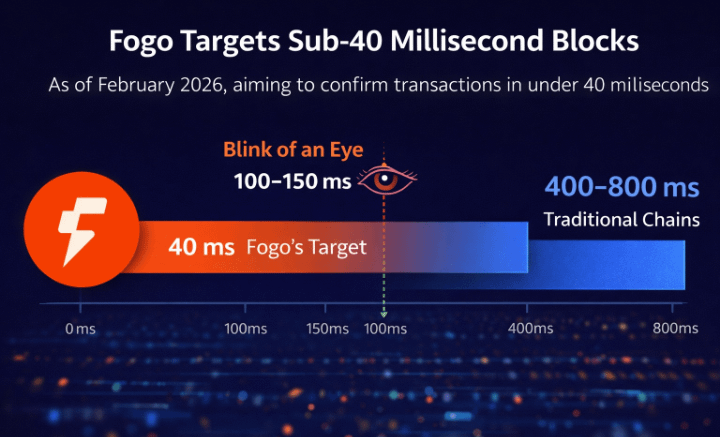
At the architectural level, what impresses me most is how Fogo takes proven components and ruthlessly optimizes them for this singular goal. It runs on the Solana Virtual Machine (SVM), inheriting that parallel execution model that allows for high throughput without sequential bottlenecks. But Fogo pushes further by implementing a custom version of Firedancer the high-performance validator client originally developed by Jump Crypto which is designed for maximum efficiency in processing and validation. This isn't just "Solana but faster"; the team introduces multi-local consensus, where validators are strategically colocated in key financial hubs (like Tokyo for Asian market alignment) to reduce propagation delays and tighten coordination. The result? Sub-40ms block times consistently targeted, with confirmation in around 1.3 seconds under normal conditions. That's orders of magnitude tighter than most peers, enabling things like on-chain order books that update in near real-time, derivatives with precise margining, and even real-time auctions or high-frequency strategies that simply aren't viable elsewhere without heavy centralization.
Privacy isn't the headline here Fogo leans into transparent, auditable execution suited for regulated or institutional flows rather than zero-knowledge obfuscation but it does incorporate thoughtful MEV mitigation to make execution fairer. By design, the architecture discourages toxic extraction patterns that plague other chains, prioritizing predictable, low-friction trading. Gas-free sessions for certain interactions and enshrined mechanisms for native price feeds further reduce friction, making the chain feel more like infrastructure than an experimental playground. For RWAs or tokenized assets where reliability trumps everything, this matters: you need settlement you can bank on, not just fast blocks that occasionally fork or stall.
On tokenomics, Fogo takes a measured approach that aligns incentives over long horizons rather than short-term speculation. The native $FOGO token has a fixed total supply of 10 billion (after an early burn adjustment), serving as gas for transactions, staking for network security, and participation in governance or ecosystem rewards. Staking secures the validator set, which remains curated for performance and reliability important for maintaining those latency guarantees. Fees are designed to accrue value back to the protocol and stakers, creating a flywheel where increased trading activity directly strengthens security and decentralization. There's no aggressive inflation or endless unlocks that dilute early participants; instead, the model emphasizes sustainable participation. Recent developments reinforce this maturity: the public mainnet launched in mid-January 2026 after rigorous testing, accompanied by a strategic token sale on Binance that raised $7 million at a reasonable valuation, focusing funds on foundation operations rather than hype. Flames points program conversions to tokens, community-driven airdrops, and immediate listings on major exchanges like Binance, OKX, and Bybit show thoughtful rollout—avoiding the pitfalls of overpromised pre-sales.
Operationally, the signals are encouraging for a project still in its early innings. The team, drawing from Wall Street execution backgrounds, has demonstrated transparency around launches, incident handling (though none major yet), and steady progress on GitHub and docs. Validator performance has held up in stress tests, with reports of peak throughputs far exceeding many competitors while keeping latency stable. No major exploits or downtime incidents have surfaced in the first months, which builds quiet confidence. Ecosystem traction is emerging too: early dApps focused on perps, spot trading, and liquidity provision are deploying, with integrations like Pyth for oracle feeds ensuring reliable pricing.
Of course, nothing is proven until it's battle-tested at scale. Forward checkpoints that will determine if Fogo becomes indispensable include: sustained real trading volume migrating from CEXs or other DeFi venues (not just testnet hype), successful handling of extreme market events without latency spikes, broader validator decentralization over time (beyond initial curation), and adoption by serious liquidity providers or institutions needing that performance edge. If Fogo can demonstrate that on-chain trading can match or exceed CEX execution without compromises, it positions itself as the settlement rail for the next wave of DeFi evolution, especially as tokenized assets and regulated flows demand both speed and verifiability.
My personal takeaway is that Fogo represents the kind of boring reliability the space needs more of. It's not chasing broad narratives or flashy features; it's laser-focused on solving a real pain point in financial infrastructure with engineering precision. In a world where most chains promise everything to everyone, Fogo's restraint feels refreshing and potentially irreplaceable if it delivers.