
I once watched a trader lose money because his transaction landed three blocks later than expected. Not a bug. Not a validator failure. Just physics—his node in New York, the block producer in Tokyo.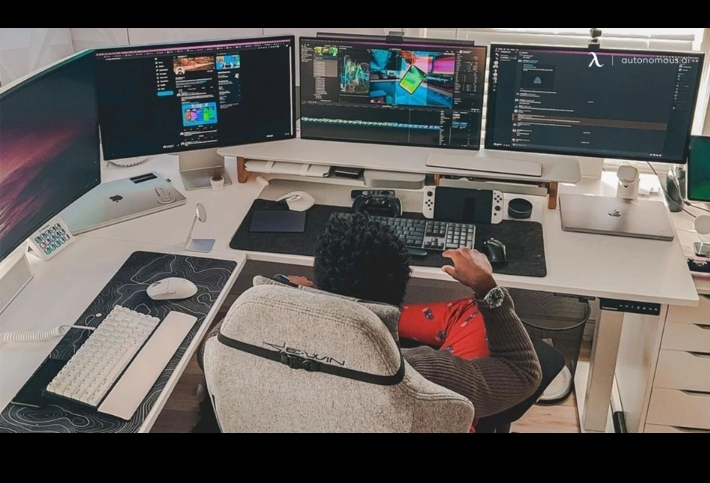
That moment stuck. Crypto calls latency a technical metric. For traders, it is money leaving the table.
Fogo launched in January 2026 to fix what keeps professional traders off-chain: unpredictable latency, uneven client performance, and the physical limits of global data transmission. Built on the Solana Virtual Machine, it targets sub-40 millisecond blocks with 1.3 second finality. Those numbers put it in conversation with centralized exchanges, not just other L1s.
Why One Client Makes Sense
Most chains celebrate client diversity. In practice, the network moves as fast as the slowest client. A validator which I know that runs the optimized infrastructure but still underperforms when another client ships buggy code. He cannot outrun the network.
Fogo chose one client. Everyone runs the same software.
Based on Jump Crypto's Firedancer, it uses tile architecture—dedicated CPU cores, zero-copy streaming, kernel bypass. These are engineering choices that eliminate overhead other chains accept as normal.
Yes, a single-client bug affects everyone. Fogo bets deterministic performance matters more for traders than theoretical diversity benefits.
Hardware That Sets the Bar
Consistency demands standardized infrastructure. Minimum specs:
· 24-core CPU with AVX512
· 128GB ECC RAM
· 1TB NVMe SSD
Recommended: 32 cores, 512GB RAM, separate storage layers.
These are professional machines. No home validators. For trading workloads, predictability matters more than permissionless idealism.
Geography: The Problem Everyone Ignored
Global networks pretend distance does not matter. Physics disagrees. New York to Singapore is 70-80 milliseconds before any computation starts.
Fogo's answer: multi-local consensus. Validators colocate in Tokyo, London, and New York. During each region's trading hours, they communicate at data-center latency.
The network rotates every eight hours following global sessions. Asia overnight. Europe and the London-New York overlap. US afternoon. If a region fails, global consensus takes over automatically.
A trader tested latency during Asian hours: 2 milliseconds to Tokyo validators versus 180 milliseconds on random networks. That difference pays for itself.
Built for Trading, Not General Purpose
Fogo integrates infrastructure traders actually need.
Native price feeds via Pyth Network deliver real-time data at protocol level. An enshrined DEX powered by Ambient Finance couples liquidity with execution.
FluxRPC separates query traffic from consensus—someone checking balances cannot slow block production. Lantern edge caching serves frequent requests from distributed nodes. Market makers colocate in the same data centers as validators.
A market maker told me he spends six figures annually colocating near centralized exchanges. Being next to the matching engine is standard practice. Fogo lets him do the same for DeFi.
Economics That Enforce Performance
Total supply: 10 billion FOGO, 2% burned at genesis. Initial circulating supply: 38.98%.
Inflation starts at 6%, drops to 4% year two, then 2% with potential for 1%. Validator commissions fixed at 10% to prevent fee wars that compromise performance.
Here is the key: rewards depend on latency. Validators must vote within one to two slots for maximum rewards. Economics enforce the low-latency requirement.
Validators and Governance
Initial set: seven operators with Solana and Hyperliquid experience. Permissionless-but-capped model—anyone can run a non-voting node, but voting requires council approval via 7-of-7 multisig.
Governance follows Fogo Improvement Proposals: idea, discussion, submission, stake-weighted voting. Delegators can vote independently if they disagree with their validator.
Who Actually Got Tokens
Community: 15.25%, including 6% airdropped at mainnet to over 3,000 participants via Echo.
Institutional: 8.77% with four-year vesting.
Core contributors: ~37% with cliffs and long-term lockups.
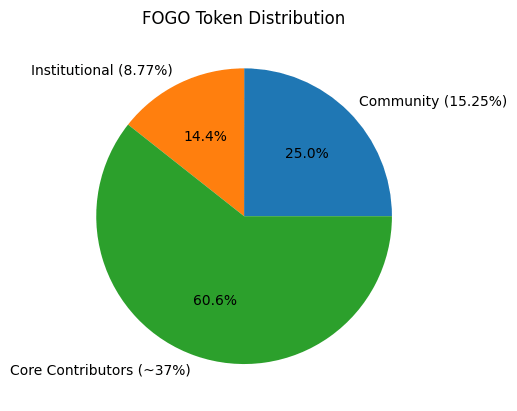
I have seen too many projects where community gets crumbs while insiders dump. Fogo's structure looks different.
Does It Actually Perform?
Chainspect rankings (December 2025) placed Fogo fastest among competing L1s, ahead of Solana, Sui, and Aptos. Testnet delivered consistent sub-40ms blocks and 1.3 second finality under simulated trading loads.
Mainnet will tell the real story.
The Three Taxes Fogo Eliminates
Existing blockchains impose:
· Latency tax: unpredictable execution timing
· Friction tax: fee volatility breaks strategy modeling
· Bot tax: MEV extraction eats returns
Fogo addresses each through deterministic performance, predictable fee markets, and colocated validators that minimize arbitrage.
For high-frequency strategies, 40 milliseconds versus 400 milliseconds determines whether a strategy exists at all.
Why This Matters
Institutional DeFi needs infrastructure comparable to traditional finance. Centralized exchanges run microsecond matching engines with colocated participants. Traders spend fortunes to be physically close.
Fogo delivers similar parameters while preserving decentralized settlement and transparency. Combined with "Made in USA" regulatory positioning, it targets firms that previously refused to operate on-chain.
What I Actually Think
Fogo made trade-offs: single client over diversity, professional hardware over accessibility, validator approval over full permissionlessness, geographic rotation over uniform distribution.
Each decision aligns with its intended user: professional traders who need predictable execution.
The infrastructure exists. The incentives align. The performance claims check out.
Now someone has to actually use it.
A trader once told me: "I do not care about decentralization theater. I care whether my trade lands when I want it to land."
Fogo built for that person. We will find out if enough of them exist.