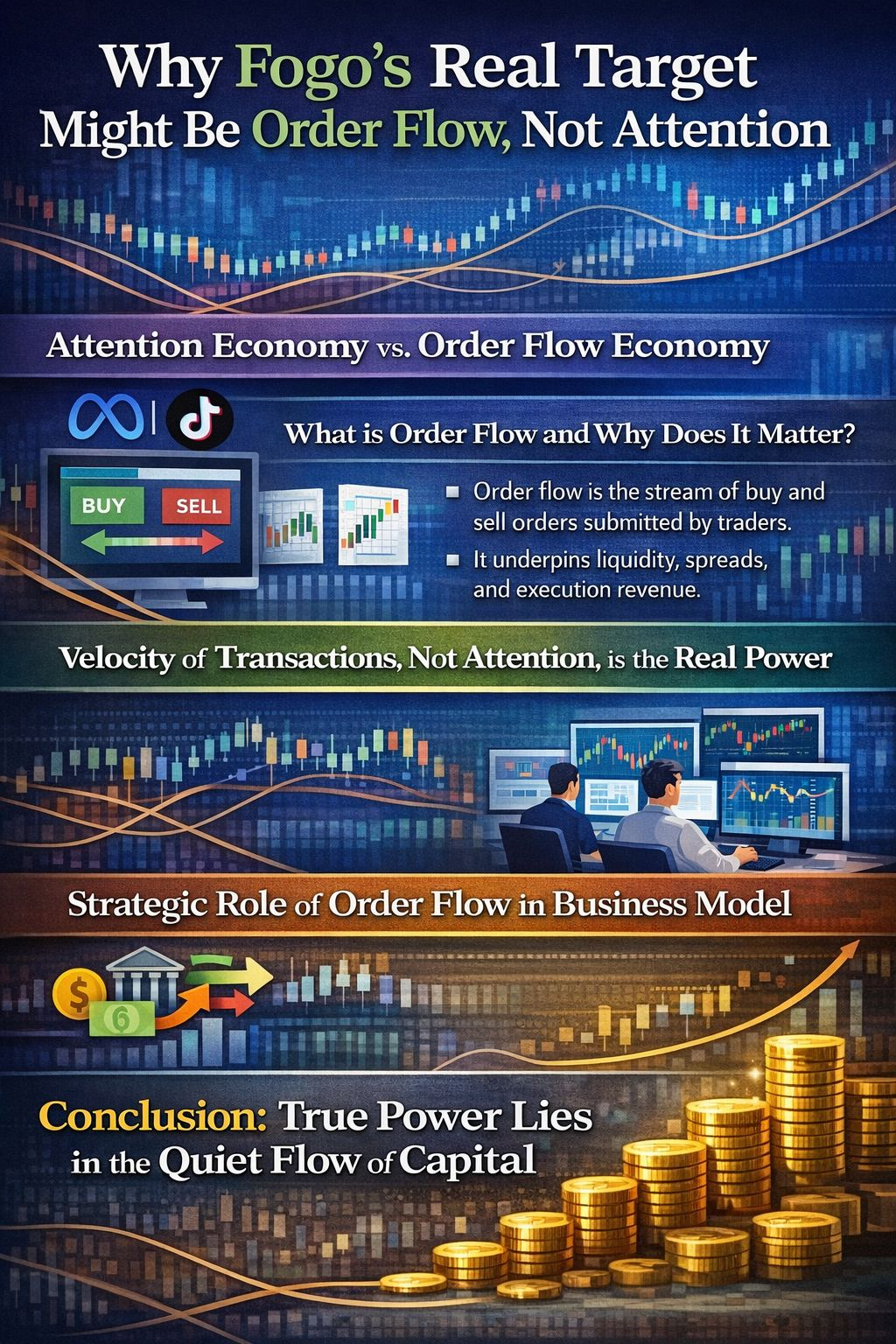
In the modern startup ecosystem, attention is often treated as currency. Platforms battle for clicks, engagement, and time spent, believing that scale inevitably leads to monetization. But in the world of trading infrastructure, attention is secondary. For Fogo, the real strategic asset may not be user attention at all — it may be order flow.
At first glance, it’s easy to assume that a trading platform’s success hinges on visibility. More users mean more trades, and more trades mean more revenue. That logic mirrors the growth strategies of consumer tech giants like Meta or TikTok, where capturing and monetizing attention is the central business model. But financial markets operate under different incentives. In trading, what truly matters is not how many people are watching — it’s who is trading, how often, and in what size.
Order flow refers to the continuous stream of buy and sell orders entering a trading venue. It is the lifeblood of exchanges, brokers, and market makers. Reliable order flow enables tighter spreads, improved liquidity, and better price discovery. It also creates monetization opportunities through transaction fees, spreads, and, in some models, payment for order flow arrangements.
If Fogo is positioning itself as more than just another trading interface, then its competitive advantage may lie in aggregating and directing high-quality order flow rather than simply attracting casual users. In financial markets, not all activity is equal. A small number of highly active traders can generate more revenue and strategic value than a massive pool of passive users. From this perspective, depth matters more than breadth.
This shift in focus reframes product decisions. Features that seem designed to boost engagement — real-time analytics, advanced execution tools, low-latency infrastructure — may actually be engineered to attract serious traders whose orders are predictable and valuable. The goal becomes less about gamifying trading and more about building an ecosystem where consistent transactional activity thrives.
The economics further support this thesis. Platforms that control order flow hold leverage. They can negotiate with liquidity providers, optimize routing for better execution, or even internalize trades to capture spreads. The strategic value of order flow becomes especially clear when compared to pure attention models. Attention fluctuates with trends; order flow, once institutionalized, becomes sticky.
Moreover, in a maturing trading landscape where zero-commission models compress margins, differentiation increasingly depends on execution quality and liquidity depth. A platform that commands meaningful order flow can reinvest into better pricing, faster infrastructure, and superior analytics — creating a feedback loop that attracts even more serious traders.
This does not mean attention is irrelevant. Brand visibility helps attract the first wave of users. But attention is the funnel; order flow is the engine. Sustainable trading businesses are built not on virality but on velocity — the velocity of capital moving through their systems.
If Fogo’s long-term ambition is to become core market infrastructure rather than just a front-end application, then prioritizing order flow over attention is not just strategic — it’s essential. In financial markets, the loudest platform is not always the most powerful. The platform that quietly captures and directs capital often is.